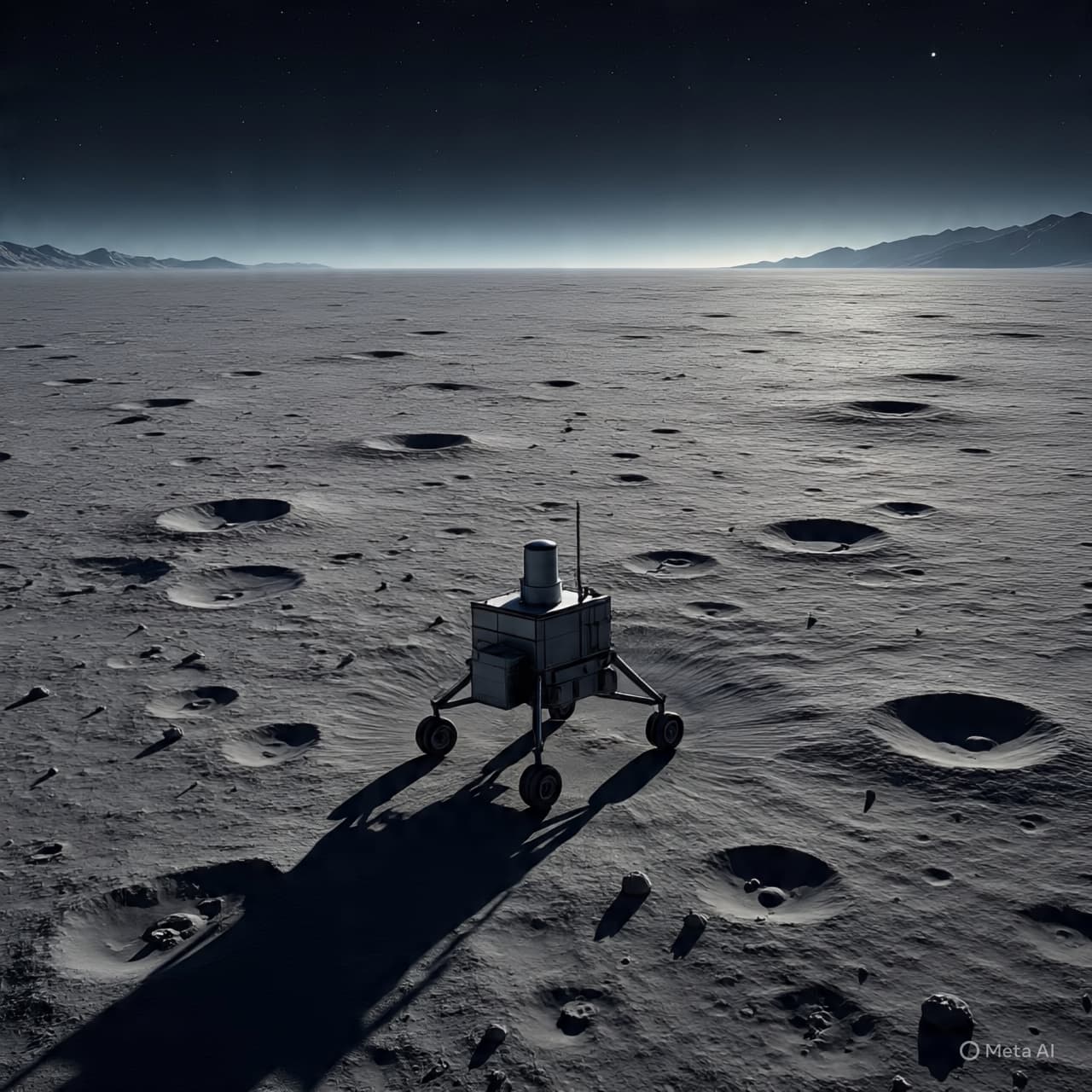
For decades, the silent surface of the Moon has held its secrets close — a barren expanse where relics of human ambition sit undisturbed, half-buried in shadows cast by ancient craters. Among these treasures is one of the most evocative artifacts from the early Space Age: Luna 9, the Soviet Union’s pioneering lander that became the first spacecraft to make a soft landing on the lunar surface in 1966. Yet for nearly 60 years, the exact spot where this historic visitor came to rest remained uncertain, a celestial mystery that has now drawn renewed attention from scientists and enthusiasts alike.
The search for Luna 9’s final resting place has been a blend of archival detective work and modern technology. Researchers have applied advanced machine learning techniques to high-resolution images captured by NASA’s Lunar Reconnaissance Orbiter, scanning swaths of the lunar surface for subtle patterns that could betray the presence of artificial objects. These efforts have narrowed down a series of promising candidate sites where the lander’s remnants may lie — faint anomalies in the regolith that stand out against the natural terrain.
This work, described in a recent study in the journal npj Space Exploration, employs computer-vision models trained to recognize features consistent with known lunar landing sites. The algorithm combed through imagery of the region where Luna 9 was thought to have touched down, identifying possible locations that merit closer scrutiny. While the imagery alone cannot yet provide definitive proof, the convergence of computational prediction and orbital data has set the scientific community buzzing about the possibility of solving an enduring lunar riddle.
The potential discovery of Luna 9’s site is about more than satisfying curiosity. It represents a link to a transformative moment in space exploration history — a time when robotic missions first proved that soft landings on other worlds were possible. Such a finding also illustrates how old mysteries can be revisited with new tools, and how open data from orbital missions can empower both seasoned researchers and dedicated citizen scientists in collaborative discovery.
Still, scientists caution that the identification remains tentative. Orbital imagery, even at high resolution, cannot unequivocally confirm the identity of an object without closer inspection or additional imaging under varying light conditions. A future lunar mission — robotic or crewed — could provide the definitive evidence needed to place Luna 9’s legacy firmly on the map.
In gentle closing news: researchers using machine learning and lunar orbiter imagery have identified candidate sites for the long-lost Soviet Luna 9 lander on the Moon. Confirmation will await further analysis, but this marks a promising step toward locating one of the earliest robotic explorers in space history.
AI Image Disclaimer Graphics are AI-generated and intended for representation, not reality.
Sources (Media Names Only) IFLScience Scientific American Popular Science Universe Magazine Phys.org
Published by Banx Network. This article is part of the Banx decentralized media programme, powered by the BXE token on the XRP Ledger.