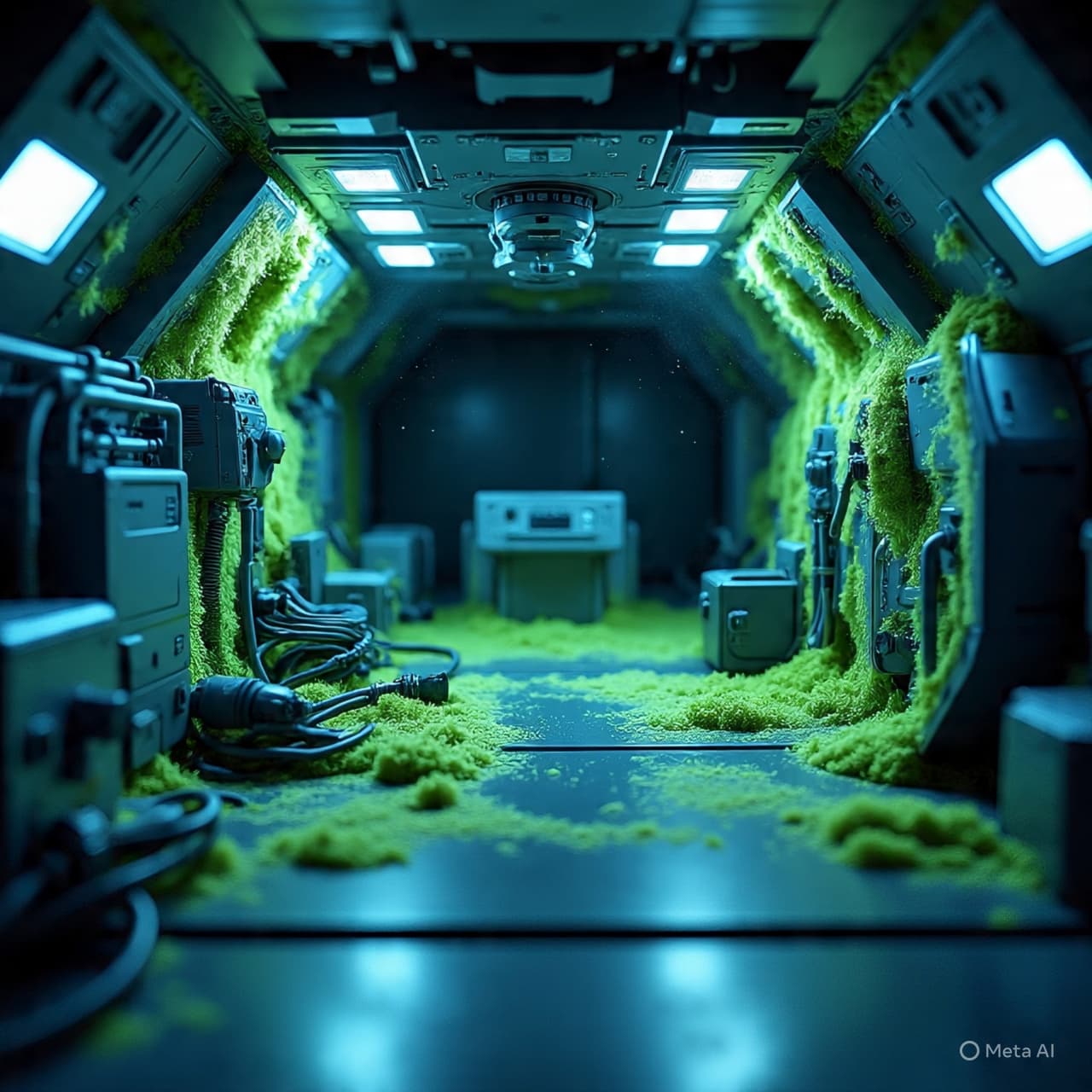
There is a particular stillness to orbit, a kind of continuous motion that, paradoxically, feels like suspension. Within spacecraft and stations circling the Earth, life is carefully measured—air, water, light, all maintained within narrow margins. Yet even in these controlled environments, something quieter persists, settling gently onto surfaces, forming layers too thin to notice at first glance.
Biofilms, communities of microorganisms that adhere to surfaces, have long accompanied human activity, both on Earth and beyond it. In space, however, their behavior takes on new dimensions. Without gravity to guide the settling of particles or the flow of fluids in familiar ways, these microbial communities adapt, reorganizing themselves within an altered physical landscape.
Recent work supported by NASA has turned its attention to this subtle process, inviting volunteers to help study how biofilms form and change in microgravity conditions. The research seeks to understand how bacteria and other microorganisms respond to the unique environment of spaceflight—how they grow, interact, and persist over time.
The findings suggest that biofilms in space may differ in structure and resilience compared to their Earth-bound counterparts. In microgravity, the absence of sedimentation and buoyancy-driven flow allows cells to remain suspended longer, influencing how they come together and attach to surfaces. This can lead to denser or more complex formations, shaped by conditions that have no direct parallel on the ground.
There is also a practical dimension to this inquiry. Biofilms can affect spacecraft systems, contributing to material degradation or influencing the performance of water and air systems. At the same time, they hold potential for beneficial applications, such as waste recycling or supporting life-support systems in long-duration missions. Understanding their adaptability is therefore both a matter of maintenance and possibility.
What emerges from these studies is a portrait of life that adjusts quietly, responding to shifts in environment with subtle but meaningful changes. The microorganisms themselves do not announce their adaptation; they simply continue, reorganizing in ways that reflect the conditions around them.
In this sense, the study of biofilms in space becomes part of a broader effort to understand how living systems behave beyond Earth. It suggests that even in environments shaped by technology and intention, biological processes find ways to persist, to adapt, and to integrate into the structures that sustain human presence.
NASA-supported research indicates that biofilms can form and adapt under microgravity conditions, with potential implications for spacecraft maintenance and future long-duration missions. Scientists are continuing to analyze how these microbial communities behave in space to inform both risk management and biotechnological applications.
AI Image Disclaimer
Visuals are AI-generated and serve as conceptual representations.
Source Check
NASA ScienceDaily Nature Microbiology Smithsonian Magazine BBC Science
Published by Banx Network. This article is part of the Banx decentralized media programme, powered by the BXE token on the XRP Ledger.