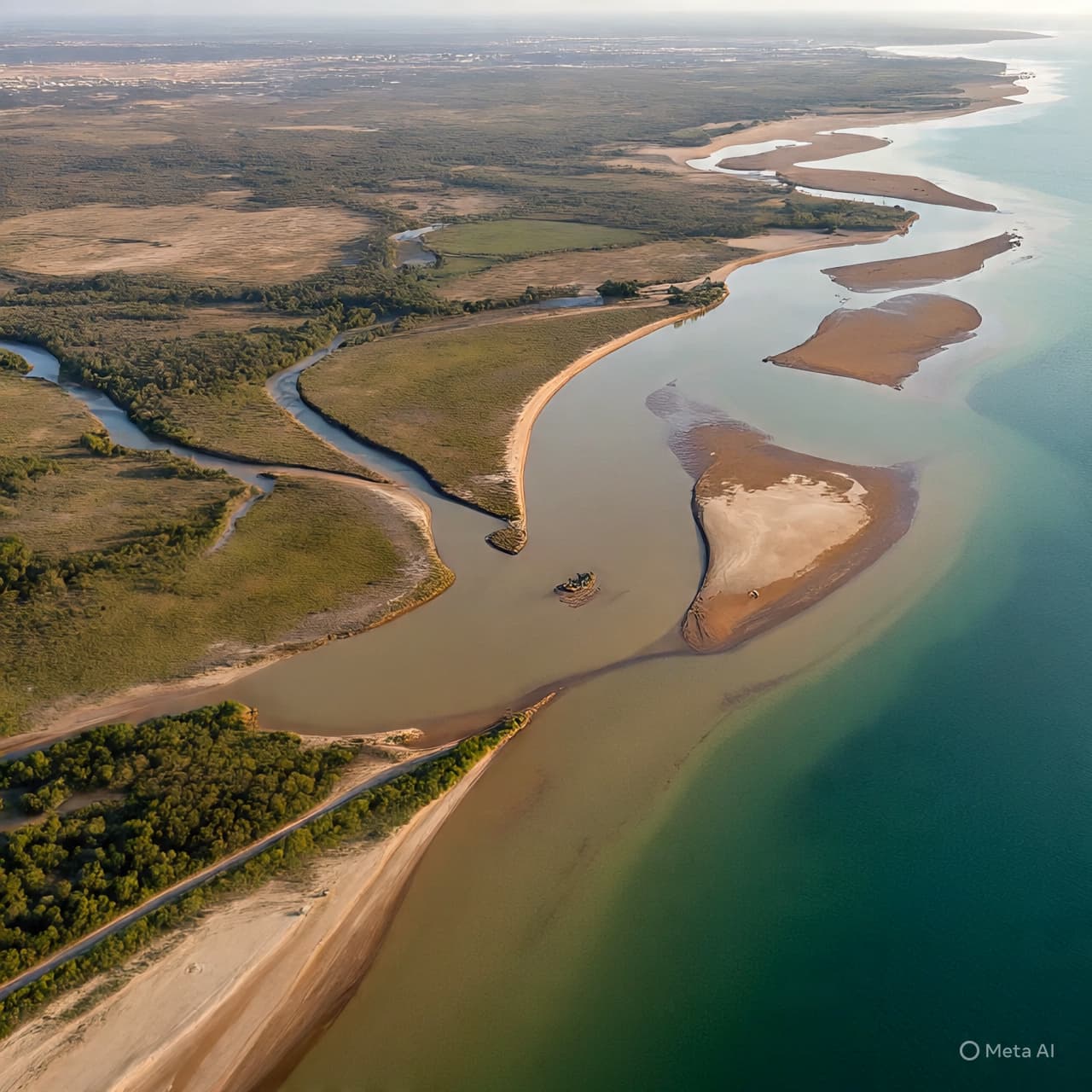
At the edge of northern China, the Yellow River slows as it approaches the sea.
For thousands of kilometers it has carried the memory of landscapes—dust from plateaus, fragments of rock, and grains of soil worn down by time. By the moment the river reaches the wide marshes and shifting channels of the Yellow River Estuary, its waters hold not only sediment but traces of the human world that has grown along its banks.
Rivers have always been collectors. They gather rain, soil, nutrients, and sometimes the less visible residues of industry and agriculture. Among these are trace metal(loid)s—elements such as arsenic, cadmium, lead, and chromium. In small amounts they occur naturally in rocks and sediments. Yet when concentrations rise, they can quietly reshape aquatic ecosystems.
Recent research examining the estuary and its surrounding coastal waters has begun to map the distribution of these elements with careful detail. Scientists collected sediment and water samples across the estuary and the adjacent marine area, analyzing the presence and concentration of multiple trace metal(loid)s.
Their findings reveal a landscape influenced by both geology and human activity.
In some areas of the estuary, concentrations remain close to natural background levels, shaped primarily by the immense sediment load that the Yellow River delivers each year. The river is famous for its dense, ochre-colored flow—an effect of fine particles eroded from the Loess Plateau upstream. These sediments naturally contain trace quantities of metals that settle into the estuarine seabed.
But the patterns are not uniform.
Certain regions show higher accumulations of specific elements, suggesting the influence of industrial discharge, urban runoff, and agricultural inputs from upstream provinces. Over time, these substances can attach to fine sediment particles, traveling long distances before finally settling where river currents slow and tides shift direction.
The estuary itself is a dynamic environment. Channels migrate, sandbars emerge and disappear, and the meeting of freshwater and seawater constantly reshapes the chemistry of the water. Salinity changes can influence how metals bind to particles or dissolve back into the water column, altering how they move through the ecosystem.
Researchers found that sediment grain size, organic matter content, and hydrodynamic conditions all play roles in determining where metals accumulate. Fine sediments, rich in organic material, tend to act as natural traps—holding metals more readily than coarser sands.
This process means that certain sheltered zones within the estuary may gradually collect higher concentrations over time, even when pollution sources lie far upstream.
For scientists studying coastal environments, such patterns offer insight into the complex relationship between rivers and seas. Estuaries serve as transitional spaces where terrestrial materials meet marine systems, and where pollutants may be diluted, transformed, or stored in sediments for decades.
Understanding these processes is essential for managing coastal ecosystems that support fisheries, wetlands, and migrating birds.
The study reports that the distribution of trace metal(loid)s in the Yellow River Estuary is shaped by both natural sediment dynamics and human activities upstream. Researchers identified sediment composition, hydrodynamic conditions, and organic matter as key factors controlling where these elements accumulate.
AI Image Disclaimer
These visuals were generated with artificial intelligence and are intended as illustrative concepts rather than real photographs.
Source Check
Credible coverage and/or primary reporting exist from: Marine Pollution Bulletin Science of the Total Environment ScienceDaily Phys.org Environmental Science & Technology
Published by Banx Network. This article is part of the Banx decentralized media programme, powered by the BXE token on the XRP Ledger.