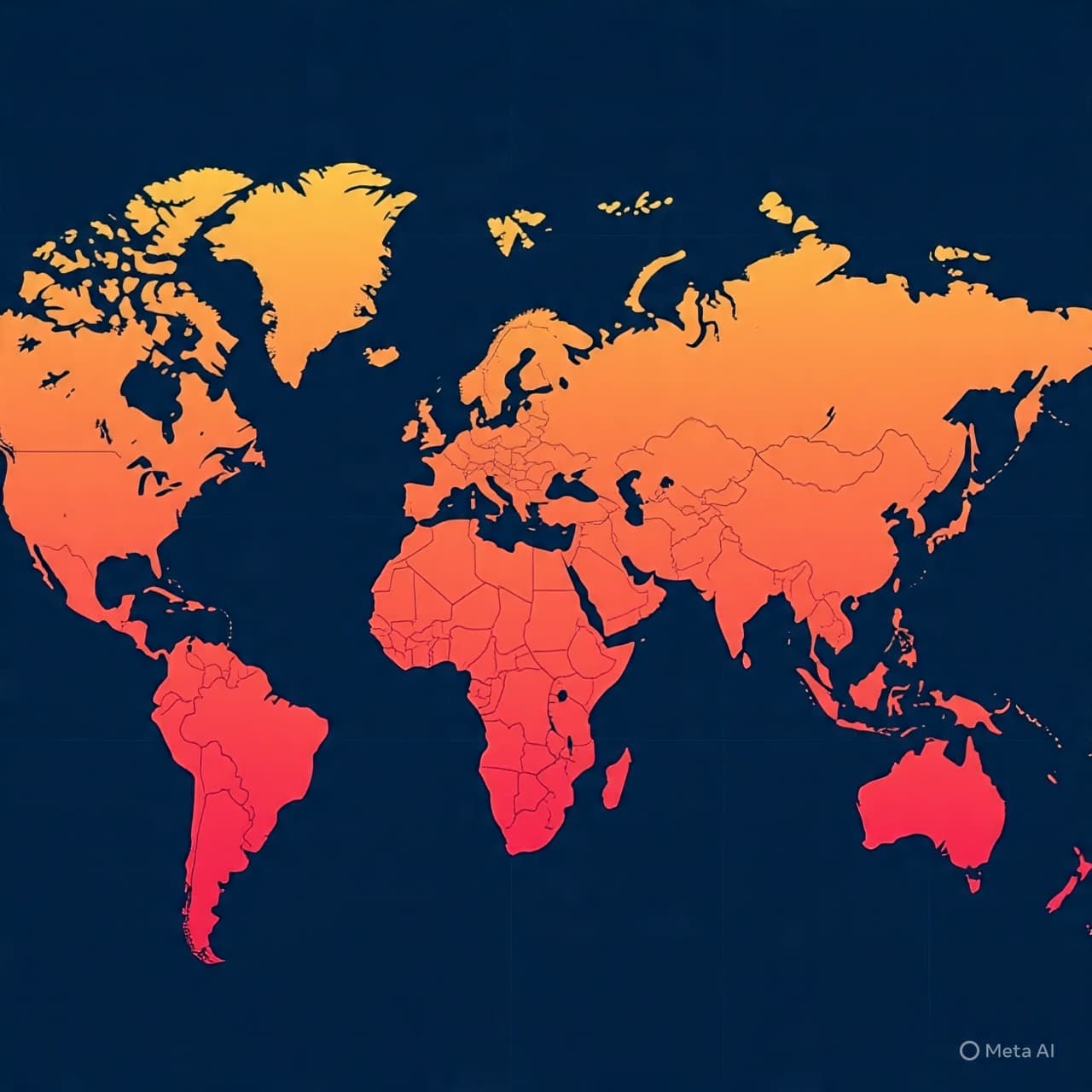
There are moments when the weather stops being a passing conversation and becomes a quiet reckoning. The kind that settles into daily life not with a single dramatic event, but with persistence — mornings that feel warmer than memory allows, nights that offer little relief, seasons that blur their old boundaries. As 2025 approaches its final weeks, scientists say the planet is living through one of those moments now.
Climate advisers and monitoring agencies are warning that 2025 is on course to break or closely rival global heat records, continuing a pattern that has reshaped expectations of what “normal” weather looks like. In the United Kingdom, forecasters say average temperatures are likely to make this year the hottest on record, surpassing benchmarks that were themselves set only recently. The warmth has lingered, not in spikes alone, but as a steady presence woven through months that once offered more balance.
Across Europe and beyond, data from the European Union’s Copernicus Climate Change Service suggests that 2025 is likely to rank as the second or third hottest year globally since records began in the 19th century, trailing only last year’s unprecedented highs. Measurements show global average temperatures hovering close to — and at times above — 1.5 degrees Celsius over pre-industrial levels, a symbolic threshold that climate scientists have long warned about. What was once framed as a future risk is now appearing as a present condition.
For those who track these changes year after year, the numbers carry an emotional weight. “This is our future,” one senior climate adviser cautioned, a statement offered less as alarm and more as recognition. The phrase reflects a growing understanding within the scientific community: that record heat is no longer an exception to explain away, but a pattern to be understood and addressed. Each warm year adds another layer to a trend shaped by decades of greenhouse gas emissions.
In cities, the consequences of sustained heat are increasingly tangible. Prolonged warm spells strain energy grids, intensify drought conditions, and amplify health risks, particularly for older populations and those without access to cooling. Urban centers trap heat overnight, while rural areas contend with stressed crops and altered rainfall patterns. Though the experience of 2025 has varied by region, its imprint has been widespread and unmistakable.
Scientists emphasize that natural climate cycles still play a role, but the underlying direction is clear. The recurrence of record-breaking years points to a system responding to human activity, not random fluctuation. Each month that ranks among the warmest on record adds momentum to a narrative that is global in scale and generational in consequence.
Yet alongside the warnings sits a quieter appeal. The data, advisers say, is not merely diagnostic — it is instructive. Rising temperatures underscore the need for adaptation, from heat-resilient infrastructure to public health planning, while reinforcing the urgency of reducing emissions. The future described by today’s climate models is not abstract; it is already arriving in incremental, measurable ways.
As 2025 draws to a close, it leaves behind more than statistics. It leaves a reflection — of choices made, systems strained, and a climate steadily reshaped. Whether this future becomes more severe or more stable will depend on how societies respond, not to a distant warning, but to the warmth already in the air.
AI IMAGE DISCLAIMER “Illustrations were produced with AI and serve as conceptual depictions.”
SOURCES Copernicus Climate Change Service UK Met Office World Meteorological Organization Reuters Associated Press
Published by Banx Network. This article is part of the Banx decentralized media programme, powered by the BXE token on the XRP Ledger.