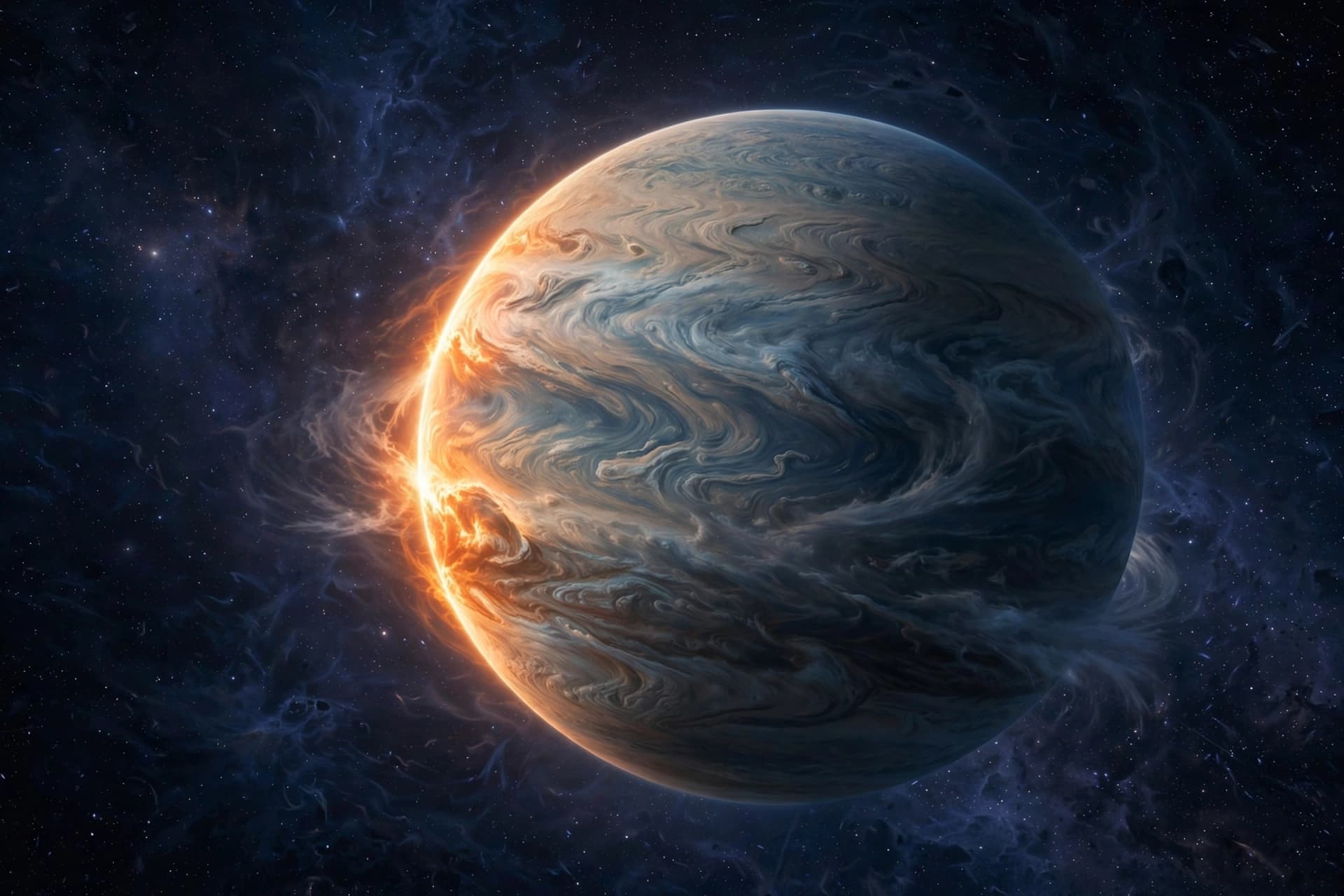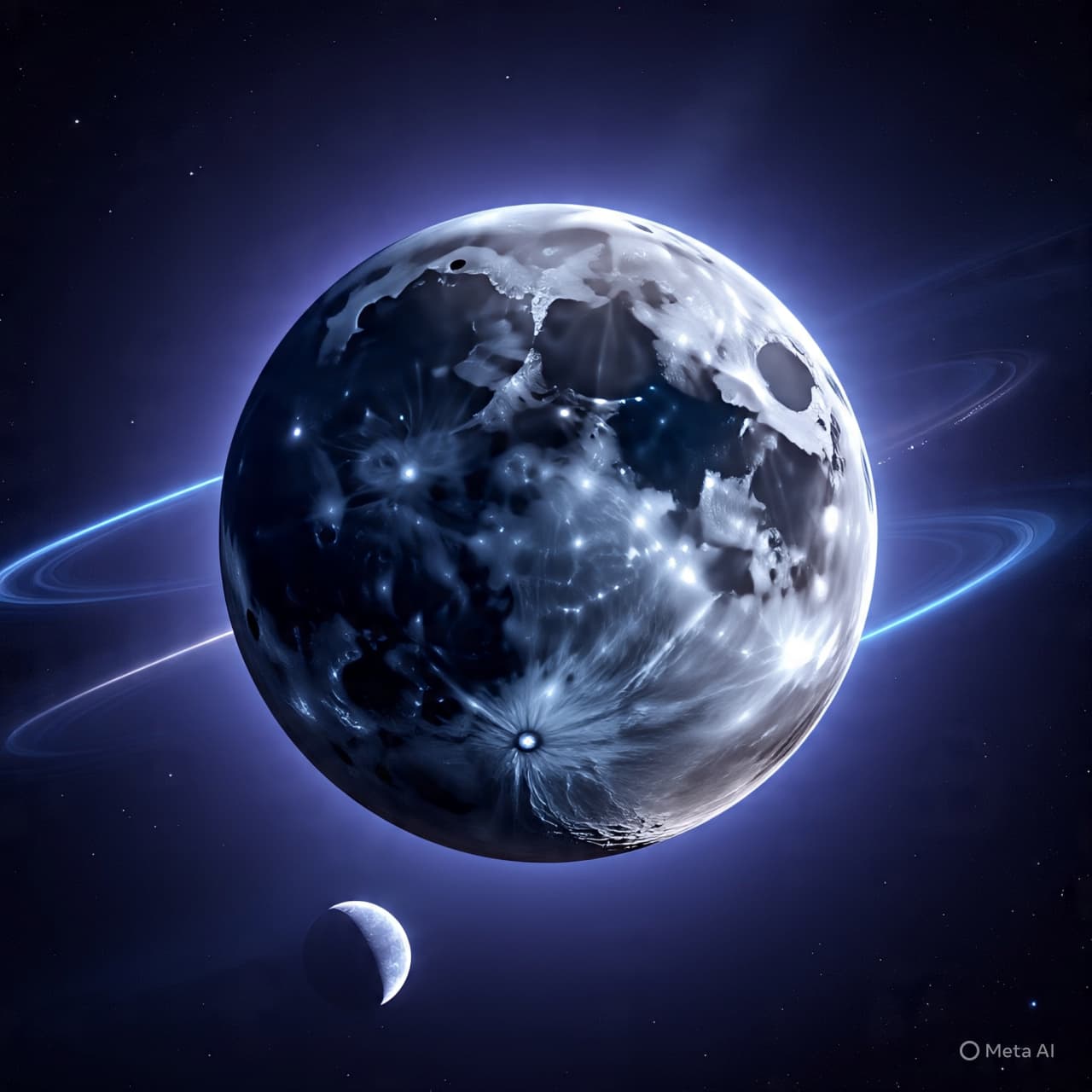
Far from the warmth of the Sun, Saturn turns slowly in the dark, wrapped in rings and silence. Around it, moons trace familiar paths, repeating their ancient choreography. Among them moves Enceladus, small enough to seem insignificant against the gas giant’s vastness, a pale sphere of ice drifting through a magnetic sea. Yet in that quiet orbit, something unexpected is unfolding.
Enceladus has long intrigued scientists for what lies beneath its frozen surface: a hidden ocean, warmth where none should exist, plumes of water vapor erupting from fractures near its south pole. Those geysers, once thought of mainly as signs of internal activity, are now understood to do something more subtle and far-reaching. As water vapor escapes into space, it becomes ionized, joining Saturn’s magnetosphere and turning the moon into an active participant in an invisible electromagnetic system.
Saturn’s magnetic field stretches millions of kilometers into space, shaping a vast bubble where charged particles flow along unseen lines. When Enceladus passes through this environment, its plume-fed particles disturb that flow. The interaction generates electromagnetic waves, known as Alfvén waves, which travel along magnetic field lines like ripples along a taut string. These waves do not fade near the moon. Instead, they propagate across enormous distances, carrying Enceladus’s influence far beyond its immediate orbit.
What surprises researchers is the scale. Enceladus is only a few hundred kilometers wide, lacking a magnetic field of its own, yet its interaction with Saturn’s magnetosphere produces structures that extend hundreds of thousands of kilometers through space. In effect, the moon behaves like a small but persistent generator, transferring energy and momentum into Saturn’s magnetic environment and subtly reshaping it.
This discovery reframes the relationship between planets and their moons. Saturn’s magnetosphere is no longer seen as a system dominated solely by the planet itself. Instead, it emerges as a living, responsive space, molded by the bodies moving within it. Enceladus, through nothing more than escaping water and motion, alters the behavior of a planetary-scale magnetic field.
There is a quiet poetry in that imbalance of scale. A world small enough to be overlooked exerts a reach that rivals structures thousands of times its size. In the deep stillness around Saturn, Enceladus does not shout or shine brighter than its neighbors. It simply moves, releases, and listens — and in doing so, leaves a signature written not in rock or ice, but in waves traveling through darkness.
AI Image Disclaimer
Visuals are AI-generated and serve as conceptual representations.
Sources
NASA Cassini Mission Phys.org EurekAlert Sci.News
Published by Banx Network. This article is part of the Banx decentralized media programme, powered by the BXE token on the XRP Ledger.