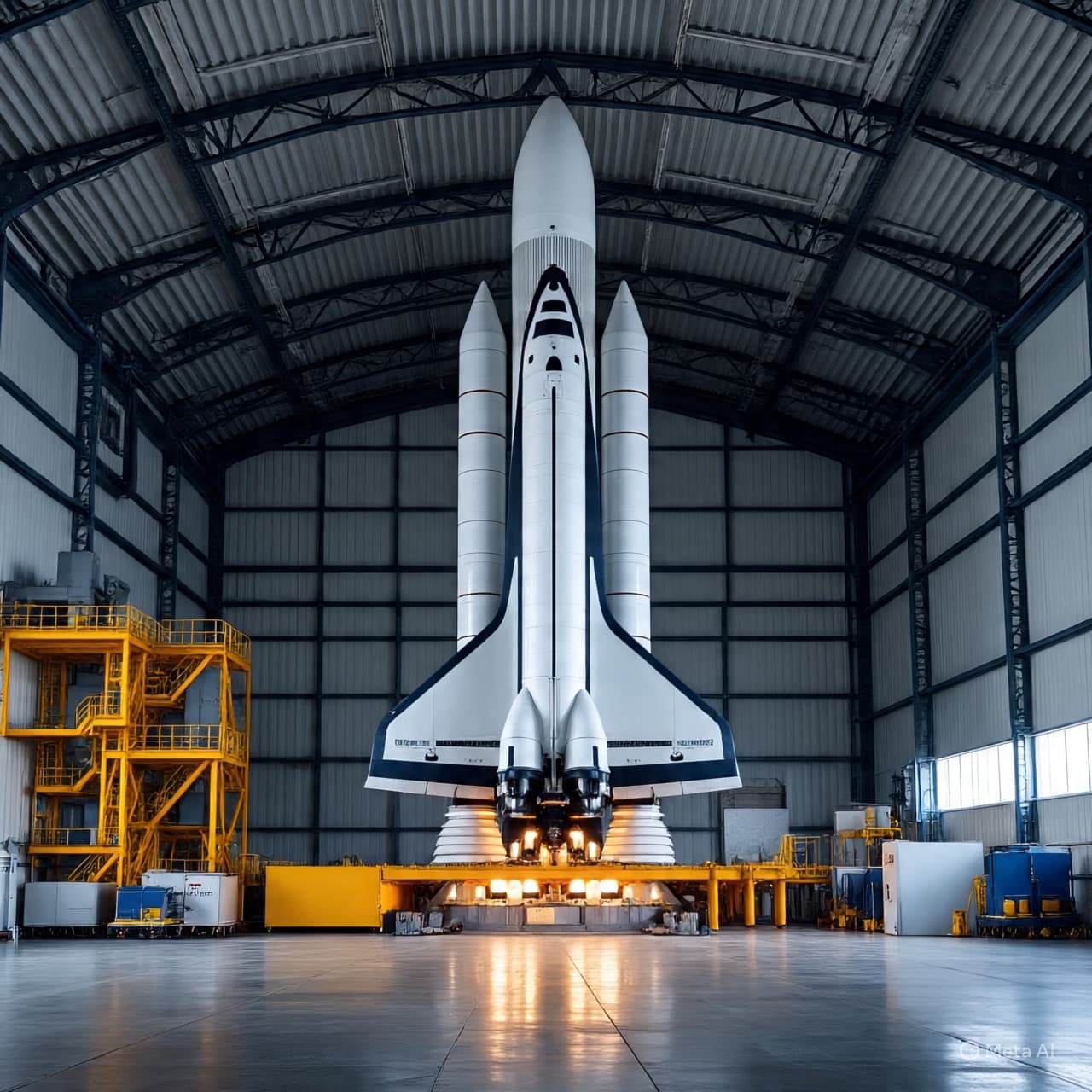
In the stillness before dawn, long shadows stretch across the Vehicle Assembly Building at NASA’s Kennedy Space Center, where steel and promise rise together against a pale horizon. There is a hush here that holds its breath — not silence exactly, but something like anticipation, shaped by decades of dreaming and the patient assembly of machines built to carry those dreams forward.
NASA is preparing to move one of its largest and most complex creations toward the launch pad: the Space Launch System, a towering rocket designed to send humans beyond low Earth orbit and on a journey around the Moon. It is the most powerful rocket the agency has ever built, capable of generating millions of pounds of thrust, and it carries with it both the weight of history and the quiet pull of unfinished exploration.
Inside the cavernous assembly building, engineers and technicians have spent months integrating the rocket’s massive core stage, its four RS-25 engines, and the Orion spacecraft that will sit at its peak. Together, they form the backbone of the Artemis II mission, a planned crewed flight that will send four astronauts — three from the United States and one from Canada — on a roughly ten-day voyage looping around the Moon before returning to Earth.
The scene invites reflection not only on scale, but on continuity. The engines powering the Space Launch System trace their lineage back to the Space Shuttle program, adapted and refined for a new era of exploration. The launch pad itself has borne witness to Saturn V rockets and shuttle launches alike, its concrete and steel marked by cycles of departure and return. Now, it stands ready once more, as if remembering what it was built to do.
Soon, the rocket will roll slowly from its shelter toward Launch Pad 39B, carried by a crawler that moves at a deliberate pace. This short journey across the Florida landscape is ceremonial in its own way, signaling the transition from construction to countdown. Once there, teams will conduct fueling tests and full dress rehearsals, carefully simulating the moments before launch to ensure that every system responds as intended.
Beyond the technical choreography lies a broader ambition. The Artemis program envisions the Moon not as a final destination, but as a proving ground — a place to test spacecraft, life-support systems, and human endurance in preparation for longer missions deeper into the solar system. The upcoming flight will not land on the lunar surface, but its path around the Moon is designed to validate the systems that future crews will rely on when they do.
For now, however, the focus remains on readiness. The rocket stands assembled, the spacecraft secured, the crews trained and waiting. As the days shorten and preparations advance, the scene settles into a familiar rhythm of checks, pauses, and quiet adjustments. In these moments before motion, the return of human flight toward the Moon feels less like a declaration and more like a continuation — a careful step along a path long imagined and slowly reclaimed.
In clear terms, NASA is completing preparations for the Artemis II mission, which will be the first crewed flight of the Space Launch System and Orion spacecraft. The mission aims to send astronauts on a round-trip journey around the Moon, testing critical systems and setting the stage for future lunar landings.
AI Image Disclaimer Illustrations were created using AI tools and are not real photographs.
Sources (Media Names Only) NASA The Guardian Reuters Associated Press
Published by Banx Network. This article is part of the Banx decentralized media programme, powered by the BXE token on the XRP Ledger.