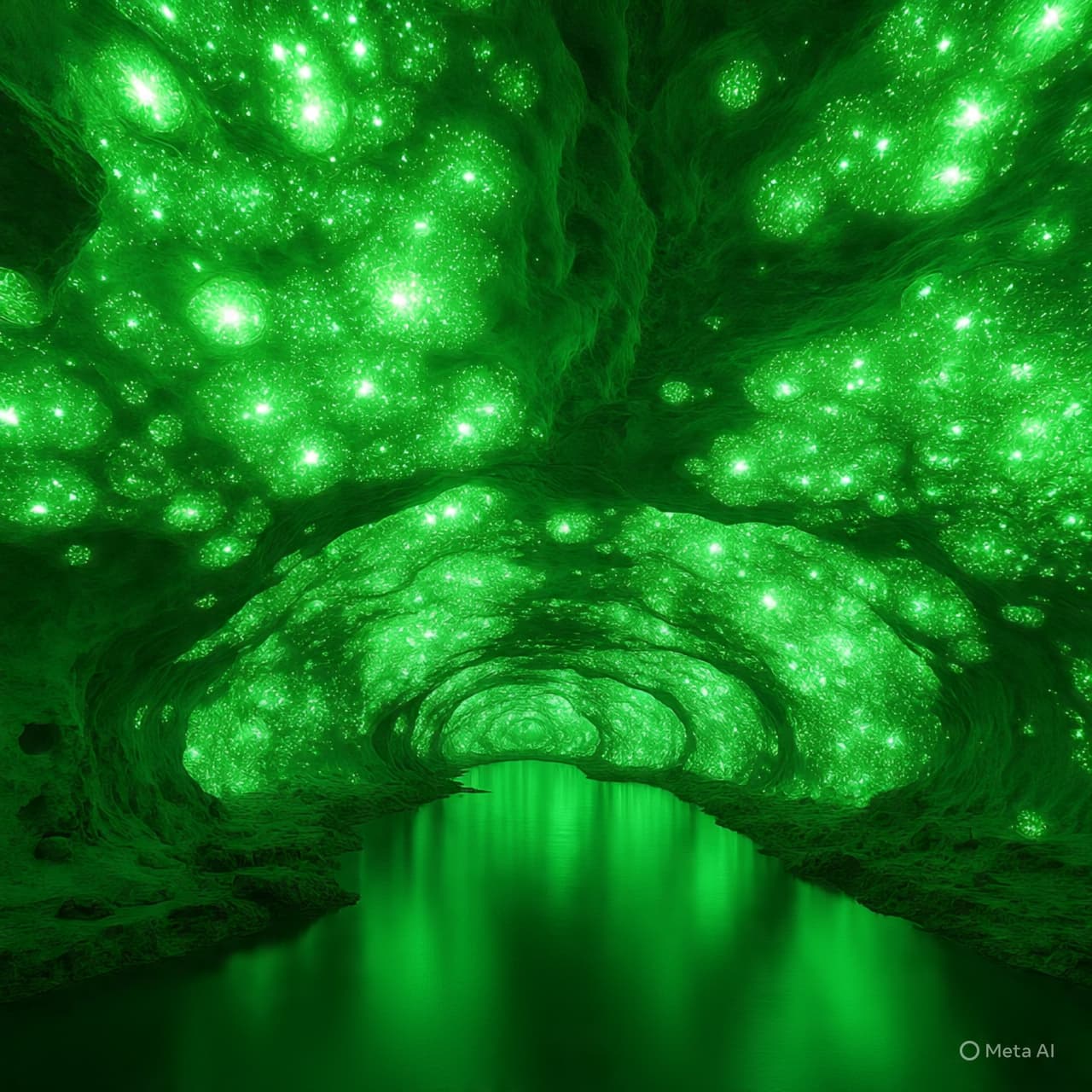
Down in the quiet chambers far beneath the sun‑baked desert of southeastern New Mexico, time seems to move differently. Here, in the winding sanctuaries of Carlsbad Caverns National Park, stone holds the slow memory of epochs, carved by water and patience into passageways that hikers and visitors seldom see. And yet, in a recess far removed from human footsteps, something alive has revealed itself — not as a relic of stone but as a banner of bright green, a living sheath across limestone untouched for millions of years.
The cavern corridors stretch deep into Earth’s past, a limestone tapestry formed over hundreds of millions of years, growing through ancient reef systems and silent chemical dance far before any human named them. In passages far from the light and well‑traveled trails, researchers encountered something unexpected — a dense mat of green. Not paint, nor mineral stain, but cyanobacteria, thriving in an environment that had never felt the warmth of sunlight, yet carrying fluorescence and life in its folds.
These microorganisms — some ancient cousins to the earliest photosynthesizers — exploit a rare trick. They use uncommon forms of chlorophyll that can harvest near‑infrared light, a spectrum invisible to human eyes yet present in faint glimmers deep within limestone walls. In these obscured galleries, where visible light never penetrates, the mirror‑like stone reflects and amplifies scarce energy, providing just enough to sustain microbial life in a dance of chemistry and light so subtle that only careful measurement can reveal its presence.
To stand before this bright green wall is to confront the layered quiet of ages. While on the surface the desert may seem barren and still, beneath it lies a sanctuary where life adapted to the near‑absence of light in ways that challenge our assumptions about where biology can persist. For countless millennia, these organisms likely endured, shielded from sunlight and change, their slow existence untouched by passing seasons and human presence. The wall itself — a testament to persistence — invites meditation on life at its most resilient, unfolding where light is faint and conditions austere.
But this discovery has ripples beyond the cavern’s cool shadows. If life can photosynthesize in places with only near‑infrared light, scientists surmise, then the search for life beyond Earth may need to widen its eyes, not just for worlds drenched in visible starlight but those lit by redder suns or distant, filtered rays. In this sense, the bright green bloom on a New Mexico cave wall becomes not only a marvel of terrestrial adaptation but a whisper of possibility for distant planets orbiting stars unlike our own.
In contemporary terms, researchers describe finding colonies of previously hidden cyanobacteria in remote sections of Carlsbad Caverns deep underground. These microbes appear to be capable of photosynthesis using near‑infrared light reflected within the limestone, an unusual mechanism in a light‑deprived environment. Scientists are studying how these organisms survive and what their existence may suggest about the limits of life in extreme conditions both on Earth and beyond.
All Visuals are AI‑generated and serve as conceptual representations.
Sources (Media Names Only)
Yahoo News IFLScience
Published by Banx Network. This article is part of the Banx decentralized media programme, powered by the BXE token on the XRP Ledger.