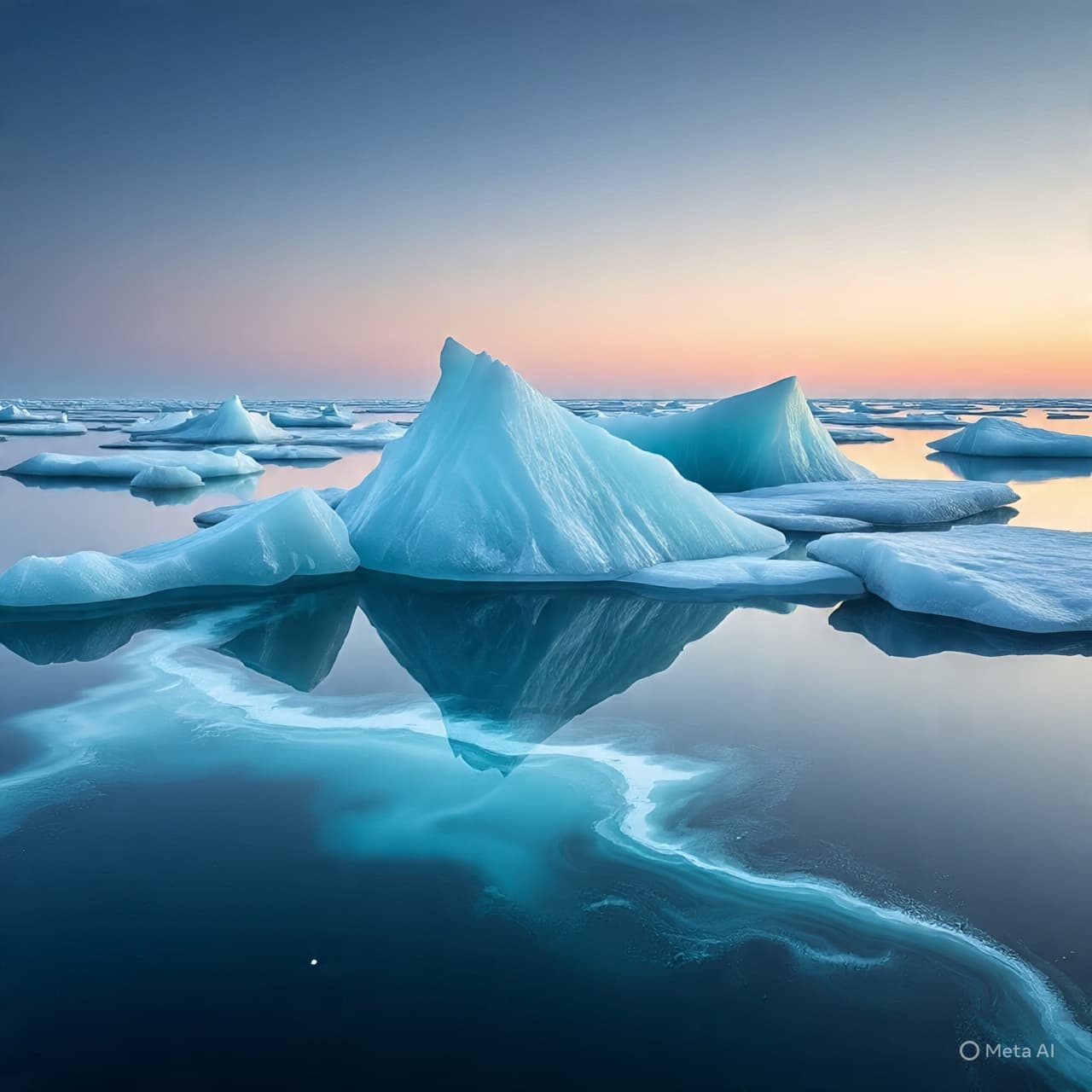
Far from the world’s attention, beneath the vast white sprawl of Antarctica, lies a realm where the ocean speaks in movements too small to see and too powerful to ignore. These motions — known as submesoscales — swirl and bend like quiet currents of thought, shaping the fate of ice shelves that have stood for thousands of years. Recent scientific findings suggest that these subtle ocean patterns may be among the key drivers of submarine melting inside the hidden cavities beneath Antarctic ice.
Unlike the roaring waves or dramatic winter storms that dominate imagery of the Southern Ocean, submesoscale motions are delicate, swirling structures often no more than a few kilometers wide. Their size may be modest, but their impact is immense. They can stir heat upward, funnel warmer water into narrow cavities, and accelerate the thinning of ice from below, where the process remains out of sight yet central to the continent’s stability.
These cavities — sprawling, dark chambers carved by time and tide — are where the continent’s vulnerability begins. Here, meltwater mixes with circulating seawater, creating a cycle in which even slight changes in temperature can alter the balance of an entire ice shelf. Scientists now believe that submesoscales act like hidden messengers, delivering packets of warmth deep into these chambers and shaping the patterns of melt that can destabilize ice from the inside out.
The implications reach far beyond Antarctica’s frozen coastline. Ice shelves act as natural barriers, slowing the flow of inland glaciers toward the sea. When they weaken, global sea level rise accelerates, setting into motion a chain of effects that ripple outward to coastlines thousands of miles away. Understanding how submesoscales influence melt is therefore not an academic curiosity — it is a map of future risk.
But the story is not only one of threat. It is also a reminder of the planet’s intricate choreography. Tiny motions of water, shaped by winds, temperature contrasts, and the geometry of ice itself, can determine whether an ice shelf endures or fractures. These patterns illustrate a world in which outcomes are written not by singular events but by accumulations of subtle forces.
Published by Banx Network. This article is part of the Banx decentralized media programme, powered by the BXE token on the XRP Ledger.