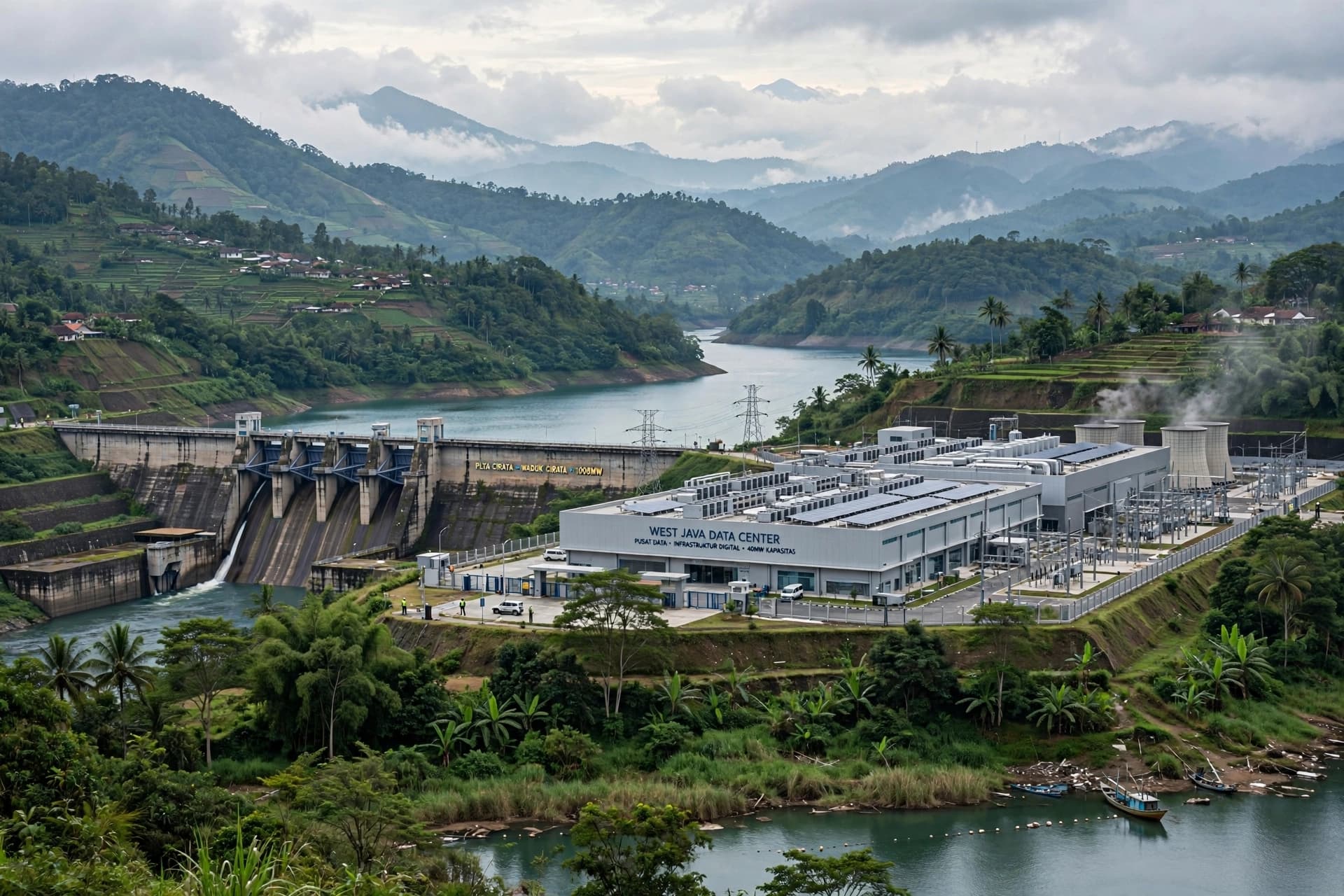
From a distance, a data center can seem almost abstract—a building filled with machines somewhere beyond the screen. Yet the larger the facility becomes, the more physical its requirements are: electricity, water, land, cooling systems and connections to surrounding infrastructure.
That reality has come into focus in Jatiluhur, West Java, where the provincial government has ordered Singapore-based BDx Data Centers to halt construction of a major artificial-intelligence data center until required permits are obtained and its environmental impact assessment process is completed.
BDx had broken ground on the 640-megawatt AI campus, known as CGK4, on September 22. The project is designed to support high-density computing workloads as demand for AI infrastructure continues to grow across Southeast Asia.
The first facility is planned at 120 megawatts of information-technology capacity, with the initial building expected to begin operating in early 2027. The broader campus is planned to contain six buildings and is expected to be developed over roughly three years.
BDx has said the Jatiluhur campus has secured 845 megavolt-amperes of grid capacity from Indonesia’s state electricity company PLN. The project forms part of a wider Indonesian platform where BDx says it has secured more than 1.2 gigavolt-amperes of power capacity across its AI-oriented campuses.
The first building is designed around direct-to-chip liquid cooling, a technology intended to manage the heat generated by dense AI computing equipment. The architecture is planned to support racks requiring as much as 500 kilowatts of power, reflecting the increasingly demanding physical infrastructure behind advanced AI systems.
The location itself adds another dimension. The campus is situated near Jatiluhur Dam, and BDx has been pursuing a cleaner electricity supply, including a proposed hydropower arrangement with state-owned Perum Jasa Tirta II.
West Java officials have said the investment is supported but must comply with applicable regulations. Governor Dedi Mulyadi instructed the company to stop construction until the required permits are secured and the environmental assessment process is completed.
The pause arrives as Indonesia seeks to expand its position in the regional data-center industry. The country has attracted investment from operators and technology companies seeking new capacity for cloud services and AI workloads, while questions surrounding electricity, water, land and environmental impact have become increasingly important as facilities grow larger.
The situation also shows the physical side of the AI expansion that is often hidden behind software interfaces. Artificial intelligence may operate through digital networks, but the systems that train and run increasingly powerful models require large buildings, specialized cooling, substantial electricity supplies and carefully planned infrastructure.
For BDx, the immediate issue is therefore procedural rather than a change to the underlying technology ambitions of the project. The company’s planned 640-megawatt campus remains part of Indonesia’s expanding digital infrastructure landscape, while construction now waits for the necessary permits and environmental review to be completed.
Published by Banx Network. This article is part of the Banx decentralized media programme, powered by the BXE token on the XRP Ledger.