
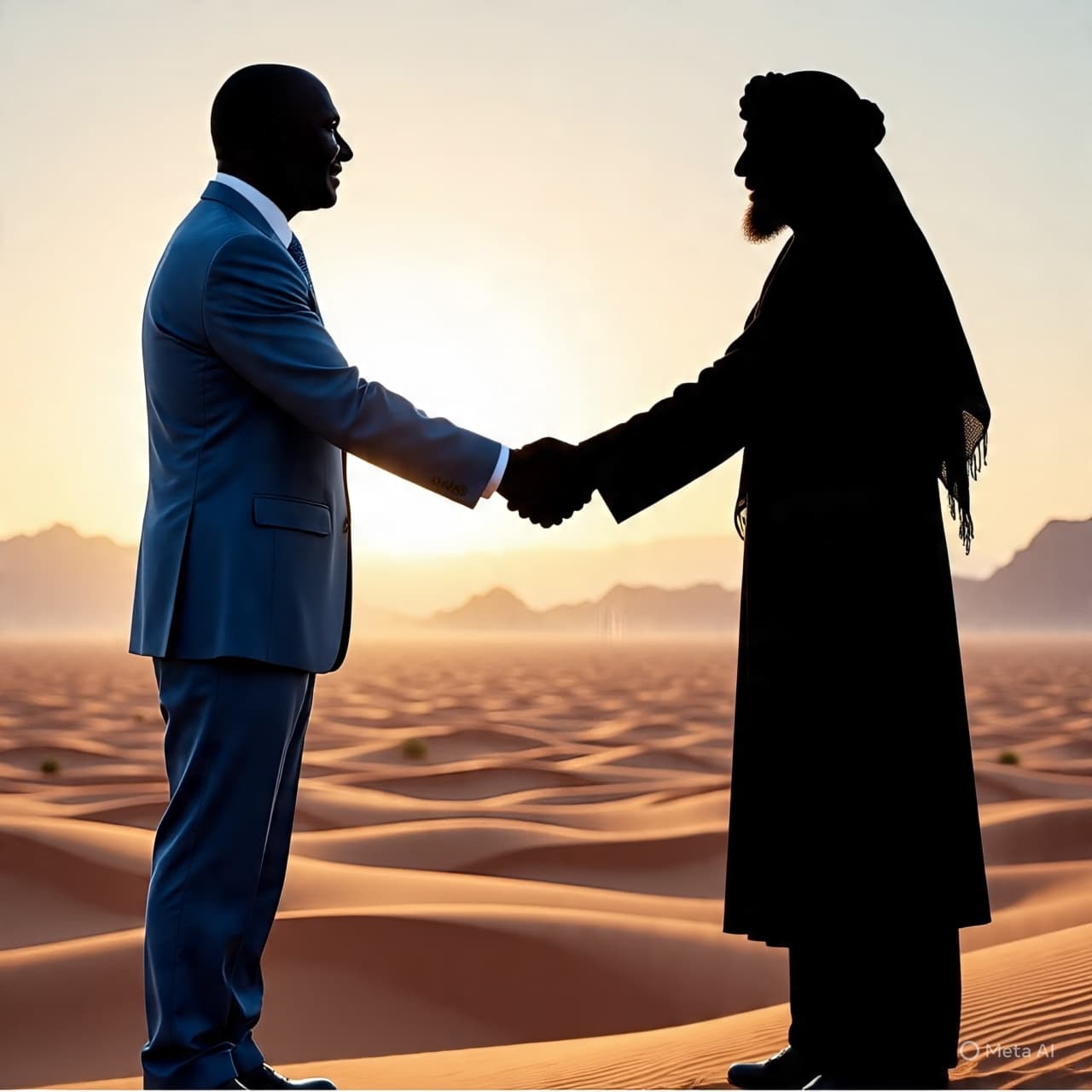
In the quiet theater of international politics, words often arrive before actions, like distant thunder hinting at an approaching storm. Sometimes they are deliberate, carefully measured; at other times, they drift into the public space like fragments of a larger, unseen conversation. When former U.S. President Donald Trump spoke of negotiations with Iran and suggested that the United States could receive a “great gift,” the remark did not land as a conclusion, but rather as an opening—an invitation to interpret, to question, and perhaps to wonder.
Diplomacy, after all, rarely unfolds in straight lines. It bends, pauses, and occasionally circles back on itself, shaped as much by perception as by policy. Trump’s claim evokes a familiar tension in U.S.–Iran relations, where dialogue has often existed alongside distrust, and gestures—real or implied—carry layers of meaning. The idea of a “gift” in this context feels less like a tangible offering and more like a symbol, a suggestion of concession, recognition, or strategic advantage.
Yet, the landscape between Washington and Tehran has long been marked by careful distance. Even in moments when negotiations appear possible, they are often accompanied by competing narratives. One side’s signal of openness may be read by the other as calculation. In this delicate balance, language becomes a tool not only for communication but also for positioning—each phrase echoing across audiences both domestic and international.
Trump’s framing also reflects a broader pattern in political discourse, where diplomacy is sometimes presented in simplified terms to capture public attention. The notion of receiving something significant, framed as a “gift,” carries an emotional resonance that extends beyond policy details. It speaks to expectations of gain, of progress, of movement after periods of stagnation. And yet, beneath that simplicity lies a far more intricate reality, where negotiations—if they exist—are shaped by multiple actors, interests, and constraints.
Observers might see in this moment not a clear shift, but a reminder of how narratives are formed. In the absence of confirmed developments, statements such as these can function as signals, testing reactions or shaping perceptions. They can also blur the line between possibility and certainty, leaving room for interpretation while maintaining strategic ambiguity.
For Iran, too, any suggestion of negotiation carries its own set of implications. Engagement with the United States has historically been both a pathway and a paradox—offering potential relief or recognition, while also raising questions of sovereignty and trust. In this sense, the idea of a “gift” becomes even more complex, shaped by differing expectations on both sides.
As the conversation continues to unfold, what remains most visible is not a definitive outcome, but a moment suspended between intention and reality. Trump’s words, like many before them in the realm of diplomacy, may ultimately serve less as a declaration and more as a reflection—of ongoing tensions, of cautious possibilities, and of the enduring uncertainty that defines relations between nations.
In the end, whether this “gift” represents a tangible development or simply a rhetorical gesture is a question that time, rather than language, will answer.
AI Image Disclaimer
Illustrations were produced with AI and serve as conceptual depictions.
Source Check
Credible coverage on statements and narratives involving U.S.–Iran dynamics and remarks by Donald Trump can typically be found in:
Reuters
The New York Times
Al Jazeera
BBC News
The Washington Post
Published by Banx Network. This article is part of the Banx decentralized media programme, powered by the BXE token on the XRP Ledger.

.jpg&w=3840&q=75 "US Declares Drought Disaster for Parts of Puerto Rico as Dry Conditions Persist")