
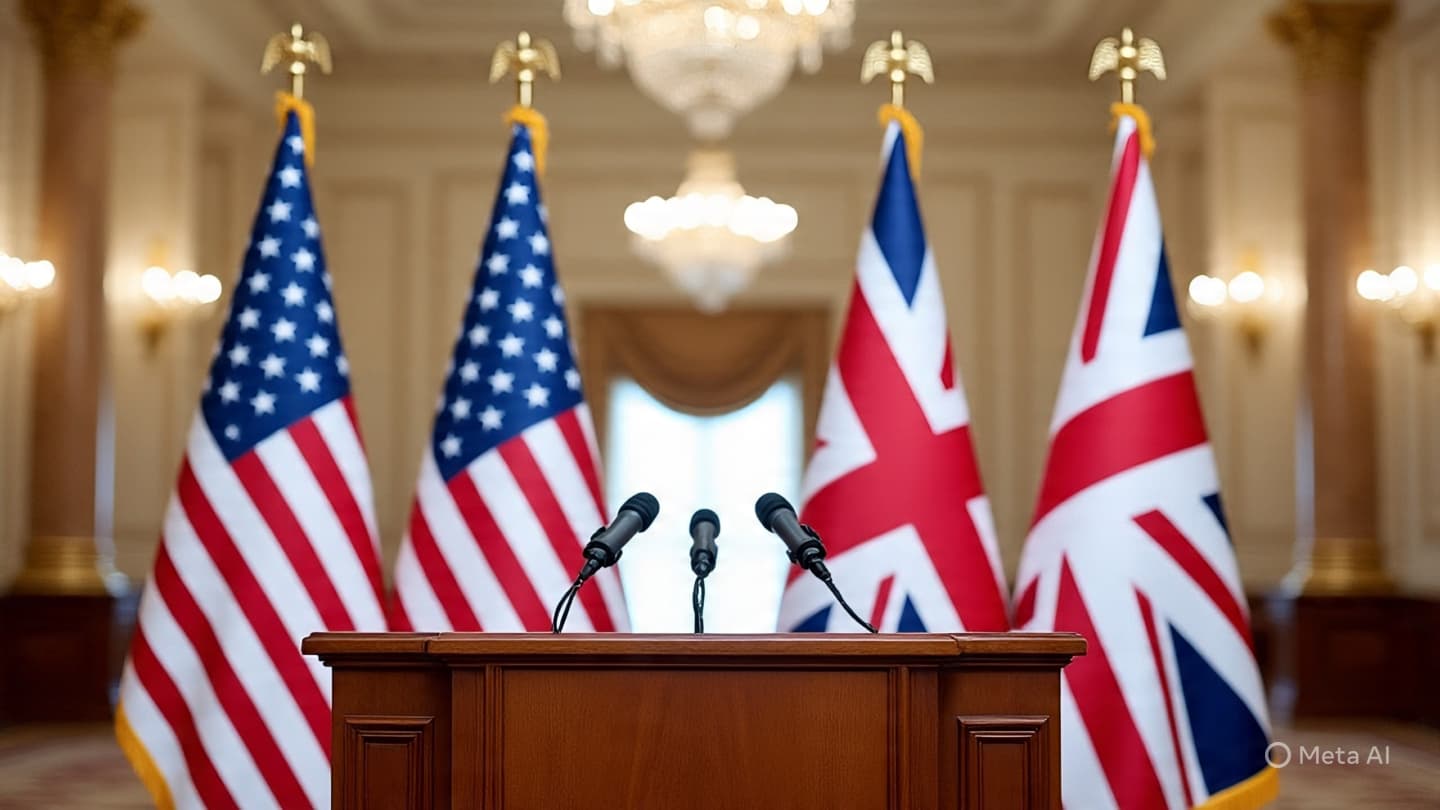
Key Highlights
- Donald Trump claims he speaks for the UK more than Prince Harry, sparking debate.
- The statement reflects ongoing discussions about political representation and influence.
- Public reactions in the UK range from amusement to skepticism.
Former U.S. President Donald Trump recently made headlines with his assertion that he speaks “for the UK more than Prince Harry.” This remark has resonated across both American and British media, igniting discussions about representation, authority, and the nature of political discourse. Trump's comment, made in a public forum, raises questions about who holds the right to represent a nation and the implications of such claims in a globalized world.
Prince Harry, who has distanced himself from royal duties, remains a significant public figure, particularly through his advocacy work and media presence. His voice, while no longer formal within royal structures, continues to resonate internationally. The juxtaposition of Trump's assertion against Harry's status highlights the complexities of representation in contemporary politics. Historically, the United States and the United Kingdom have enjoyed a close relationship, often referred to as a “special relationship,” characterized by shared values and mutual interests.
Observers note that Trump's statement can be interpreted through various political lenses. Supporters may view it as a bold expression of confidence and alignment with British sentiments, while critics may question the legitimacy of his claim. This divergence in interpretation reflects the broader spectrum of public discourse, where statements can be polarizing and elicit a range of reactions.
The British government has yet to formally respond to Trump's comment, adhering to its typical approach of maintaining a separation between official policy and external commentary. Public reactions in the UK have varied, with some expressing amusement at the audacity of the claim, while others exhibit skepticism regarding Trump's understanding of British politics and culture.
Media coverage has underscored the contrast between Trump's assertion and the traditional role of representation within the UK, which is defined by constitutional structures rather than individual claims. This distinction emphasizes the complexity of interpreting such remarks, as they can often be laden with implications that extend beyond their immediate context.
In navigating the intersection of personal opinion and public influence, figures like Trump and Harry illustrate how language can shape perceptions and spark broader conversations. The ongoing dialogue surrounding Trump's statement serves as a reminder that communication is not solely about the words spoken but also about how they are received and interpreted by diverse audiences.
As the discussion continues, the relationship between the U.S. and the UK remains grounded in diplomatic, economic, and cultural ties that transcend individual voices. These connections are continually evolving, influenced by shifting political landscapes on both sides of the Atlantic. Ultimately, the concept of representation is a shared and dynamic construct, shaped by the structures and voices that sustain it, rather than mere declarations.
Published by Banx Network. This article is part of the Banx decentralized media programme, powered by the BXE token on the XRP Ledger.



