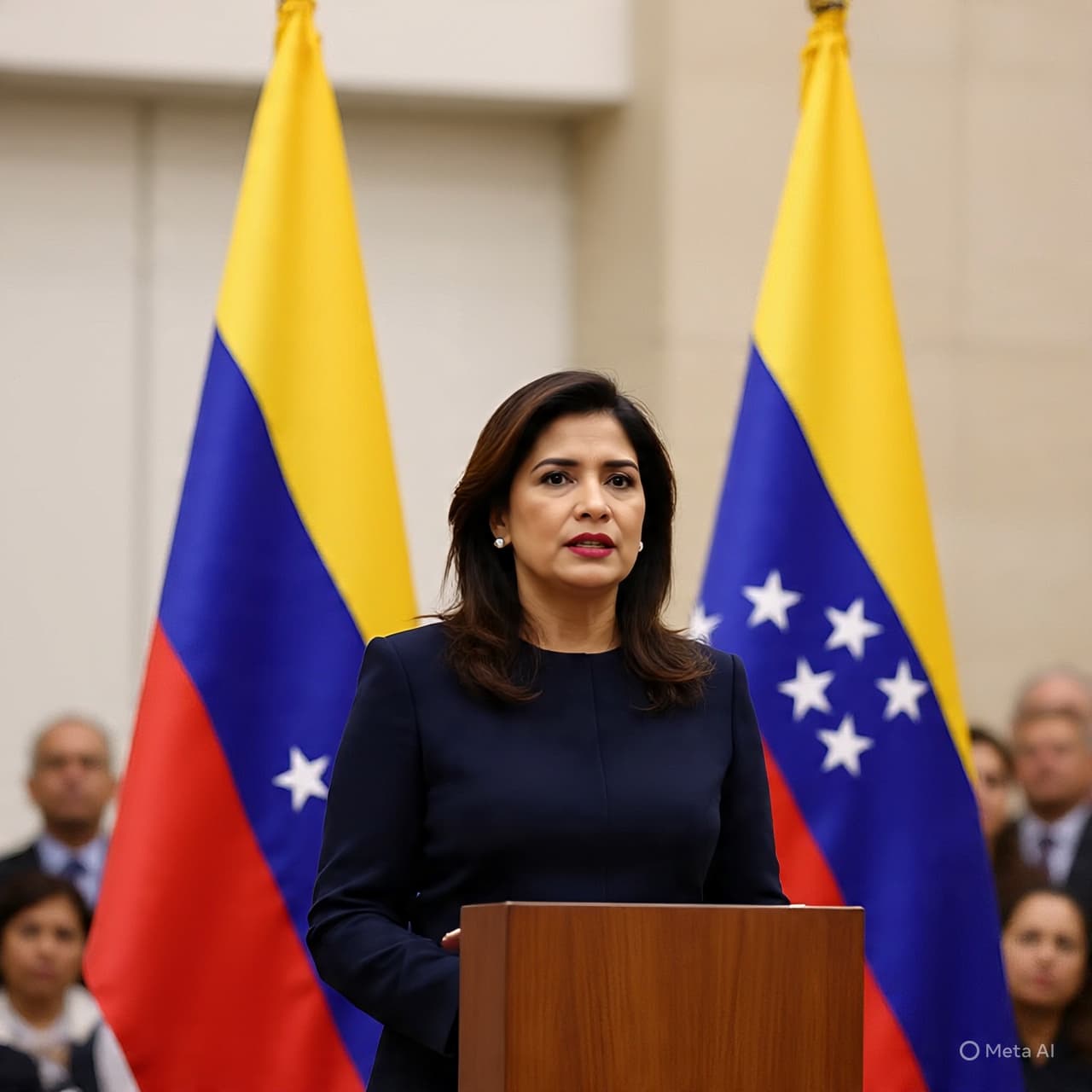
There is a moment, as dusk brushes across Caracas, when the day’s noise settles into a thoughtful hush — and in that quiet, the possibility of conversation holds its own gravity. It is in such a space that Venezuela’s acting president, Delcy Rodríguez, extended a call this week that seeks to bring together voices from every corner of the nation, a gesture toward shared reflection amid tumultuous currents of change.
In the hallways of the Miraflores Palace, where history and hope often intertwine, Rodríguez spoke of what she called a “true political dialogue” — one that would include both aligned supporters and opposing sectors of political life in Venezuela. Her words were not sharp declarations but an invitation, framed by the inauguration of the government’s new Programme for Coexistence and Peace, to convene a broad meeting aimed at fostering mutual understanding and practical outcomes. The task of organizing this dialogue was entrusted to Jorge Rodríguez, president of the National Assembly and the Council of Sovereignty and Peace, to reach “all political actors” without outside imposition.
For a nation that has seen years of discord, economic struggle, and political upheaval, this appeal carries layers of meaning. It reflects not just a procedural ritual but a longing for unity, a subtle recognition that no single voice, no matter how powerful, holds the answer to the complexities Venezuelans face. In her call, Rodríguez emphasized that the process must be “strictly national” — a conversation guided from within, not dictated by foreign capitals or external agendas.
The backdrop to this moment is a country navigating profound change. In recent weeks, Venezuela has grappled with intense political developments following the capture of Nicolás Maduro in early January and Rodríguez’s assumption of the interim presidency. The leadership has been both consolidating power and responding to internal pressures, including demands for the release and humane treatment of detained critics and political prisoners, whose families continue to wait and advocate for justice outside prison gates.
Within this context, the gesture toward dialogue resonates with echoes of both past efforts and renewed aspirations. Some view it as a pragmatic step to ease societal tensions and chart a path forward that acknowledges diverse perspectives, while others remain cautious, underscoring the deep wounds that political conflict has left in communities and institutions. This call for conversation, tender in its framing, is also set against ongoing engagements on other fronts — from diplomatic exchanges to symbolic assertions of national identity in response to international narratives.
In the soft language of dialogue, there is hope that common ground might be rediscovered — however incrementally — through conversation that reaches beyond rhetoric to concrete outcomes. It is a hope carried not in grand declarations, but in the quiet act of inviting many voices into a shared space.
In straightforward terms, acting President Delcy Rodríguez has proposed convening an inclusive national political dialogue in Venezuela, to be organized through the National Assembly and Council for Sovereignty and Peace, with the aim of achieving immediate, concrete results while rejecting external influence. The initiative is part of a broader Programme for Coexistence and Peace, reflecting ongoing political transitions and internal calls for stability
AI Image Disclaimer Visuals are created with AI tools and are not real photographs.
Sources (5 media names):
CGTN The Guardian Reuters Associated Press Reuters (separate report on symbolic social media action)
Published by Banx Network. This article is part of the Banx decentralized media programme, powered by the BXE token on the XRP Ledger.