
Key Highlights
- Unseasonal frost has hit Aroma Marka, affecting local agriculture.
- Up to 40% of crops, including staple tubers, have been devastated.
- Emergency relief efforts are underway to support affected farmers.
[Impact of Unseasonal Frost]
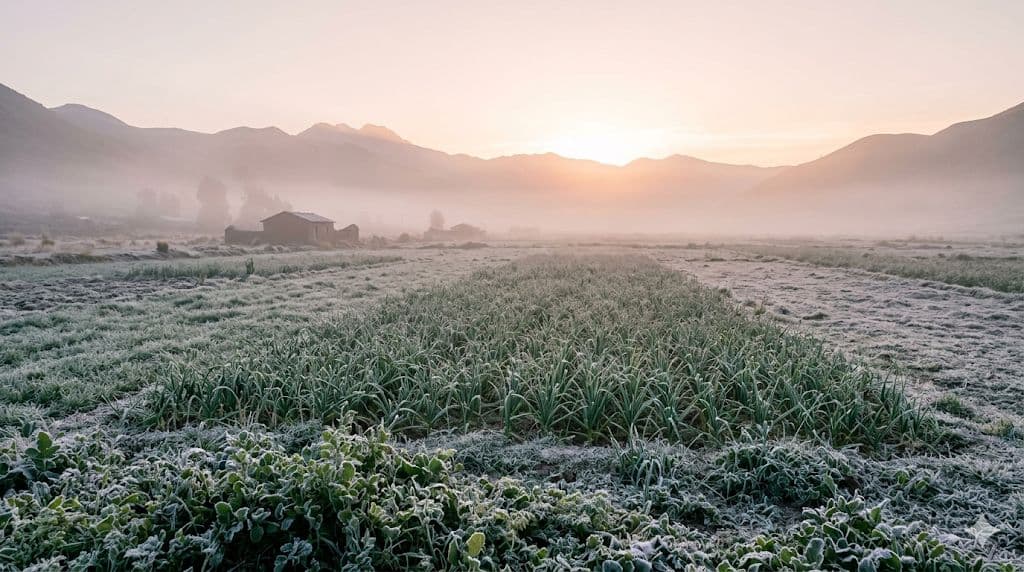
A profound stillness accompanies the arrival of an unseasonal frost in Aroma Marka, a region known for its vibrant agricultural communities. This unexpected weather event has transformed the landscape overnight, coating it in a delicate, crystalline silver that belies its destructive nature. The sudden descent of freezing air feels like an uninvited guest, disrupting the natural order of the growing season.
For local farmers, the dawn check of the fields has become a moment of quiet apprehension. The vibrant green of maturing crops, which only days before promised a bountiful return, now appears muted and heavy under the weight of ice. This visual contradiction—a winter wonderland imposed upon a season meant for growth—highlights the fragility of the agricultural cycle in high-altitude ecosystems.
[Historical Context]
This anomalous cold snap represents a rupture in the traditional calendar that has guided local life for centuries. The plants, caught in the middle of their natural cycle, possess no defense against temperatures that plummet without the usual warnings of late autumn. Within hours, the delicate cellular structure of the leaves is compromised, turning promising foliage into a dark, withered memory.
Walking through the rows of damaged crops, the atmosphere is one of reflective resignation rather than open despair. The losses are visible in the downward tilt of the stalks and the absence of the usual morning bird activity along the field edges. This situation serves as an environmental reminder of the thin margin of survival that dictates human existence in these high-altitude regions.
[Changing Agricultural Practices]
The frequency of these out-of-season temperature drops has introduced a layer of unpredictability that complicates every decision made by local cultivators. When to sow, weed, and harvest are no longer certainties derived from ancestral observation, but gambles against an increasingly erratic atmosphere. The air currents that descend from the high glaciers seem to have lost their traditional boundaries, further complicating agricultural practices.
In local plazas, conversations move slowly, mirroring the cautious pace of life during these cold intervals. Neighbors share observations about the unique behavior of this frost, noting how it settled in low hollows while sparing some higher ridges. There is a collective effort to understand a phenomenon that defies the established memory of the elders, as they seek to adapt to these new realities.
[Emergency Response]
The vulnerability of these crops underscores the delicate relationship between temperature, altitude, and food security in the region. A single night of clear skies and stagnant air can undo months of careful preparation, soil turning, and water management. This situation forces a reevaluation of traditional crop varieties that may no longer be suited to these sharp fluctuations in temperature.
As the sun rises higher, the frost melts away, revealing the true extent of the damage. Official agricultural reports indicate that the recent cold snaps have devastated up to 40% of local agricultural production, primarily affecting staple tubers and high-altitude grains critical to both local consumption and regional markets. Municipal authorities are currently organizing emergency relief efforts and assessing the economic impact on rural households, as the community grapples with the aftermath of this unexpected frost.
Published by Banx Network. This article is part of the Banx decentralized media programme, powered by the BXE token on the XRP Ledger.



