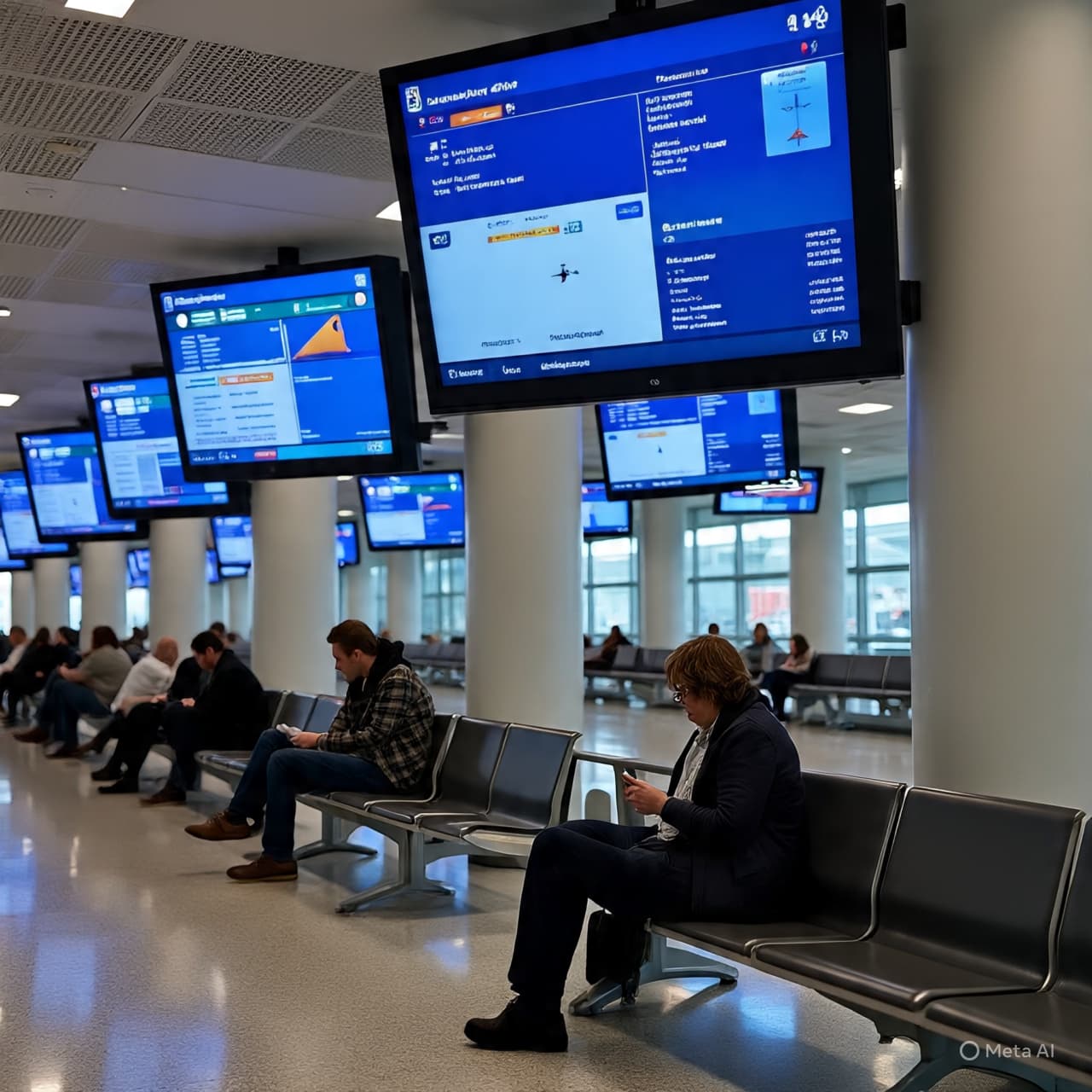
Late afternoons at busy airports often unfold with a familiar rhythm. Planes descend in steady intervals, their silhouettes crossing the sky like punctuation marks in an ongoing sentence of arrivals and departures. In Orlando, where travel often carries the buoyancy of vacation and return, that rhythm briefly faltered when one aircraft met the runway with more force than expected.
The United Airlines plane had completed its flight and was in the final moments of arrival when the landing turned unusually rough. Passengers felt the jolt as the aircraft struck the runway, a moment that lingered beyond the usual compression and release of wheels touching ground. When the aircraft came to a stop, it did not roll onward to the gate as planned. Instead, it remained where it was, disabled on the runway, its presence interrupting the flow of traffic behind it.
Airport operations adjusted quickly, as they are designed to do. A ground stop was issued, halting departures and arrivals while crews assessed the aircraft and cleared the runway. Flights already airborne were delayed in holding patterns or diverted, while those on the ground waited, engines quiet, schedules suspended in a shared pause. Inside the terminal, the usual movement softened into stillness, screens updating as passengers absorbed the news.
United Airlines later confirmed that the aircraft had experienced an extremely hard landing that left it unable to taxi. The airline said there were no immediate reports of serious injuries, though the event prompted inspections and standard safety checks. Emergency responders were present as a precaution, their vehicles positioned with practiced calm rather than urgency.
Such incidents are rare, but not unfamiliar to aviation professionals. Landings are moments of concentrated precision, shaped by weather, speed, weight, and countless variables managed in seconds. When one element shifts unexpectedly, the effects can ripple outward, grounding not just one plane but an entire sequence of travel.
As the runway reopened and operations resumed, Orlando International Airport returned gradually to motion. Flights departed, arrivals continued, and the interrupted afternoon folded back into the broader current of air travel. The disabled aircraft was removed for inspection, and passengers were rebooked, their journeys delayed but not ended.
In straightforward terms, a United Airlines flight made an extremely rough landing in Orlando that disabled the aircraft on the runway, prompting a temporary ground stop while crews cleared the plane and ensured safety. No serious injuries were reported.
AI Image Disclaimer Illustrations were created using AI tools and are not real photographs.
Sources (Media Names Only) Associated Press CNN Reuters ABC News The New York Times
Published by Banx Network. This article is part of the Banx decentralized media programme, powered by the BXE token on the XRP Ledger.