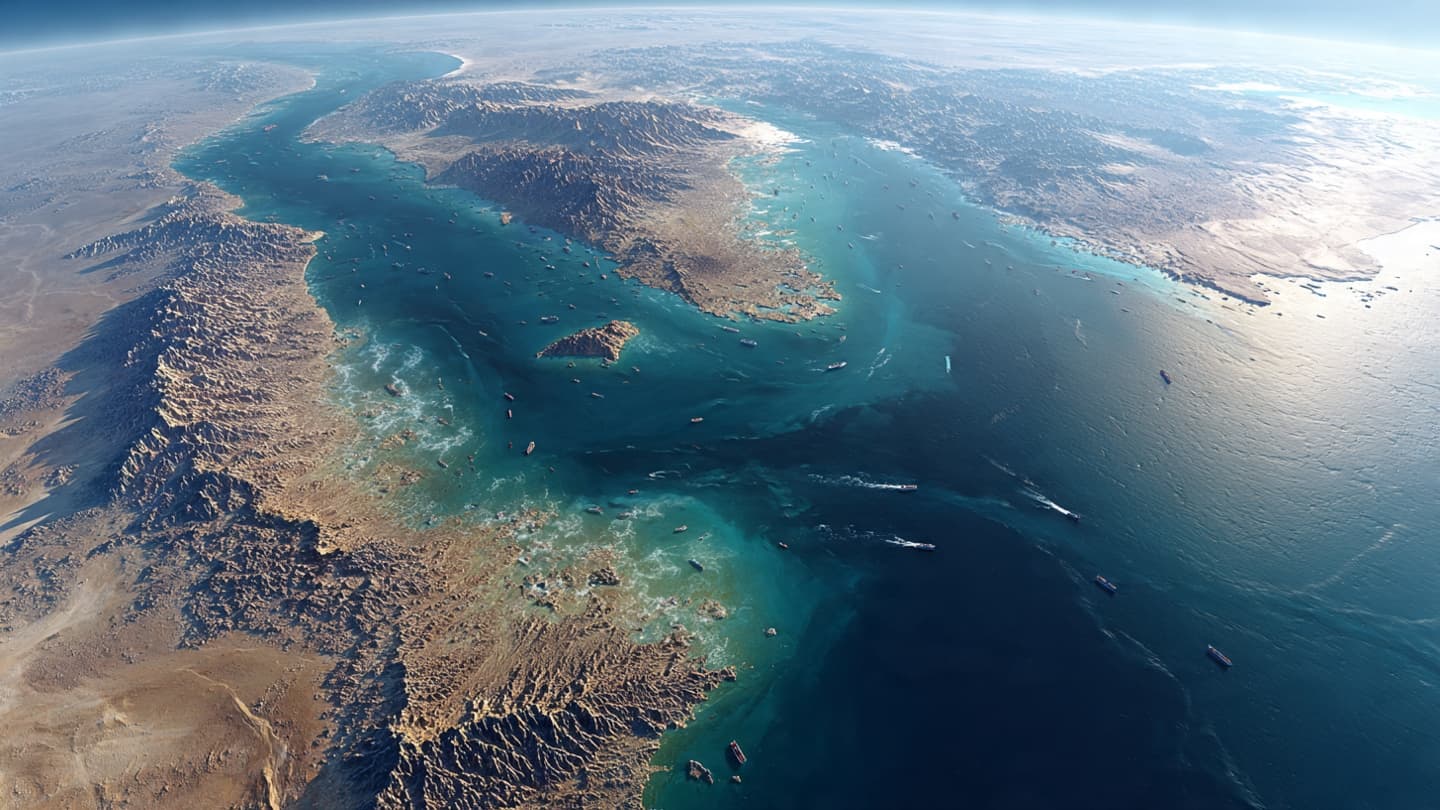
Morning arrives gently over the Strait of Hormuz. Sunlight stretches across calm waters where enormous tankers glide with deliberate patience, tracing routes that have connected continents for generations. From a distance, the passage appears almost timeless, a narrow ribbon of sea framed by rugged mountains and open horizons. Yet beneath its quiet surface rests one of the world's most consequential crossroads, where geography and geopolitics have become inseparable.
The Strait of Hormuz links the Persian Gulf with the Gulf of Oman and the Arabian Sea, serving as one of the busiest maritime corridors on Earth. A substantial share of globally traded crude oil and liquefied natural gas passes through this narrow waterway each day. Because so much international energy trade depends on uninterrupted navigation, developments in Hormuz are followed closely not only by neighboring countries but also by governments, financial markets, and industries around the world.
Iran's strategic position along the northern coastline has long given it considerable influence over activity in the strait. During periods of heightened tension with the United States and its regional partners, Iranian officials have periodically suggested that shipping through Hormuz could be disrupted if national security or economic interests come under severe pressure. Such statements are viewed by many analysts as part of Tehran's broader strategy of deterrence, emphasizing the importance of the waterway without necessarily seeking its permanent closure.
The risks involved, however, are significant. Any sustained disruption would likely affect global energy supplies, increase transportation costs, and place upward pressure on oil prices. Countries that rely heavily on imported energy—including many across Asia and Europe—could experience economic consequences extending far beyond the Gulf itself. Financial markets often react quickly to uncertainty surrounding the corridor, reflecting its importance to the broader international economy.
Yet the consequences would not be confined to Iran's trading partners. Iran itself depends on maritime commerce and regional stability for much of its own economic activity. A prolonged interruption could complicate exports, deepen existing economic challenges, and invite greater international pressure. This delicate balance helps explain why analysts often describe threats involving Hormuz as instruments of strategic signaling rather than immediate operational intentions.
Regional governments continue to watch developments carefully. Gulf states have invested in alternative export routes where possible, while naval forces from multiple countries maintain a presence intended to safeguard commercial shipping. These overlapping security arrangements illustrate how one relatively narrow passage has become central to international cooperation, competition, and crisis management.
Diplomatic efforts remain equally important. International mediators continue encouraging dialogue between regional rivals, recognizing that miscalculation at sea could rapidly escalate into a broader confrontation. Maritime incidents, even when limited in scope, have the potential to affect commercial confidence and regional security simultaneously.
For the crews guiding cargo vessels through Hormuz, the daily routine remains remarkably ordinary despite extraordinary circumstances. Navigation charts are followed with precision, engines maintain steady rhythms, and ships continue moving between continents. Their journeys quietly symbolize the interconnected nature of modern commerce, where distant economies depend upon the uninterrupted passage of vessels through a channel only a few dozen miles wide at its narrowest point.
As tensions between Iran and the United States continue to evolve, the Strait of Hormuz remains more than a geographic feature. It has become a meeting place of strategy, economics, diplomacy, and uncertainty. Whether these waters continue to carry trade peacefully or become further entangled in regional confrontation will depend largely on decisions made far beyond the horizon—decisions whose effects may ultimately reach households and markets around the world.
AI Image Disclaimer The accompanying illustrations are AI-generated visual interpretations and are intended to conceptually represent the subject rather than depict actual events or locations.
Sources Reuters Associated Press BBC News Al Jazeera International Energy Agency (IEA)
Published by Banx Network. This article is part of the Banx decentralized media programme, powered by the BXE token on the XRP Ledger.