In the early history of our solar system, Mars may have looked less like a silent desert and more like a distant cousin of Earth. Rivers appear to have once traced their way across its surface, lakes may have pooled in ancient basins, and a thicker atmosphere likely wrapped the planet in a gentler climate. Today, however, the Martian landscape tells a different story—one of cold winds, thin air, and a sky far lighter than it once might have been.
The question of what happened to that ancient atmosphere has lingered for decades, drifting quietly through planetary science like an unfinished sentence. Now, NASA has launched two small spacecraft designed to help complete that thought, beginning a mission focused on understanding how Mars slowly lost much of the air that once surrounded it.
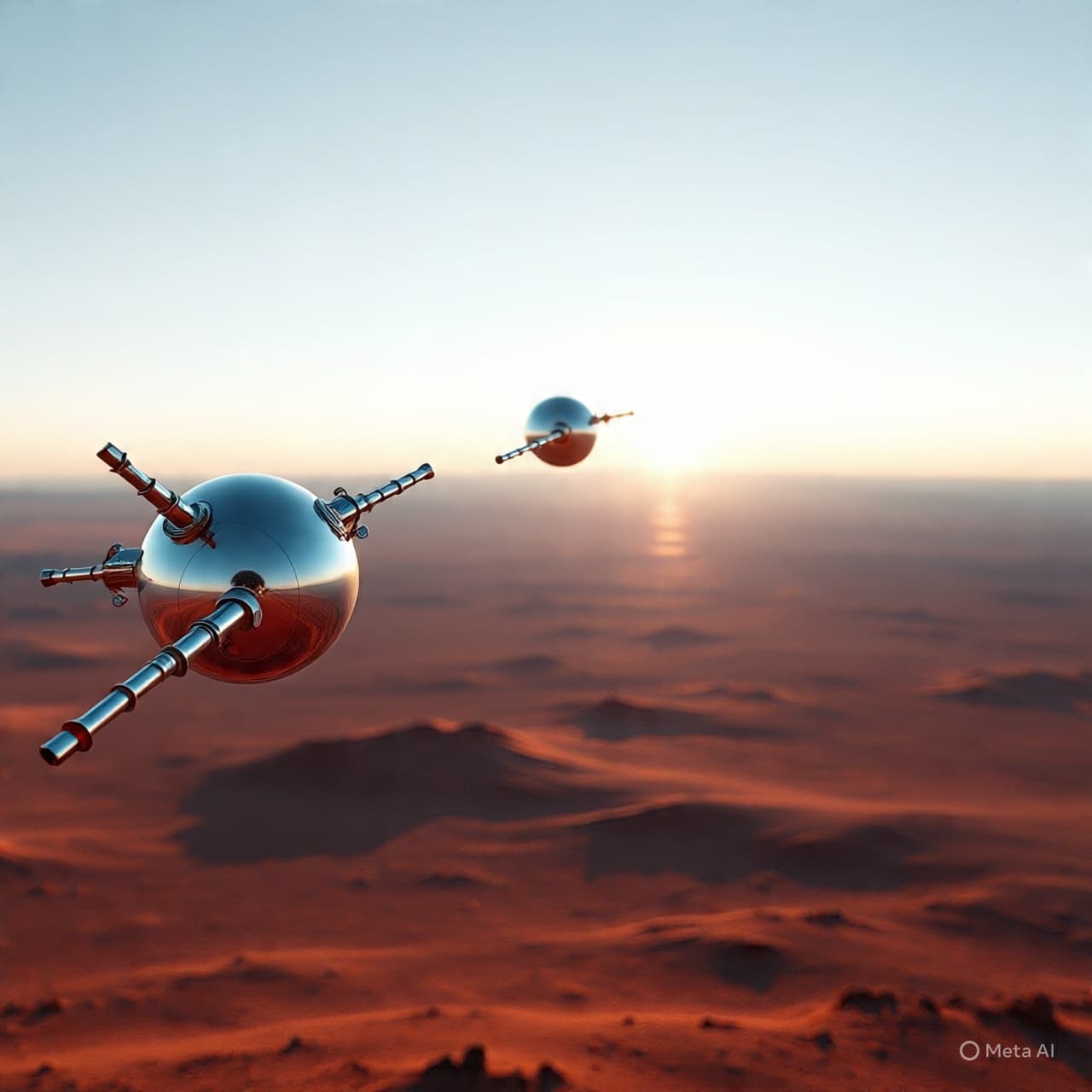
The twin spacecraft, part of a coordinated investigation of the Martian environment, were sent into space to study the interaction between the planet and the powerful stream of charged particles flowing from the Sun. Known as the solar wind, this constant outpouring of energy can gradually strip away the upper layers of a planet’s atmosphere, especially if that planet lacks a strong global magnetic field.
Mars, unlike Earth, does not possess such a protective magnetic shield. Billions of years ago, its internal dynamo faded, leaving the atmosphere more exposed to the steady pressure of solar radiation and energetic particles. Scientists believe that over immense spans of time, these forces may have gradually eroded the planet’s atmosphere, allowing lighter gases to escape into space.
The newly launched spacecraft aim to observe this process more precisely. By flying in coordinated orbits, the pair will measure how solar wind particles interact with Mars’ upper atmosphere and magnetic environment. The twin vantage points will allow scientists to capture a more detailed picture of how atmospheric particles are lifted, accelerated, and ultimately lost to space.
Each spacecraft carries instruments designed to monitor charged particles, magnetic fields, and atmospheric ions. Together, their data will help researchers understand how energy from the Sun transfers into the Martian atmosphere and how that energy contributes to the escape of gases.
This approach offers a different perspective from earlier missions. NASA’s MAVEN spacecraft, which has been studying the Martian atmosphere since 2014, already revealed that the solar wind plays a major role in atmospheric loss. The new twin spacecraft mission builds on that knowledge by observing the process simultaneously from two positions, allowing scientists to track how solar wind disturbances propagate across the planet’s environment.
The dual measurements may prove especially valuable during solar storms, when bursts of solar energy dramatically increase the flow of particles toward Mars. During these events, atmospheric escape can intensify, offering a clearer view of the mechanisms gradually thinning the planet’s air.
Understanding this process is not only about Mars. Planetary scientists see the Red Planet as a natural laboratory for studying how atmospheres evolve. Many rocky worlds across the universe may experience similar interactions with their parent stars. Learning how Mars lost its atmosphere could therefore help researchers understand the long-term habitability of planets beyond our solar system.
There is also a quieter layer of curiosity involved. If Mars once had a thicker atmosphere capable of supporting liquid water at the surface, it might have provided conditions suitable for life in the distant past. Determining how and when the atmosphere disappeared helps define the window during which such environments may have existed.
The twin spacecraft mission therefore moves between two scales of exploration: the immediate physics of solar wind interactions and the broader history of planetary evolution. Each particle detected, each magnetic fluctuation recorded, adds a small detail to the story of how a once more hospitable planet gradually transformed into the cold world seen today.
As the spacecraft settle into their observational routines, scientists will begin collecting measurements that could refine existing models of atmospheric escape. Over time, patterns in the data may reveal how the Sun’s influence shapes the fragile outer layers of a planet’s air.
For now, the mission represents another step in humanity’s long effort to understand Mars—not only as it is today, but as it once might have been.
The twin spacecraft have successfully launched and begun their journey toward conducting coordinated studies of how solar wind interactions continue to influence the Martian atmosphere, a process that scientists believe has played a central role in the planet’s ancient transformation.
AI Image Disclaimer Graphics are AI-generated and intended for representation, not reality.
Sources NASA Space.com New Scientist ScienceAlert Universe Today
Published by Banx Network. This article is part of the Banx decentralized media programme, powered by the BXE token on the XRP Ledger.