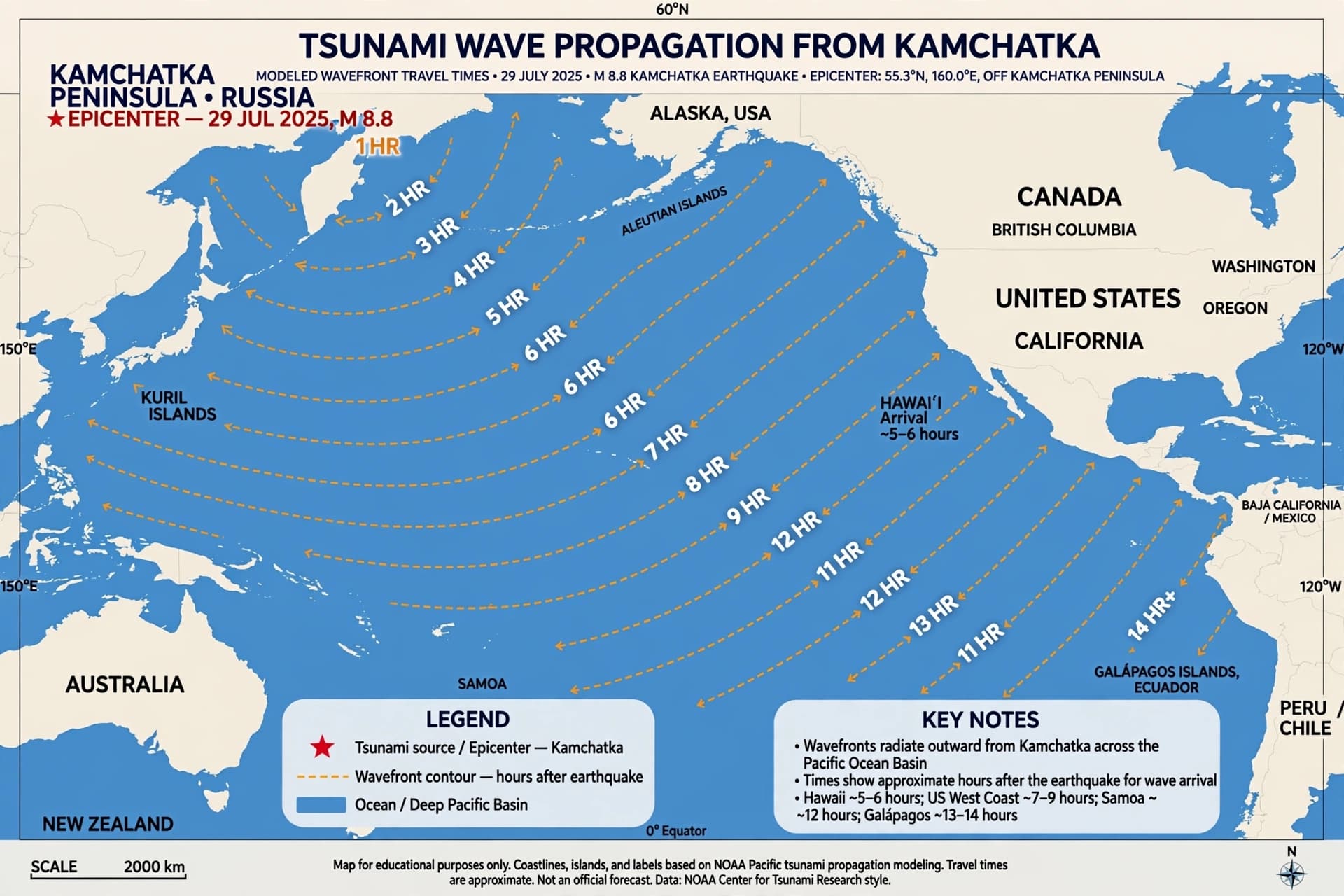
The ocean has a memory. Long after a wave has crashed against a distant shore, its energy can continue to move, reflecting and refracting through the vast basin that connects continents. On July 29, 2025, an earthquake of magnitude 8.8 struck off the Kamchatka Peninsula in Russia, triggering a tsunami that raced across the Pacific . The initial waves came and went, but the ocean did not fall silent. For more than ten hours, the Pacific kept ringing, like a bell struck once and left to vibrate.
The earthquake itself was one of the most powerful ever recorded, the strongest since the 2011 Tōhoku event . Tsunami waves reached heights of 3 to 5 meters in Kamchatka and the Kuril Islands, damaged buildings, and flooded a fish processing plant . Alerts went out across the Pacific, from Japan to Hawaii to Chile. But the story of the 2025 Kamchatka tsunami did not end when the warnings were lifted. The waves kept moving, bouncing off coastlines and underwater mountains, creating what researchers describe as a persistent oscillation that lasted long after the initial surge.
A study published by researchers at the University of Bath analyzed data from 40 deep-ocean buoys and 10 coastal tide gauges distributed across the Pacific . The analysis revealed that the tsunami energy was concentrated in a broad period band of 8 to 128 minutes. Stations aligned normal to the fault strike were dominated by shorter periods of 8 to 42 minutes, while those aligned with the fault strike experienced longer periods of 42 to 128 minutes. This broad spectral content allowed the tsunami to resonate with coastal basins of varying sizes, producing prolonged oscillations that continued for more than ten hours .
The prolonged ringing was not merely a scientific curiosity. It carried implications for tsunami warnings. Traditional warning systems focus on the first wave, the one that arrives with the most energy and poses the greatest immediate danger. But the 2025 event demonstrated that significant oscillations can persist long after the initial wave has passed, potentially causing damage in harbors and coastal areas hours after authorities have downgraded their alerts . Understanding the rhythm of these lingering oscillations could help forecasters refine their warnings, distinguishing between the initial threat and the longer, subtler resonance that follows.
The phenomenon also revealed how the shape of the ocean floor shapes the fate of a tsunami. The Emperor Seamount Chain, a 2,000-kilometer range of underwater mountains east of Kamchatka, acted as a series of obstacles that reflected and redirected wave energy . Professor Fumihiko Imamura of Tohoku University explained that tsunami waves from Kamchatka approached Japan from multiple angles, and when they hit the seamounts, they bounced back and reached coastal areas later than the first waves . When multiple waves overlap, the tsunami continues over a long period, with larger waves sometimes arriving later.
The 2025 Kamchatka tsunami was the first Pacific-wide event since 2011, and it tested warning systems that had been developed over decades . The alerts were issued within minutes, and evacuations likely saved lives. But the lingering oscillations suggest that the work of understanding tsunamis is not finished. The rhythm of the Pacific, when it rings, holds information that could make the next warning more precise.
For now, researchers continue to analyze the data, looking for patterns that might predict how long a tsunami's echo will last. The ocean will keep moving long after the headlines fade. Its rhythm, if we learn to read it, may help us be ready for the next time it rings.
---
AI Image Disclaimer: All images in this report are AI-generated and do not depict actual events or locations.
Sources: University of Bath, Gizmodo en Español, NHK World-Japan, PreventionWeb, IOC/UNESCO
Published by Banx Network. This article is part of the Banx decentralized media programme, powered by the BXE token on the XRP Ledger.