

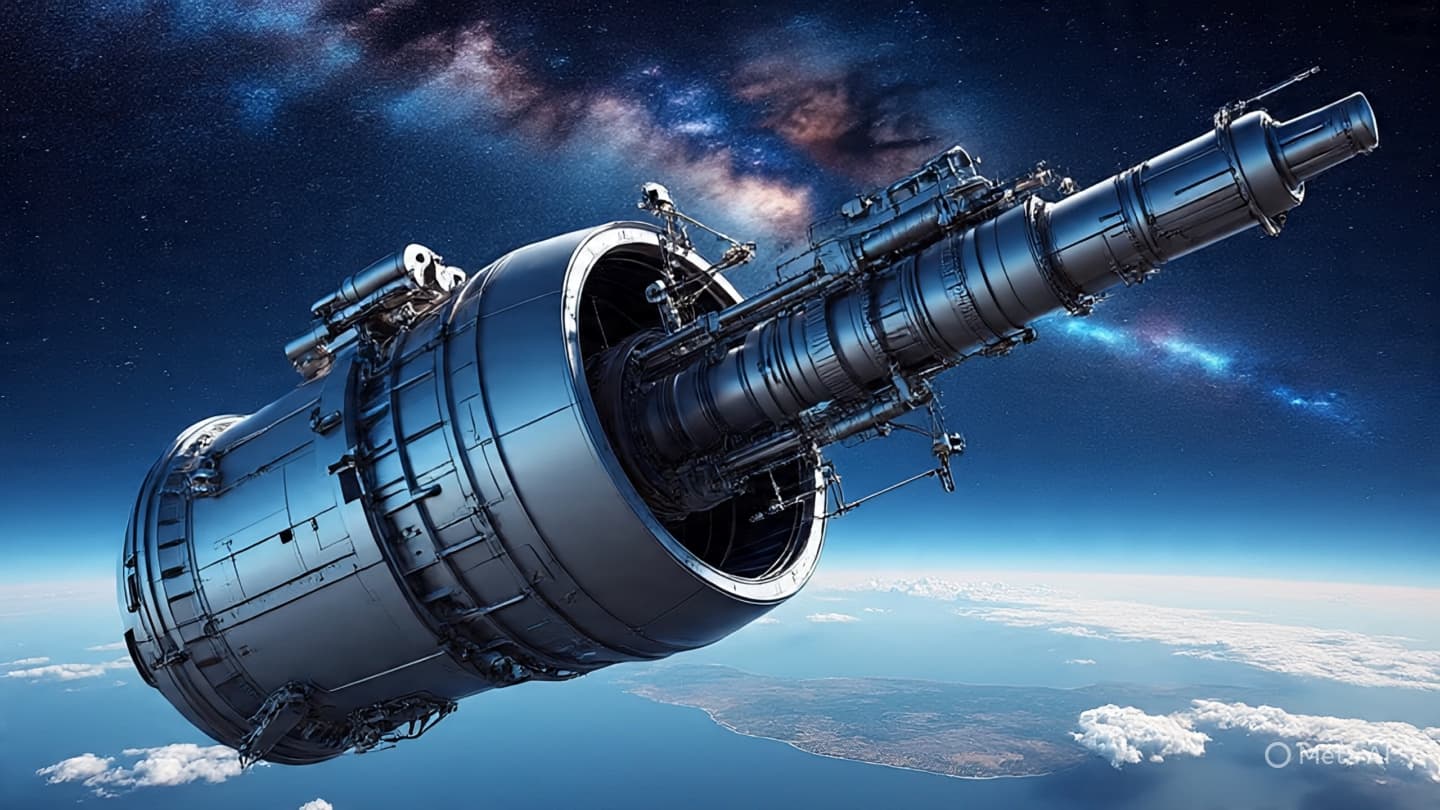
There are moments in human history when curiosity stretches beyond the horizon, asking questions that echo into the dark. Somewhere between ambition and uncertainty stands a proposed giant telescope, a structure not yet built, yet already heavy with expectation. It is imagined as a bridge—delicate yet powerful—connecting Earth to distant worlds that may, quietly and patiently, harbor life.
Scientists have long sought answers to one of humanity’s oldest questions: are we alone? The planned observatory, often discussed alongside next-generation projects like the Habitable Worlds Observatory, is designed to detect Earth-like planets orbiting distant stars. Unlike existing instruments, it would analyze atmospheric signatures, searching for hints of oxygen, methane, or other markers that suggest biological activity.
At its core, the telescope represents a leap in technological ambition. With a mirror spanning several meters and advanced spectroscopic tools, it would surpass the capabilities of current observatories such as the James Webb Space Telescope. Where Webb peers into the early universe, this new instrument would focus more precisely on nearby star systems, examining planets in the so-called habitable zone.
Yet the promise of discovery is intertwined with the reality of cost. Funding such a project requires billions of dollars and long-term political commitment. Agencies like NASA face competing priorities, from lunar missions to Mars exploration, each vying for finite resources. The telescope, while scientifically compelling, must find its place within a crowded agenda.
Supporters argue that the investment is not merely about science, but about perspective. Discovering even microbial life beyond Earth could reshape humanity’s understanding of itself. It would challenge philosophical boundaries and redefine the uniqueness of our planet. In this sense, the telescope is less a machine and more a question posed to the universe.
Critics, however, raise practical concerns. Large-scale scientific projects often face delays, cost overruns, and shifting political winds. The history of space exploration is filled with ambitious plans that were scaled back or postponed indefinitely. The telescope’s future, therefore, remains uncertain—balanced between aspiration and fiscal reality.
International collaboration could offer a path forward. Partnerships between agencies in Europe, North America, and Asia may distribute costs and expertise. Similar cooperation has enabled projects like the Hubble Space Telescope, which transformed astronomy and public imagination alike.
For now, the telescope exists as both blueprint and possibility. Engineers refine designs, scientists advocate for its importance, and policymakers weigh its value. Each step forward depends on decisions made far from the stars themselves, in meeting rooms and legislative chambers.
In the quiet vastness of space, the potential discoveries wait without urgency. Whether humanity chooses to build the instrument that can find them remains a question not of science, but of will.
AI Image Disclaimer Visuals are created with AI tools and are not real photographs.
Published by Banx Network. This article is part of the Banx decentralized media programme, powered by the BXE token on the XRP Ledger.



