
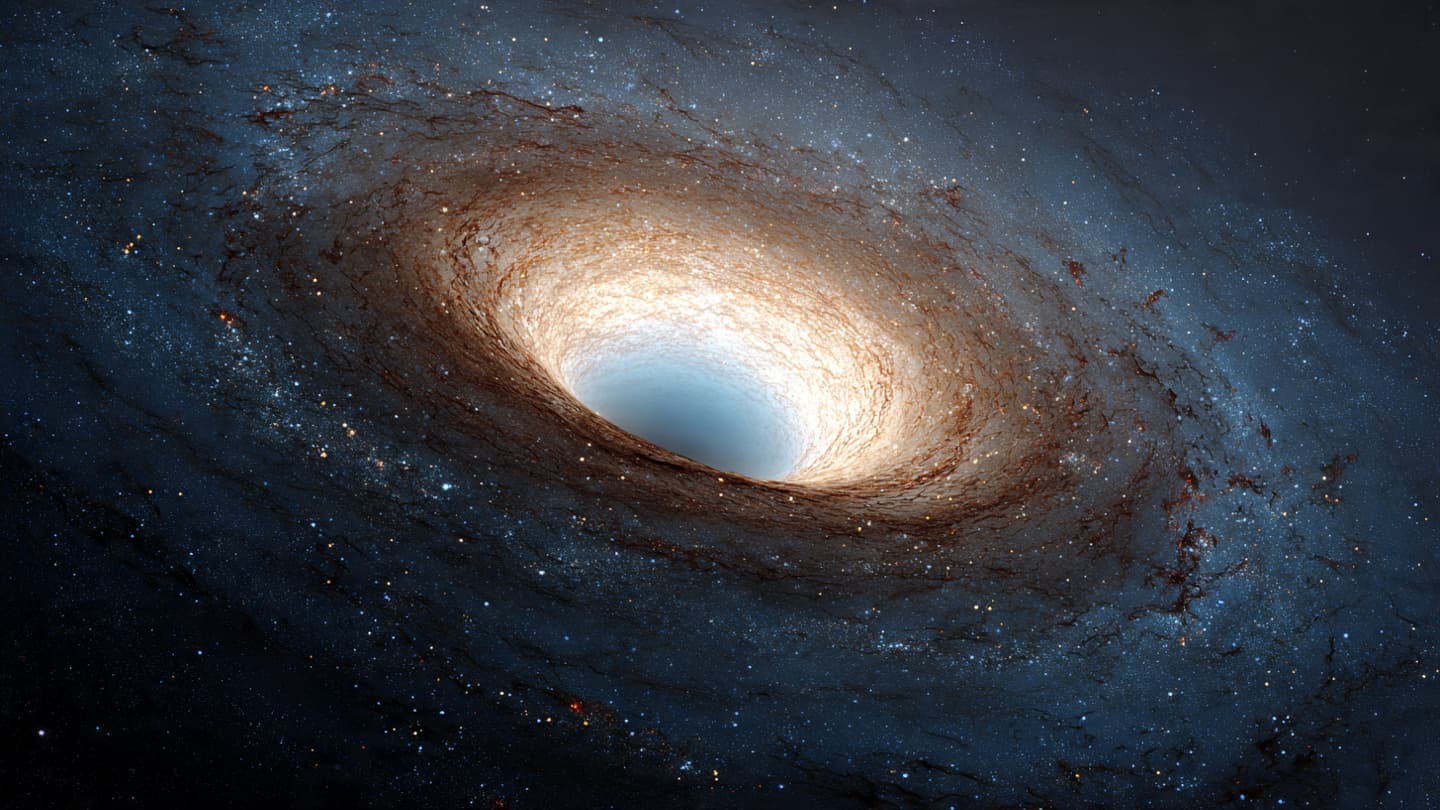
In the vast silence of the universe, not all cosmic giants roar with energy or light. Some remain quiet, almost invisible, shaping galaxies from the shadows of gravity itself.
Body: Astronomers using the James Webb Space Telescope have identified evidence of a massive black hole that appears to be in a dormant or “sleeping” state. Unlike actively feeding black holes that emit intense radiation, this object shows minimal signs of activity.
The discovery is significant because dormant black holes are far more difficult to detect. Without the bright emissions typically associated with accretion processes, scientists must rely on indirect indicators such as gravitational effects on surrounding stars and gas.
Researchers suggest that this black hole resides in a distant galaxy, where its mass still exerts a powerful influence on galactic structure despite its quiet state. This challenges previous assumptions that only active black holes play a major role in shaping galaxies.
The James Webb Space Telescope, with its advanced infrared capabilities, has opened new possibilities for observing such hidden cosmic objects. Its ability to look deeper into dust-obscured regions allows scientists to uncover structures previously beyond reach.
Understanding dormant black holes is essential for building a more complete picture of galactic evolution. Scientists believe that many galaxies, including potentially the Milky Way in certain phases, may host similar inactive black holes.
While the object is not posing any threat to Earth, its discovery expands the boundaries of astrophysical knowledge and raises new questions about how black holes transition between active and dormant states.
Closing: As research continues, astronomers hope to identify more of these quiet cosmic giants. Each discovery adds another layer to our understanding of how the universe evolves over billions of years.
AI Image Disclaimer: This article uses AI-generated illustrations for conceptual visualization of space phenomena and does not represent actual telescope imagery.
Sources: NASA James Webb Space Telescope team reports, Space.com, Live Science, European Space Agency briefings
Published by Banx Network. This article is part of the Banx decentralized media programme, powered by the BXE token on the XRP Ledger.



