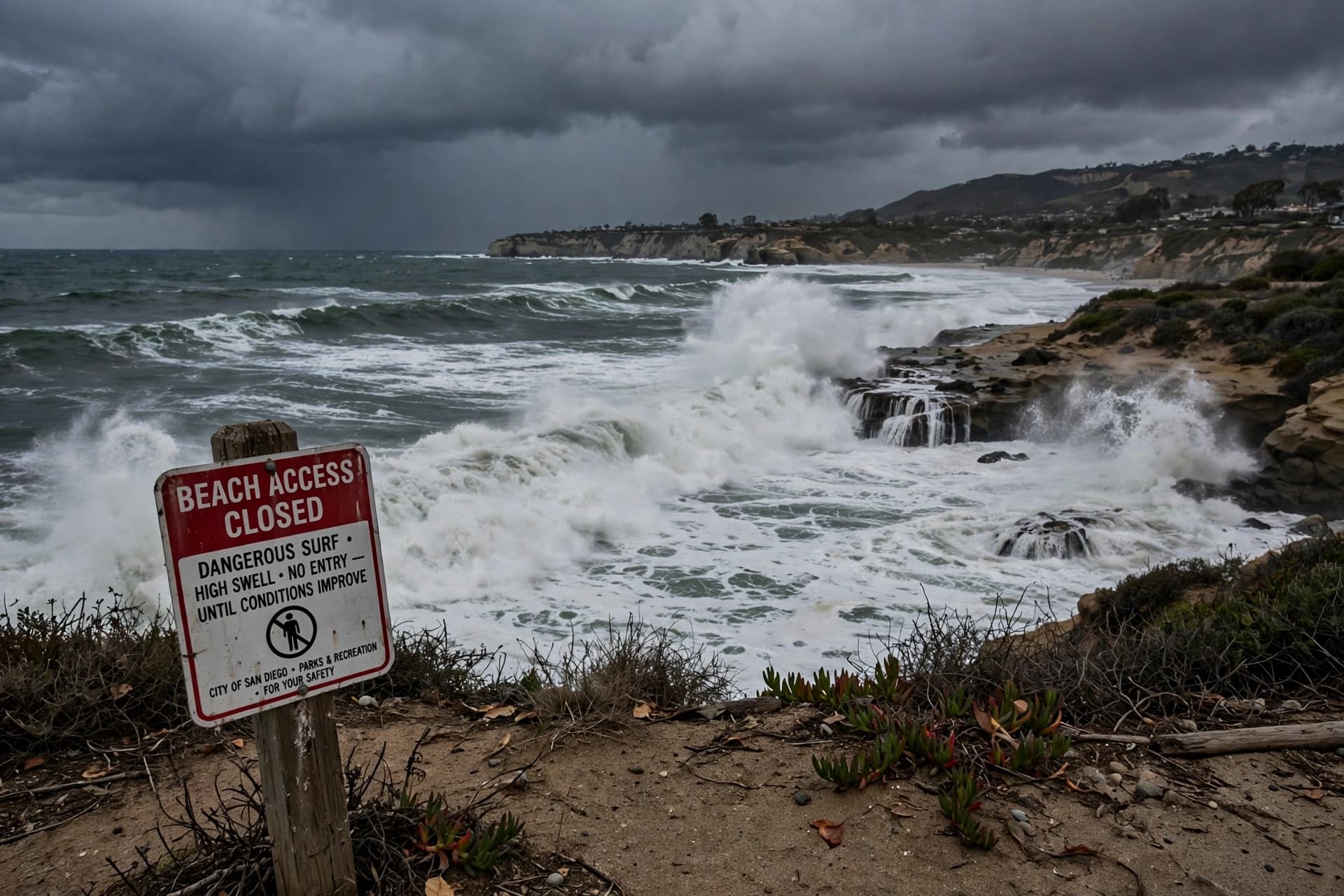
There is a particular kind of relief that arrives when a warning is lifted—not the joy of a crisis averted, but the quieter, more measured exhale of a community that had prepared for the worst and found, at least for now, that the worst had passed. Early Sunday morning, the National Weather Service discontinued the tropical storm watch for San Diego County, a rare alert that had placed the region on edge as Post-Tropical Cyclone Rachel churned northward from the Baja California coast.
The watch, only the second of its kind ever issued for San Diego County, had raised the possibility of tropical storm conditions—sustained winds of 39 miles per hour or greater—across coastal areas, valleys, mountains, and deserts . Forecasters had warned of peak gusts ranging from 25 to 40 miles per hour in lower elevations to 50 to 70 miles per hour in the mountains, with the strongest winds expected early Sunday morning . By the time the watch was canceled, Rachel had weakened into a post-tropical cyclone, its center moving inland over Mexico and its organized tropical characteristics dissipating .
But the cancellation of a watch does not mean the end of the storm’s effects. A flood watch remained in effect until 8 p.m. Sunday, and a coastal flood warning persisted until 3 p.m., followed by a coastal flood advisory through Tuesday afternoon . The National Weather Service cautioned that flooding, wind, and periods of heavy rain could still produce localized inundation, and that flash flooding would remain a concern through the day . Life-threatening surf and rip current conditions were expected to continue along the coasts of Southern California and northern Baja California, with hazardous coastal conditions lingering into the following week .
Peak wind gusts recorded in eastern San Diego County reached 59 miles per hour before the storm’s departure . Coastal areas faced risks of erosion, with strong swells peaking at six to nine feet . Water rescues and road closures were reported in some areas, a reminder that the dangers of a storm often outlast the warnings that accompany it .
The unusual nature of the event—a tropical storm watch in Southern California, a region unaccustomed to such alerts—reflects a broader pattern of extreme weather that has become increasingly difficult to categorize as anomalous. The only previous tropical storm watch for San Diego was issued for Hurricane Hilary in 2023, the first year such alerts were used for the region .
As the storm moved north and weakened, the watch that had prompted preparation and concern was quietly withdrawn. The residents of San Diego County returned to their Sunday routines, the skies still heavy with clouds, the ground still wet from rain, the ocean still churning with the remnants of a storm that had come closer than most.
AI Image Disclaimer: The visual content accompanying this report was generated using artificial intelligence for illustrative purposes only and does not depict the actual weather conditions described.
Sources: NBC 7 San Diego, National Weather Service, National Hurricane Center, KSL News, Telemundo San Diego
Published by Banx Network. This article is part of the Banx decentralized media programme, powered by the BXE token on the XRP Ledger.