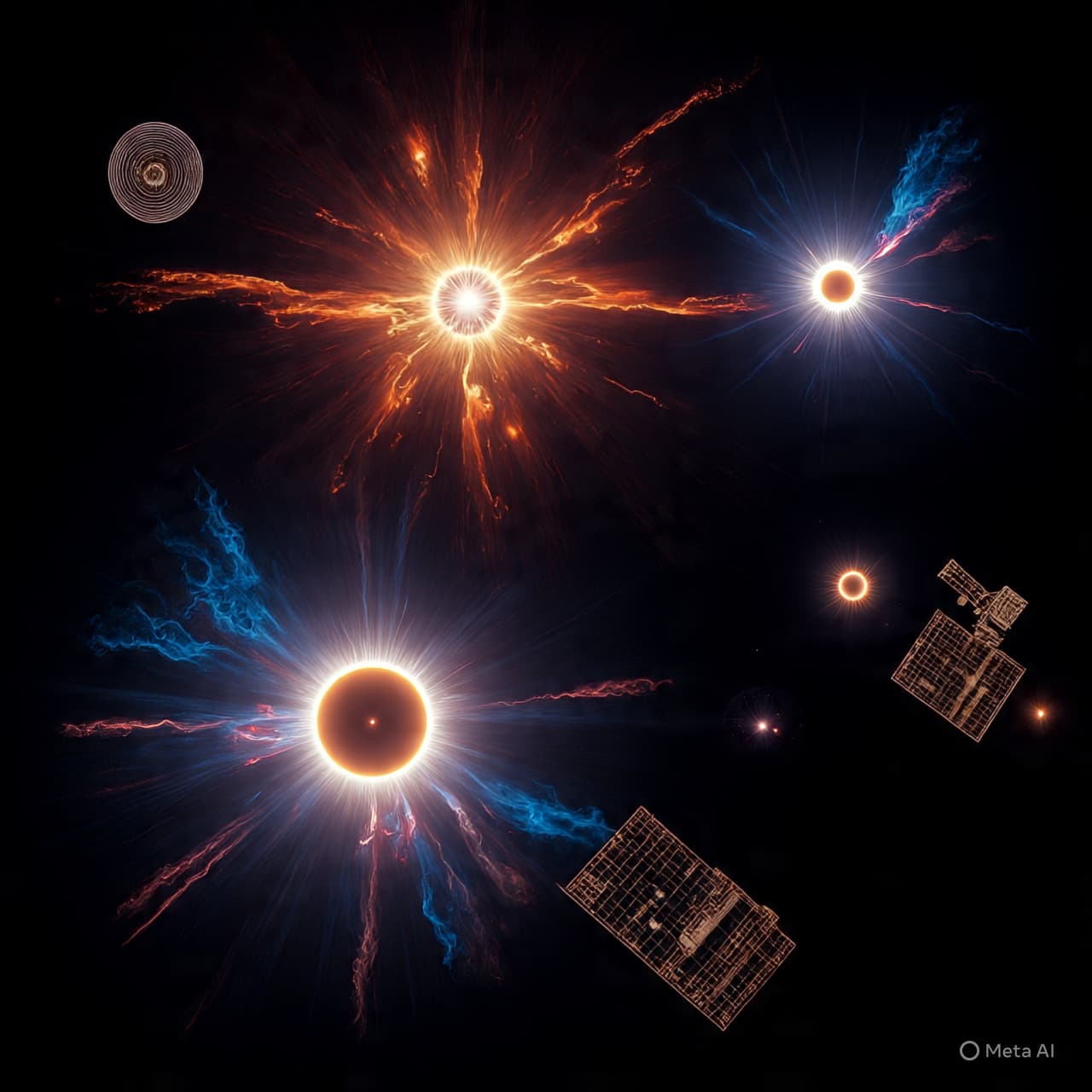
Sometimes the sky speaks in whispers of light and shadow, and sometimes it speaks with the roaring clarity of pure energy. In the quiet expanse of space, the Sun — the star that makes our very mornings possible — has recently stirred in a way that reminds us of its immense dynamism. Over the span of a few days, a series of powerful eruptions, like sudden flares lighting up a familiar but ever-changing face, have danced across its surface. These events — six in less than four days — suggest a restlessness deep within the heart of our star, a reminder that even after its peak phase of activity, the Sun’s magnetic heartbeat can still quicken in surprising pulses. In early February, an unusually intense sequence of bursts known as solar flares was captured by space observatories. These flares — energetic releases so powerful they can be measured in X-ray emissions — emanated from an active region of the Sun designated AR 14098. In the span of 96 hours, this region produced a remarkable train of six large flares, including one classified at the very top of the scale with an X8.1 designation. To picture the scale, imagine twisting and stressing magnetic fields until, suddenly, they snap and spill out vast amounts of energy — that is the essence of these solar flares, and it is a process both violent and breathtaking in its cosmic choreography. These flares shine brightly in the ultraviolet and X-ray wavelengths, caught in stunning detail by instruments like NASA’s Solar Dynamics Observatory. Though invisible to the naked eye, their signatures tell a story of magnetic complexity and power that scientists watch closely. Even though the Sun’s 11-year cycle is considered to have passed its peak, the star continues to surprise, showing that the end of a maximum does not mean the end of strong activity. For those on Earth, solar flares are not just abstract phenomena. Their bursts of charged particles and radiation can interact with our outer atmosphere, sometimes affecting radio communications or enhancing auroras near the poles. While these particular flares were not directed in a way that threatens life or infrastructure, they do offer scientists valuable data — a chance to refine forecasts and better understand our star’s complex behavior. Yet perhaps the most profound lesson is one of perspective. In the vastness of space, the Sun’s outbursts are part of a larger rhythm — a powerful reminder of the forces at play beyond the blue sky we see each day. And as we learn more, we find ourselves not at the mercy of these cosmic rhythms but in awe of their timeless story.
🖼️ AI Image Disclaimer (rotated wording)
“Visuals are created with AI tools and are not real photographs.”
---
📰 Sources
DetikInet The Daily Galaxy NASA Science Blog NASA SVS (Solar Dynamics Observatory imagery) Space weather classification context (SciTech Daily/NDTV)
Published by Banx Network. This article is part of the Banx decentralized media programme, powered by the BXE token on the XRP Ledger.