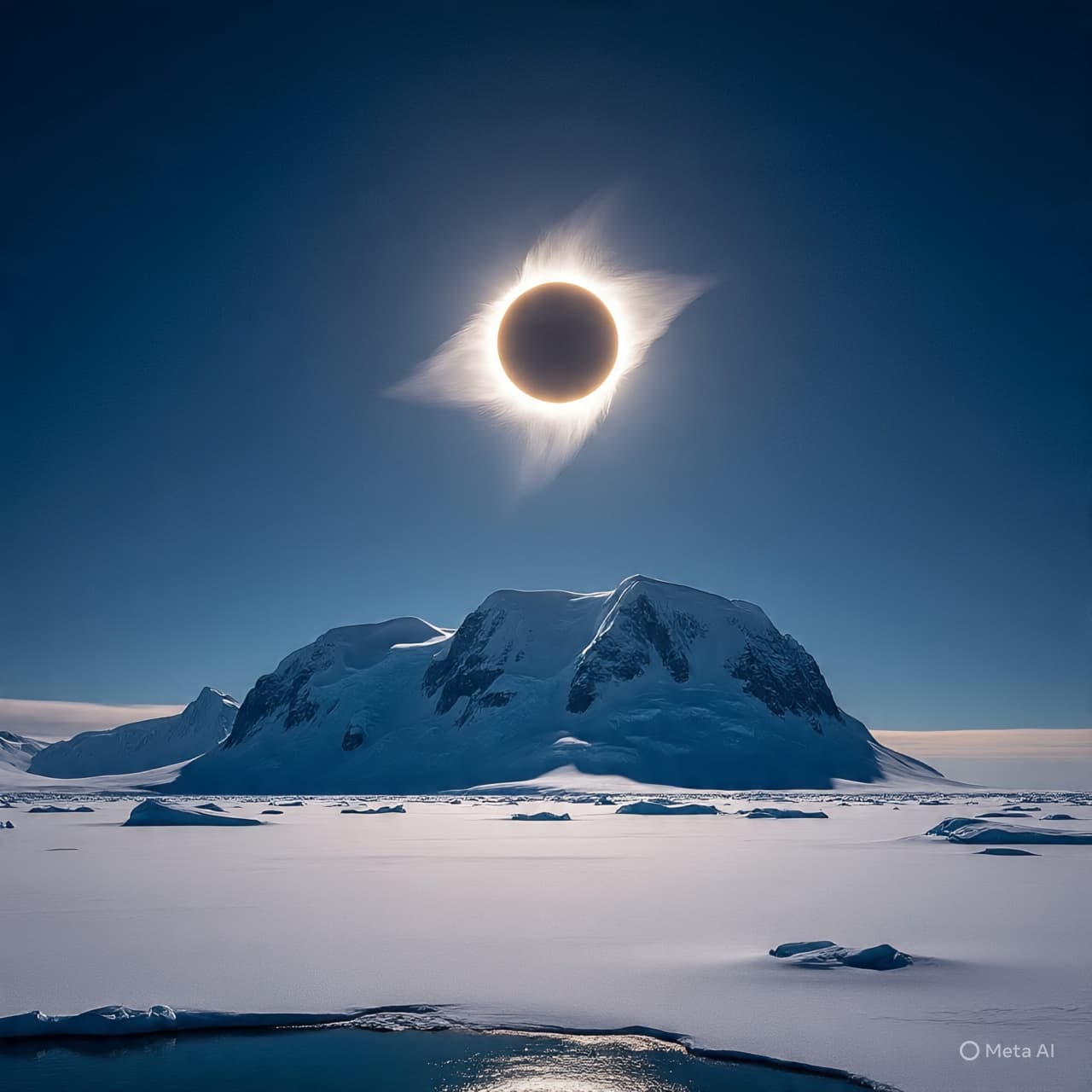
The sky rarely announces its intentions. It shifts in color, softens at dusk, brightens at dawn — but always with a kind of steady familiarity. And then, on certain rare days, it rearranges itself entirely. This week, the Moon will glide carefully across the Sun, leaving behind not darkness, but a luminous ring — a circle of fire suspended in stillness.
The event is an annular solar eclipse, often called a “ring of fire.” It occurs when the Moon moves directly between Earth and the Sun but sits slightly farther from Earth in its orbit. Because of that distance, the Moon appears just small enough that it cannot completely cover the Sun. Instead of total darkness, a bright halo remains visible around the Moon’s silhouette — a thin, radiant circle that seems almost deliberate in its geometry.
The February 17, 2026 eclipse will be one of the year’s most notable astronomical events. Yet it will unfold largely over remote regions of the Southern Hemisphere. The full annular phase — the complete “ring” effect — will be visible primarily from Antarctica. In parts of southern South America and southern Africa, observers may see only a partial eclipse, where the Moon obscures a portion of the Sun but does not create the full ring.
This geography gives the event a quiet exclusivity. Unlike total eclipses that sweep across major cities and draw crowds into open fields, this one will belong mostly to researchers stationed on ice and to those watching via live broadcast. Scientific institutions and observatories are expected to stream the event, allowing viewers worldwide to witness the alignment in real time.
Safety remains essential. Even though the Moon covers much of the Sun, the remaining sunlight is still powerful enough to damage eyesight. Experts consistently advise using certified solar viewing glasses or specialized filters for telescopes and cameras. Ordinary sunglasses are not sufficient. The rule is simple and steady: if you are looking at the Sun, protect your eyes properly.
Beyond its visual drama, the eclipse is a reminder of orbital precision. The Moon circles Earth roughly every 27 days, yet eclipses do not occur monthly because the Moon’s orbit is tilted. Only when Earth, Moon, and Sun align along the same plane does an eclipse become possible. Even then, the exact distances determine whether the result is total, annular, or partial.
Later in 2026, another solar eclipse — this time a total eclipse — will cross more populated regions, offering broader visibility. But this week’s event carries its own distinct character: quieter, more remote, almost contemplative in its reach.
When the ring appears above Antarctica’s vast white horizon, it will last only minutes. Then the Moon will drift onward, and the Sun will resume its familiar shape. The moment will pass gently, recorded in photographs, livestreams, and memory — a brief reshaping of light that reminds us how precise and delicate our celestial balances truly are.
AI Image Disclaimer Illustrations were produced with AI and serve as conceptual depictions.
Source Check
Associated Press
Reuters
BBC News
CNN
Space.com
Published by Banx Network. This article is part of the Banx decentralized media programme, powered by the BXE token on the XRP Ledger.