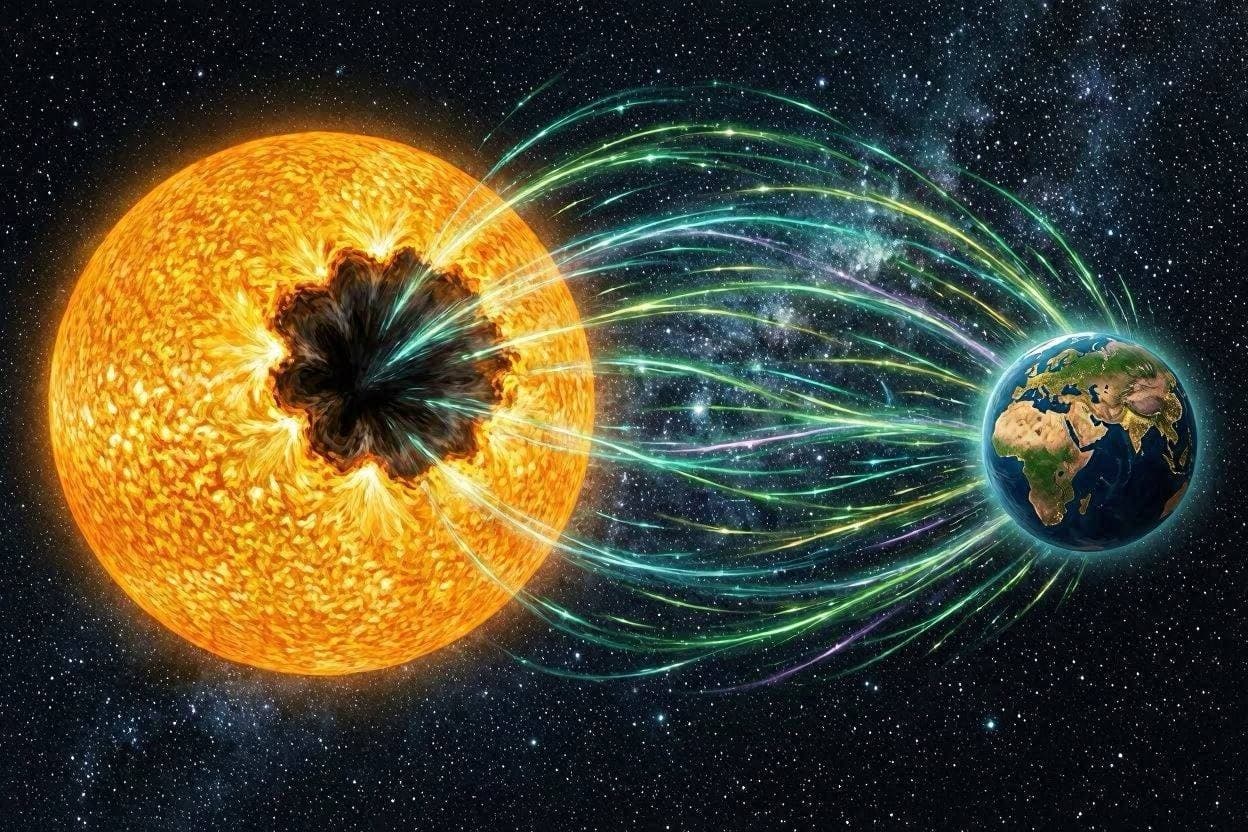
The Sun, our nearest star, is a dynamic and ever-changing entity, constantly emitting energy and particles into space. Recently, a coronal hole—a region of open magnetic field lines—has appeared on its surface, sending a stream of high-speed solar wind toward Earth. This phenomenon, while common, serves as a reminder of the powerful forces that govern our solar system. It invites reflection on the delicate balance that allows life to thrive on our planet, shielded by its magnetic field from the raw power of the cosmos.
Body: Coronal holes are areas where the Sun’s corona is darker and cooler, allowing solar wind to escape more easily. When these holes are positioned favorably, the resulting high-speed streams can interact with Earth’s magnetosphere, causing geomagnetic storms. These storms can range from mild to severe, depending on the speed and density of the solar wind. Scientists monitor these events closely to predict their potential impact on technology and infrastructure.
The expected arrival of this solar wind stream has prompted alerts from space weather forecasters. While most effects will be subtle, such as enhanced auroras at higher latitudes, there is a possibility of minor disruptions to satellite operations and radio communications. Power grids are generally resilient, but operators remain vigilant, ready to take preventive measures if necessary. The preparedness of modern society relies on accurate forecasting and robust engineering.
Auroras, or northern lights, are the most visible and beautiful consequence of geomagnetic activity. Charged particles from the solar wind collide with atoms in Earth’s atmosphere, releasing energy in the form of light. During strong storms, these displays can be seen at lower latitudes than usual, offering a spectacular sight for skywatchers. The phenomenon connects us to the cosmic dance of particles and fields, reminding us of our place in the universe.
Space weather research has advanced significantly in recent years, with satellites like the DSCOVR and SOHO providing continuous monitoring of the Sun. This data allows scientists to issue warnings days in advance, giving industries time to protect sensitive equipment. The collaboration between space agencies and private companies ensures that critical services remain operational even during periods of heightened solar activity.
Public interest in space weather has grown, driven by the visual appeal of auroras and the increasing reliance on technology. Educational initiatives help people understand the science behind these events, reducing fear and fostering appreciation. Knowing that the Earth is protected by its magnetic field provides comfort, while understanding the risks encourages responsible planning and innovation.
As the solar wind reaches Earth, scientists will analyze the data to refine their models and improve future predictions. Each event adds to our knowledge of the Sun-Earth connection, helping us better navigate the challenges of living in a space-faring civilization. The study of coronal holes and solar wind is not just academic; it is essential for safeguarding our technological way of life.
Closing: The arrival of high-speed solar wind from a coronal hole is a natural occurrence that highlights the dynamic nature of our star. While it may bring minor disruptions, it also offers the chance to witness the beauty of auroras. By staying informed and prepared, we can appreciate the power of the Sun while protecting our modern infrastructure.
AI Image Disclaimer: Please note that the images accompanying this article are AI-generated and intended for illustrative purposes only.
Sources: NOAA Space Weather Prediction Center NASA Spaceplace Space.com Live Science
Published by Banx Network. This article is part of the Banx decentralized media programme, powered by the BXE token on the XRP Ledger.