Far from the quiet blue skies of Earth, the Sun is a restless landscape of motion and energy. Beneath its brilliant glow, enormous currents of charged particles twist and surge through a sea of superheated plasma. In that luminous chaos, even the smallest disturbance can grow into a dramatic event.
Scientists have long observed that during solar eruptions, electrons sometimes accelerate to astonishing speeds. These tiny particles can race across solar material in bursts of energy that ripple through the star’s atmosphere. Yet the precise trigger behind this sudden acceleration has often remained elusive, hidden within the Sun’s complex magnetic environment.
Recent research now points to a mechanism that researchers describe in simple terms as a powerful “kick.”
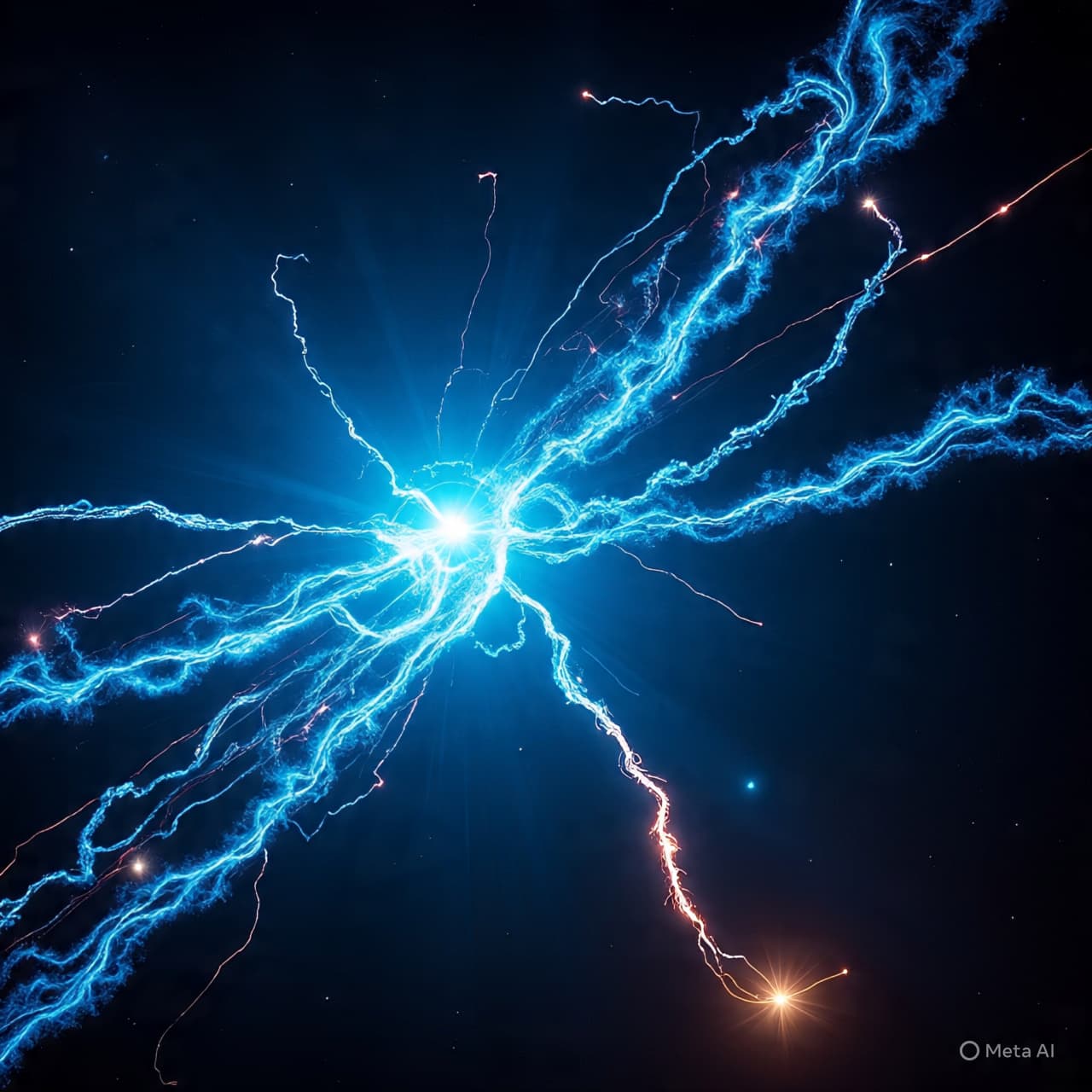
In the physics of solar plasma, this kick occurs when magnetic fields suddenly rearrange themselves in a process known as magnetic reconnection. When twisted magnetic field lines snap and reconnect, they release enormous amounts of stored energy. This release does not happen gently. Instead, it can fling charged particles outward, giving electrons an abrupt push that sends them speeding through surrounding solar material. (phys.org)
To understand this process more clearly, researchers used advanced computer simulations that recreated conditions inside the Sun’s turbulent plasma environment. These simulations allowed scientists to observe how electrons behave when exposed to rapidly shifting magnetic fields.
What they discovered was a striking sequence of events. As magnetic fields collapse and reconnect, electrons are caught within the resulting energy burst. In that moment, the particles receive a sudden injection of momentum — the “kick” that propels them forward at high speeds.
Once accelerated, these electrons can travel across large distances within solar material, interacting with surrounding plasma and sometimes generating intense bursts of radiation. Such energetic particles are often associated with solar flares, which are among the most powerful explosions in the solar system. (sciencedaily.com)
Understanding this behavior is more than a matter of curiosity. High-energy electrons produced during solar events can influence space weather, the dynamic conditions created by the Sun that affect planets and spacecraft throughout the solar system.
When solar eruptions accelerate particles toward Earth, the resulting radiation and magnetic disturbances can disrupt satellites, interfere with radio communications, and even affect power systems on the ground. By studying how electrons gain their energy at the Sun, scientists hope to improve models that predict such events. (nasa.gov)
The newly described mechanism offers a clearer explanation for why electrons sometimes appear to move so rapidly during solar activity. Rather than accelerating gradually, they may receive a sudden burst of energy from magnetic reconnection — a brief but powerful push that sends them racing through the Sun’s plasma.
In many ways, the discovery illustrates how even the smallest particles can carry the signature of immense cosmic forces. The journey of an electron across solar material reflects the immense energy stored in magnetic fields and the dynamic processes that shape our nearest star.
For researchers studying the Sun, each insight adds another piece to a complex puzzle. Solar activity influences the entire solar system, and understanding the smallest details of that activity helps reveal the larger story of how stars behave.
As observations and simulations continue to improve, scientists expect to uncover even more about the hidden physics unfolding inside the Sun’s glowing atmosphere.
For now, the idea of a simple “kick” offers a vivid reminder that even within the vast scale of a star, the motion of tiny particles can illuminate the powerful forces at work.
AI Image Disclaimer Illustrations were produced with AI and serve as conceptual depictions.
Sources Phys.org ScienceDaily NASA EurekAlert American Institute of Physics
Published by Banx Network. This article is part of the Banx decentralized media programme, powered by the BXE token on the XRP Ledger.