In the long rhythm of nature, water often writes the quiet script of life. It moves through valleys, slips between stones, and gathers in streams where plants lean gently toward its promise. For countless species, this steady presence is not merely comfort—it is survival itself. Yet sometimes the rhythm falters. Rivers thin, clouds hesitate, and landscapes that once shimmered with life grow silent beneath a relentless sun.
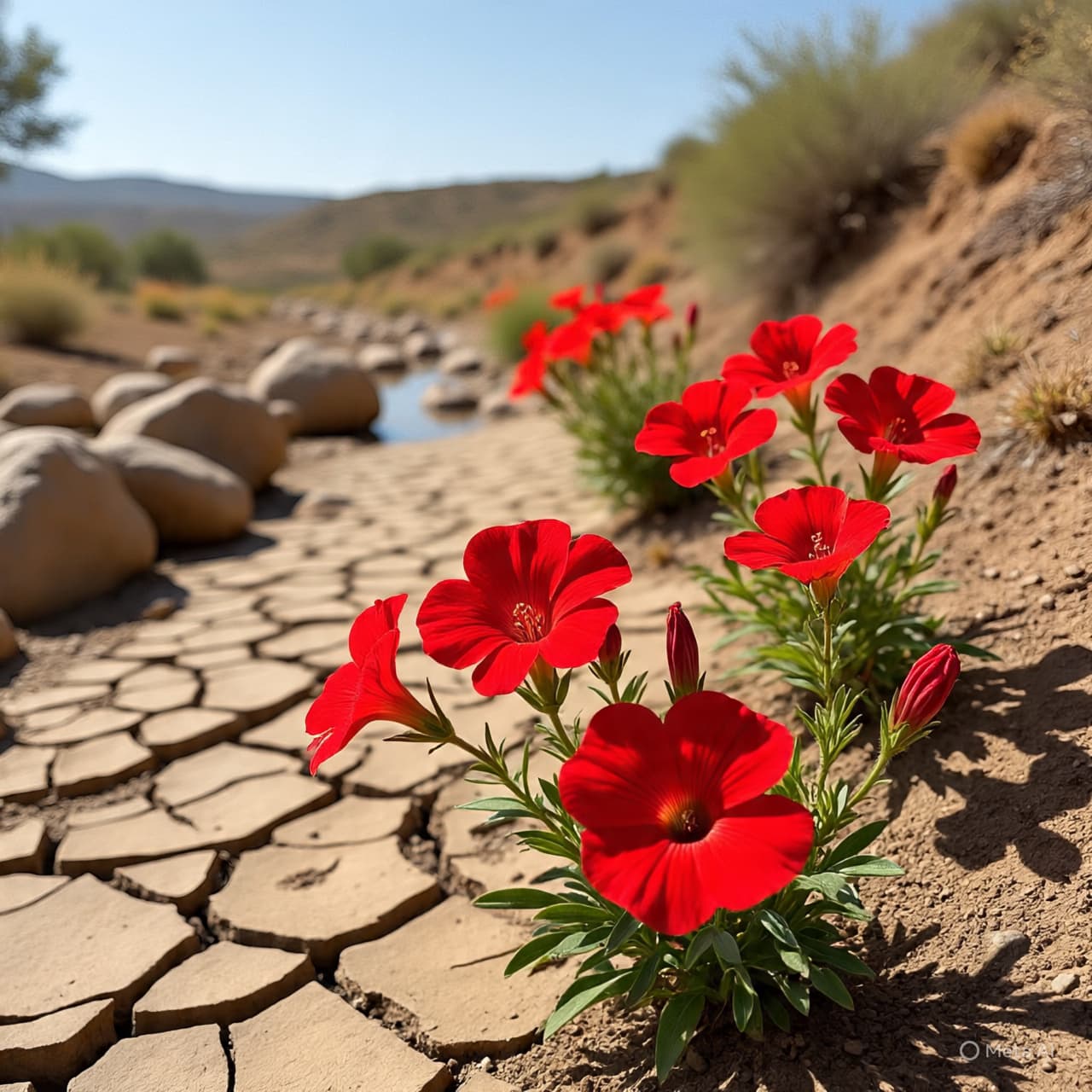
California felt such silence during the drought that stretched from 2012 to 2015. It was a drought scientists would later describe as one of the most severe in more than ten thousand years. Across hillsides and forest edges, many plants that depended on moisture began to disappear, their fragile roots unable to follow the retreating water. Among them was a small but vibrant wildflower known as the scarlet monkeyflower, a plant whose bright petals once flourished along creeks and damp soils.
For a time, it seemed that this flower, like many others, might simply fade from the landscape.
Yet nature, at times, carries within it quiet possibilities that only emerge under pressure. As researchers later discovered, some populations of the scarlet monkeyflower did not merely endure the drought—they changed in response to it. Over the course of several years, certain groups of the plant evolved traits that helped them survive with far less water than before. Scientists call this phenomenon “evolutionary rescue,” a rare process in which species adapt rapidly enough to avoid extinction when their environment shifts suddenly.
The discovery emerged from years of fieldwork and genetic analysis led by plant biologists studying monkeyflower populations along the West Coast. By comparing plants from before and after the drought, researchers identified hundreds of genetic markers associated with drought tolerance. The plants that survived and later rebounded were the ones whose genetic variations allowed them to cope with dryness more effectively.
In other words, the populations that recovered were also the populations that evolved the fastest.
This transformation was not visible in dramatic ways. The flowers still bloomed red. Their delicate forms still attracted hummingbirds and insects. But beneath those familiar petals, subtle genetic changes had begun to reshape how the plants used water, how quickly they grew, and how they endured the stress of a drier world.
The lesson emerging from this small flower reaches far beyond its creekside home. As climate change continues to reshape ecosystems around the globe, scientists have wondered whether species can adapt quickly enough to survive sudden environmental shifts. The case of the scarlet monkeyflower offers one of the clearest real-world examples that rapid adaptation can occur outside the laboratory.
Still, researchers emphasize that such resilience should not be mistaken for certainty. Not every species possesses the genetic diversity needed for rapid adaptation. Some may lack the variation that allows natural selection to act quickly. Others may face environmental changes that unfold faster than evolution can follow.
What the monkeyflower demonstrates, perhaps, is not a guarantee but a possibility—a glimpse of how life sometimes searches for new pathways when the familiar ones disappear.
Today, in parts of California where the drought once stripped moisture from the soil, these small red blooms have returned. Their presence carries a quiet message: that even in landscapes reshaped by hardship, nature may still hold unexpected strategies for survival.
And sometimes, in the space where water once flowed, a new story begins to grow.
In the end, the rediscovery of these resilient flowers offers both encouragement and caution. It suggests that adaptation can unfold more quickly than once imagined, yet it also reminds us that survival often depends on the fragile balance between environmental change and the ability of life to respond. The scarlet monkeyflower’s story is still being studied, but for now, it stands as a gentle reminder that even the smallest species can reveal surprising strength when the world around it changes.
AI Image Disclaimer Visuals are created with AI tools and are not real photographs.
Sources The Washington Post SFGATE Science Associated Press National Geographic
Published by Banx Network. This article is part of the Banx decentralized media programme, powered by the BXE token on the XRP Ledger.