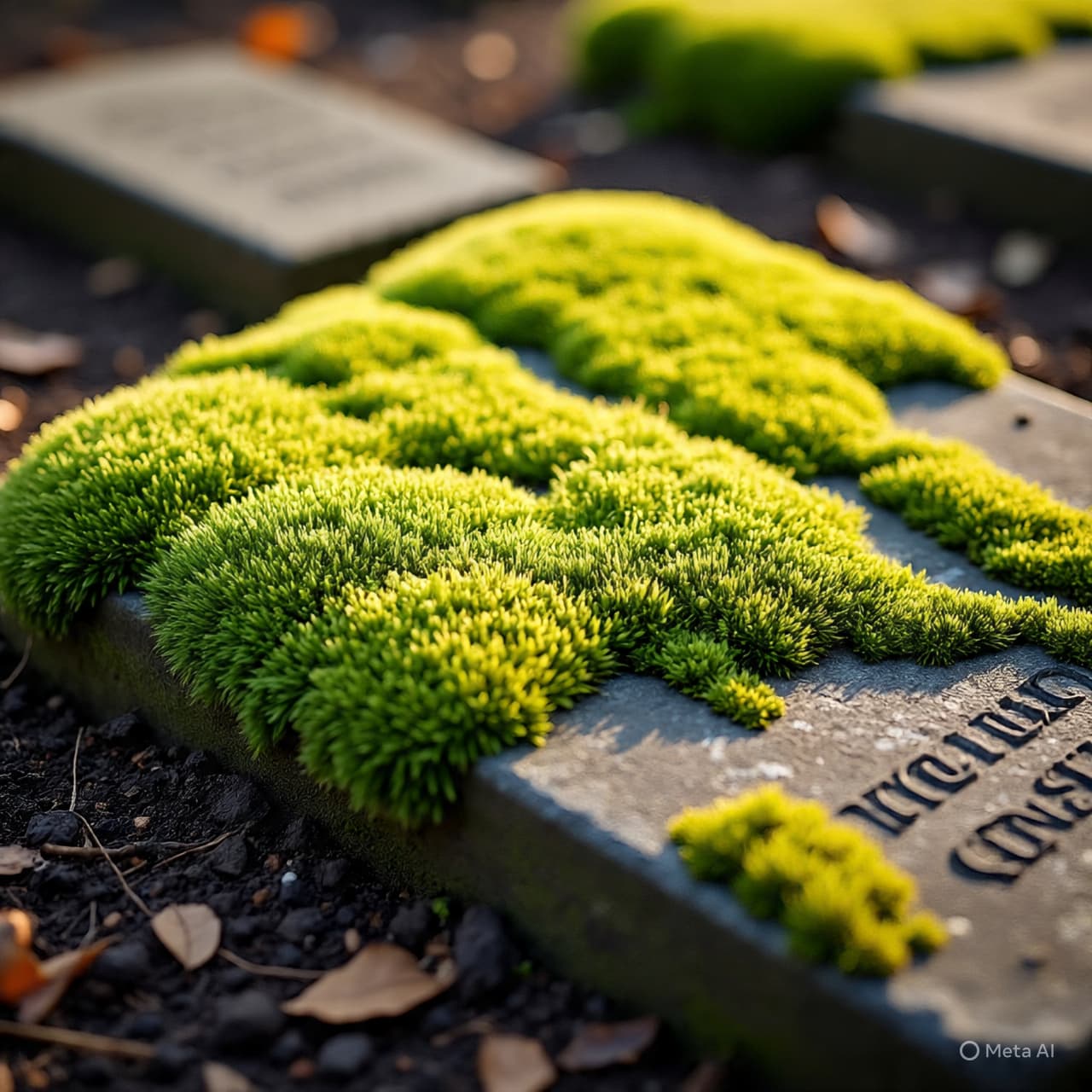
Cemeteries are places where time settles gently. Between rows of weathered headstones and quiet paths, nature continues its slow and patient work. Grass grows, leaves fall, and small patches of moss creep across stone and soil, almost unnoticed by those who pass through.
In most circumstances, such details remain part of the quiet scenery. But in one unusual criminal investigation, a small clump of moss became something more: a witness.
The case began with a discovery that startled investigators. Human remains were found in a cemetery in Germany, raising immediate questions about how the body had arrived there and who might be responsible. The location itself complicated matters. Cemeteries are places where soil is often disturbed, graves are carefully maintained, and objects are moved during burial and maintenance work.
At first, the clues were sparse. Investigators had little physical evidence linking any suspect to the site. Yet among the small traces collected during forensic analysis, scientists noticed something unusual attached to a piece of material associated with the suspect: a fragment of moss.
To many people, moss might appear interchangeable—a simple green plant that grows wherever moisture and shade allow. But to botanists and forensic specialists, moss species can be surprisingly specific about where they grow.
Each species prefers particular environmental conditions: certain soil types, humidity levels, sunlight patterns, and surrounding vegetation. In effect, moss communities often reflect the character of the place where they live.
Forensic botanists began carefully analyzing the fragment.
Under magnification, the tiny clump revealed distinctive structures that allowed researchers to identify its species. Once identified, scientists compared it with moss populations growing in different locations around the region.
The results narrowed the possibilities dramatically.
The species found on the suspect’s item was known to grow in only a limited number of areas nearby, including the cemetery where the body had been discovered. Further comparison showed that the moss matched specimens from the exact section of the cemetery connected to the investigation.
What might have seemed like an ordinary piece of plant life suddenly carried evidentiary weight.
When presented alongside other forensic findings, the moss helped place the suspect at the scene during a crucial period. The plant fragment effectively served as a botanical fingerprint, linking a person to a location that investigators had struggled to prove.
The case has since become an example frequently cited in forensic science discussions. It highlights the expanding role of environmental evidence—tiny traces from soil, pollen, plants, or insects—that can quietly preserve details about where an object or person has been.
Forensic botany itself is not new. Researchers have long used plant growth patterns to estimate time of death or to reconstruct events at outdoor crime scenes. But cases involving moss are particularly rare, largely because these small plants are often overlooked during evidence collection.
Yet moss possesses qualities that make it surprisingly useful. It grows slowly, forms distinctive communities, and often attaches firmly to surfaces. When fragments break away, they can travel with clothing, shoes, or equipment.
In that sense, moss behaves almost like a silent passenger, moving unnoticed until careful examination reveals its origin.
Scientists say the case underscores the importance of collaboration between investigators and specialists from many fields. In modern forensic work, evidence does not always arrive in obvious forms. Sometimes it appears as a grain of soil, a microscopic fiber—or a tiny clump of green plant life.
Nature, after all, records the passage of events in countless subtle ways.
In the quiet setting of a cemetery, where moss slowly spreads across stone and earth, one such fragment preserved a story that might otherwise have remained hidden. By listening closely to that small detail, investigators were able to reconstruct part of a crime that once seemed difficult to explain.
The case stands as a reminder that in forensic science, even the smallest witness can speak—if someone knows how to listen.
AI Image Disclaimer Visuals are created with AI tools and are not real photographs.
Sources Smithsonian Magazine The Washington Post The Guardian BBC News Forensic Science International
Published by Banx Network. This article is part of the Banx decentralized media programme, powered by the BXE token on the XRP Ledger.