

Key Highlights
- Primordial black holes may have existed in the early universe, influencing matter creation.
- These tiny black holes could have ended their lives in explosive bursts, reshaping the cosmos.
- The theory builds on Hawking radiation, suggesting a link between black holes and the dominance of matter.
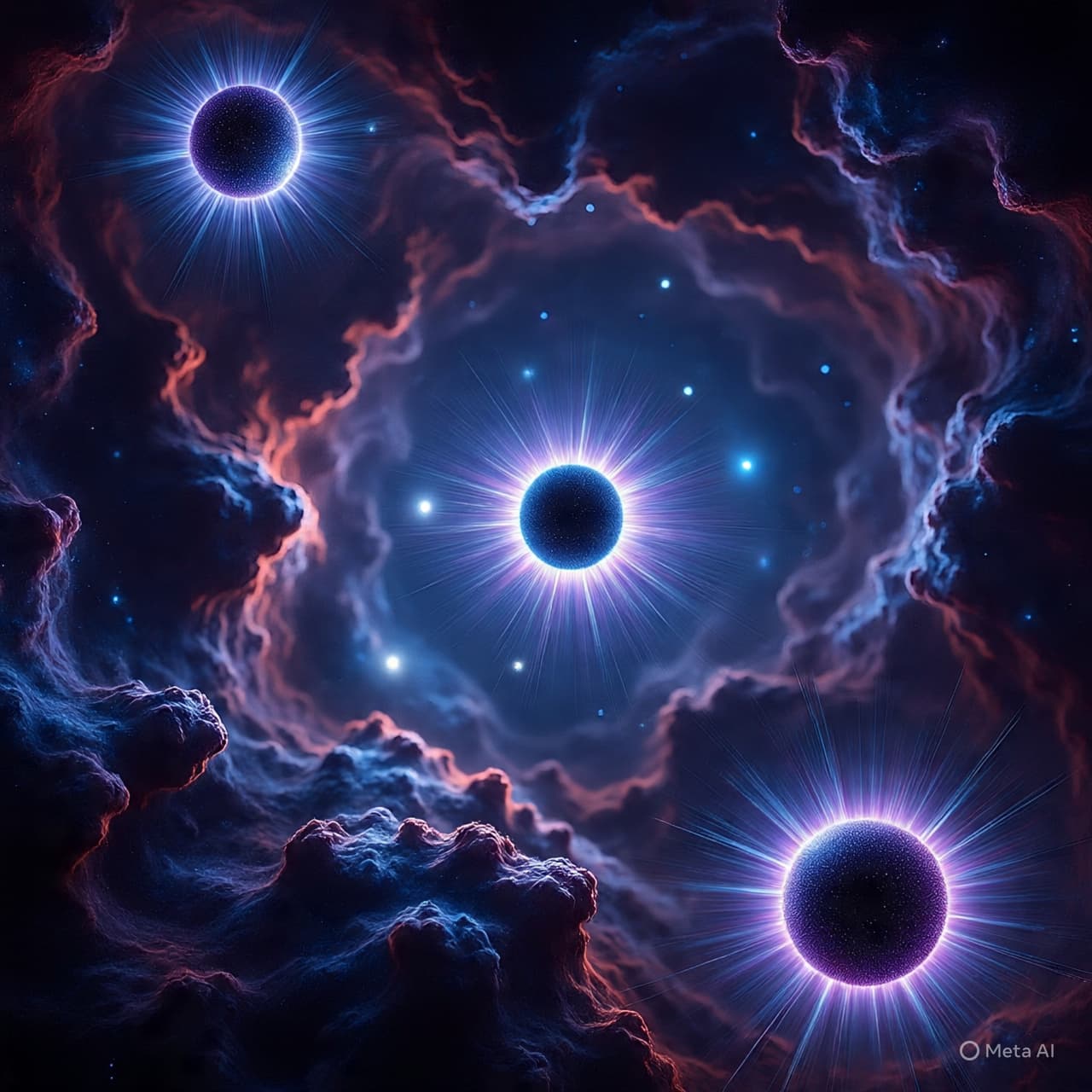
In the earliest moments of the universe, before stars flickered into existence and galaxies took shape, there may have been a different kind of presence—small, fleeting black holes, born from density fluctuations in a newborn cosmos. These primordial black holes, unlike the massive ones we observe today, were tiny, unstable, and perhaps destined to vanish almost as quickly as they appeared.
Yet, their disappearance may not have been silent. According to new theoretical research, these ancient objects could have ended their lives in bursts of energy so intense that they reshaped the very fabric of the universe. In doing so, they may have contributed to the creation of all matter as we know it.
The idea builds upon the concept of Hawking radiation, a process through which black holes lose mass over time. For primordial black holes, which were far smaller than stellar ones, this process would have been rapid. As they evaporated, they would release enormous amounts of energy in a final explosive phase. Scientists now suggest that these explosions could have produced fundamental particles in abundance. In the dense, hot environment of the early universe, such events might have tipped the balance, influencing how matter came to dominate over antimatter—a mystery that continues to puzzle physicists.
If true, this theory offers a new lens through which to view our cosmic origins. Rather than matter emerging solely from smooth, uniform processes, it may have been shaped by violent, localized events—tiny black holes flaring out of existence, seeding the universe with the building blocks of reality. The research remains theoretical, grounded in complex mathematical models rather than direct observation. Detecting evidence of primordial black holes is extraordinarily challenging, as none are believed to exist today in their original form. Their traces, if any, would be subtle, embedded in cosmic background radiation or particle distributions.
Still, the idea resonates because it bridges two profound concepts: the nature of black holes and the origin of matter itself. It suggests that something often associated with destruction might also play a role in creation—a paradox that lies at the heart of modern physics. There are, of course, competing explanations. Other theories propose different mechanisms for matter’s dominance, from asymmetries in fundamental forces to processes during cosmic inflation. The role of primordial black holes is one possibility among many, not yet confirmed.
Yet, as researchers continue to refine their models and gather data, the possibility lingers. It invites us to imagine a universe where even the briefest phenomena leave lasting imprints, where fleeting black holes might have shaped everything we see today. In that sense, the study does not just ask how the universe began—it asks whether its earliest moments were quieter or more dramatic than we have ever imagined.
Published by Banx Network. This article is part of the Banx decentralized media programme, powered by the BXE token on the XRP Ledger.




