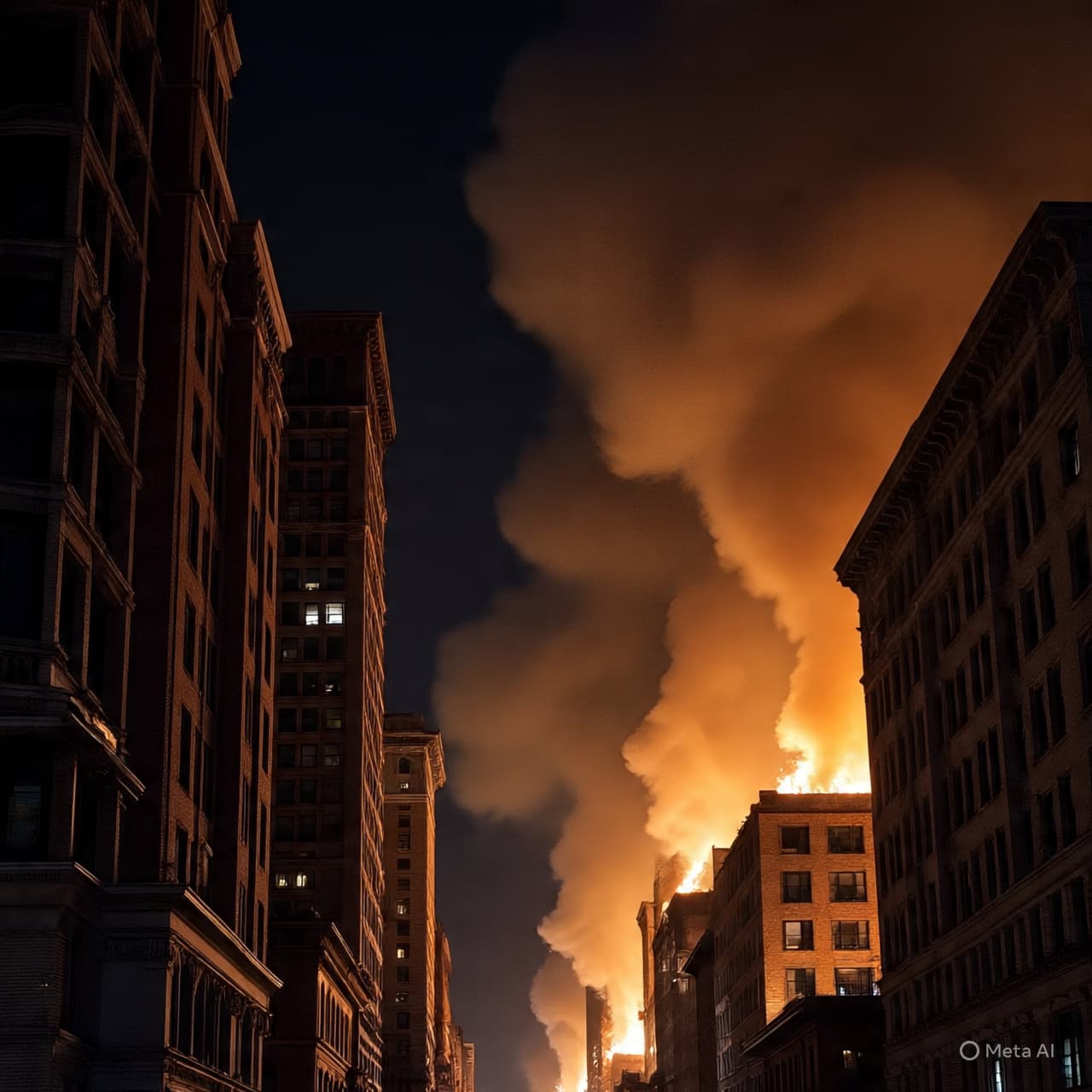
Hong Kong is a city defined by its vertical ambition—glass towers, stacked homes, and neighborhoods that rise toward the clouds as if racing daylight itself. But on a recent night, the skyline glowed with an unfamiliar intensity as a major fire swept through a cluster of residential high-rises, marking the city’s strongest blaze in seventeen years. What is normally a tapestry of neon and windows became streaked with smoke, panic, and the sharp urgency of survival.
The buildings housed roughly four thousand residents, many of whom awoke to alarms, shouts, and the disorienting orange sheen that fills hallways long before flames reach them. High-rise fires carry a particular kind of dread—not only because of their scale, but because escape routes are narrow, predictable, and often shared. Every door that opens becomes a decision. Every staircase becomes a gamble.
Emergency crews battled the blaze through dense smoke layers that rose like a second façade across the city’s silhouette. From the ground, residents watched their own homes flicker in and out of visibility, swallowed by heat and shadow. High-rises can feel invincible on an ordinary day, anchored by steel and concrete. Yet in moments like these, they reveal their fragility—structures meant to hold thousands suddenly depending on the precision of every hose line and every breath taken inside the smoke.
Fires in dense urban environments carry emotional weight beyond their physical damage. They test not only infrastructure but the quiet rhythms of community living. In Hong Kong, where apartments stack like drawers in a towering cabinet, people share walls, airshafts, routines, and stories. A disaster unfolding vertically can ripple horizontally through entire neighborhoods, reminding residents how tightly wound their lives are to one another.
As the flames were eventually contained, the aftermath took on a more complex glow: relief mixed with exhaustion, gratitude threaded through uncertainty. Residents sifted through what remained—some belongings intact, others lost to heat and soot. Yet beneath the tangible losses lay a deeper reflection about life in a city defined by density: how quickly danger can travel upward, and how resilience must travel just as fast.
The fire will be studied, timelines reconstructed, and responses measured. But for the people who lived through it, the memory will linger as a night when the skyline burned—not as a spectacle, but as a reminder that even the safest-feeling heights can be vulnerable. Still, cities have a way of healing, especially ones used to moving forward in tight spaces. Hong Kong’s lights will settle back into their familiar pattern, but with a renewed clarity about the fragile balance that holds so many lives above the harbor.
Published by Banx Network. This article is part of the Banx decentralized media programme, powered by the BXE token on the XRP Ledger.