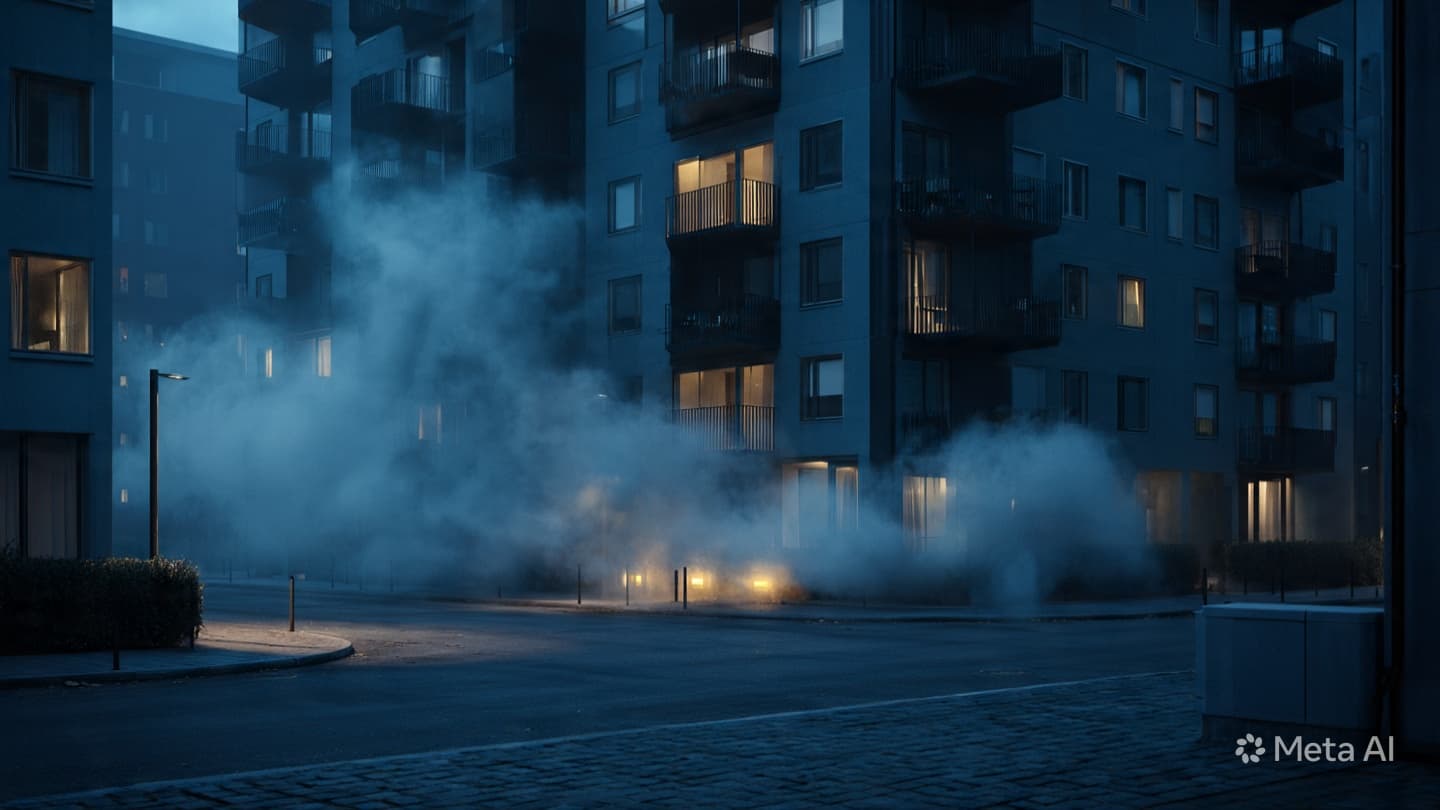
The night over the residential districts traditionally offers a quiet closure to the day’s anxieties, wrapping the multi-story apartment complexes and tree-lined avenues in a predictable, soft stillness. In these neighborhoods, safety is understood as the warmth of an interior light and the familiar hum of the city settling into its late-night routine. It is a fragile sanctuary, built on the assumption that the roof above will remain a reliable barrier against the shifting elements of the wider world.
Yet, the modern sky increasingly behaves as an unpredictable landscape, carrying mechanical forces that can break apart in an instant far above the earth. On a recent evening, the quiet skyline became the backdrop for a dramatic aerial encounter, as defensive measures met an incoming threat in the high atmosphere. The resulting destruction did not arrive as a singular, direct impact, but as a slow, widely scattered shower of burning metal fragments that drifted down upon the sleeping neighborhoods below.
The transition from a distant explosion to an immediate, localized crisis happens with a strange and disorienting speed. As the burning fragments pierced the canopy of the trees and struck the roofs of residential structures, multiple fires erupted simultaneously across several separate districts. The air, which had been crisp and clear, was suddenly thick with the acrid scent of burning insulation, melting asphalt, and the sharp, urgent calls of neighbors checking on one another in the dark.
To observe the aftermath of such widespread debris is to understand a reality where the very acts of protection carry their own complicated, heavy consequences for those on the ground. The damage is not concentrated in one tragic crater, but distributed across a wide urban geography—a burning vehicle in one courtyard, a collapsed roof in another, and a shattered balcony miles away. These fragments combine to create a collective narrative of vulnerability that touches multiple households at once.
The response of the municipal fire crews and volunteer networks began under the fading glow of the emergency sirens, their vehicles maneuvering through the narrow residential lanes with a practiced, somber urgency. Working against the clock to contain the scattered blazes before they could merge into larger conflagrations, the emergency workers hauled hoses up darkened stairwells and cleared burning debris from the sidewalks. It is an exhausting, methodical labor performed by men and women whose faces are quickly blackened by the soot of their surroundings.
The technological and tactical dimensions of aerial interceptions are frequently analyzed in the detached language of military strategy and air defense efficiency metrics discussed in faraway capitals. On the ground, however, those abstractions dissolve into the immediate, practical reality of a family watching their living room burn or a neighborhood working together to douse a flaming fragment in a communal garden. The true measure of the night is found in the resilience of those who must sweep up the ash.
By the early morning hours, the fires had been brought under control, leaving the affected districts to wake up under a heavy, gray shroud of smoke and damp soot. The residents emerged into the cool air to assess the physical toll on their blocks, their movements quiet and deliberate as they began the familiar task of clearing away the metal shards and boarding up exposed windows.
Municipal emergency management services confirmed that falling missile debris from overnight interceptions caused widespread fires and structural damage across multiple residential districts. Local authorities reported that while air defense units successfully neutralized the primary threats, the scattered fragments struck several apartment buildings and parked vehicles, necessitating a large-scale deployment of firefighting units to stabilize the affected civilian sectors.
Published by Banx Network. This article is part of the Banx decentralized media programme, powered by the BXE token on the XRP Ledger.