In the quiet after sunset, when daylight loosens its hold and the sky exhales into indigo, there are evenings that feel like whispered invitations. The horizon dims, and for a few fleeting moments, the universe arranges itself into a delicate composition — not loud, not demanding, but quietly precise. On Feb. 19, just such a scene unfolds, as a razor-thin crescent moon slips into view beside the steady glow of Saturn, offering skywatchers a brief and gentle spectacle.
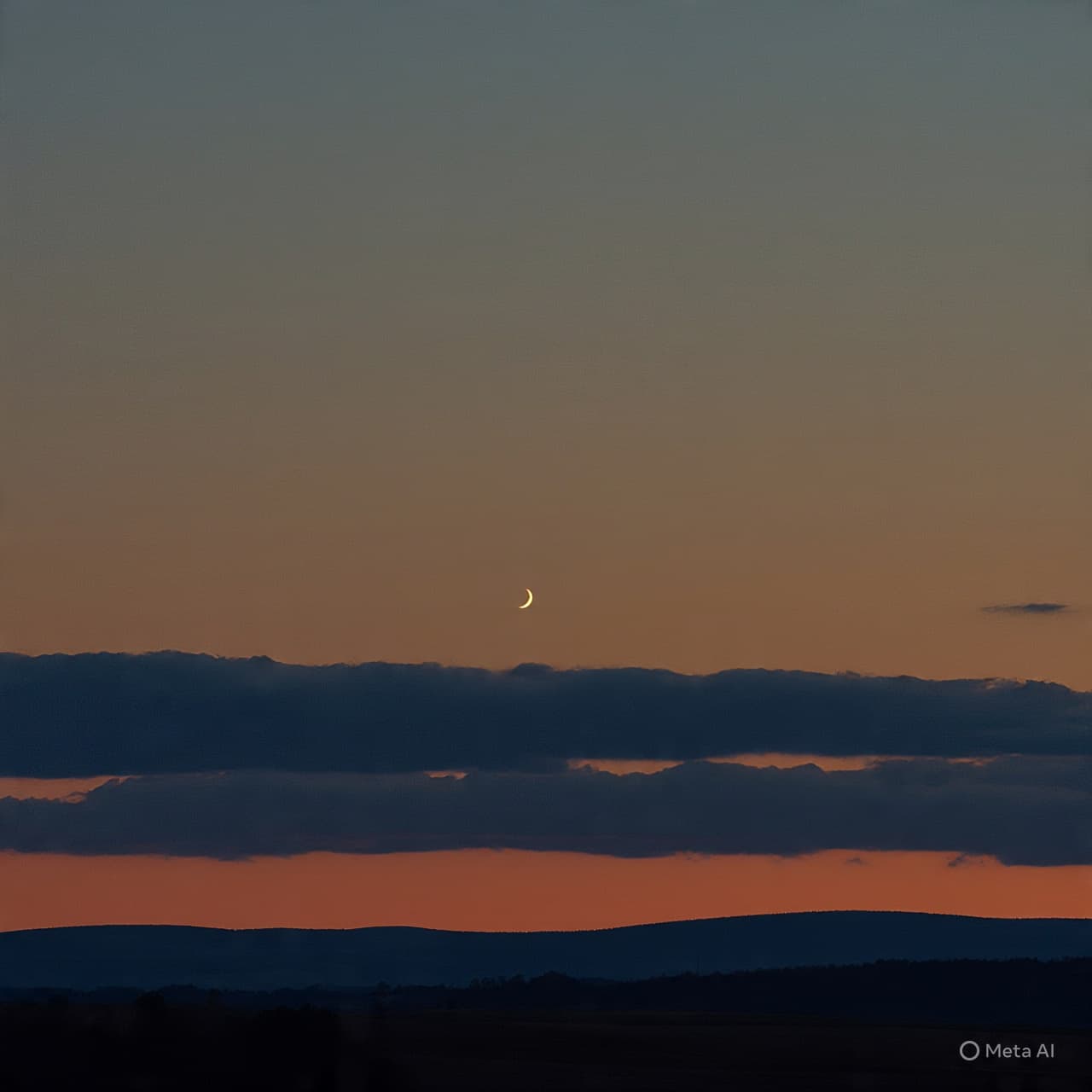
The crescent moon, only days past new, appears as a fine silver arc suspended low in the western sky. Its illuminated edge — slender as a brushstroke — reflects sunlight from a steep angle, leaving most of its surface cloaked in shadow. Sometimes, attentive observers may even glimpse “earthshine,” the faint glow that softly outlines the moon’s darker side, illuminated by sunlight bouncing off Earth’s oceans and clouds.
Nearby, Saturn stands as a calm companion. Unlike the moon’s changing face, Saturn’s light is steady and patient, a pale golden point that does not twinkle as stars often do. Though its iconic rings remain invisible to the naked eye, the planet’s presence is unmistakable. Through binoculars or a small telescope, Saturn transforms from a bright dot into a miniature world, hinting at its grandeur far beyond what the eye alone can perceive.
The pairing is known as a conjunction — an apparent close approach of two celestial bodies in the sky. While the moon and Saturn remain separated by millions of miles in space, from Earth they appear momentarily side by side, as though engaged in a quiet conversation. Such alignments are not rare in astronomical terms, yet each carries its own charm because of timing, angle, and the delicate phase of the moon.
Visibility will depend on local weather and a clear western horizon. Observers are encouraged to look shortly after sunset, before the duo sinks below the skyline. The window is brief — often less than an hour — as both moon and planet follow the sun beneath the horizon. Urban viewers may need an unobstructed view free of tall buildings or trees, while rural skies may offer a more expansive stage.
For those who miss this encounter, the rhythm of the sky continues. The moon will grow fuller in the days that follow, climbing higher each evening, while Saturn slowly shifts position along the ecliptic. The cosmos, after all, moves in cycles — patient, predictable, yet always capable of inspiring wonder.
On Feb. 19, the sky offers a small reminder: beauty does not always arrive in spectacle. Sometimes, it comes as a slender crescent and a distant planet sharing the twilight, visible to anyone willing to pause and look westward.
AI Image Disclaimer
Images in this article are AI-generated illustrations, meant for concept only.
Source Check: Credible coverage and skywatch guidance available from:
1. Space.com 2. NASA 3. Sky & Telescope 4. EarthSky 5. TimeandDate.com
Published by Banx Network. This article is part of the Banx decentralized media programme, powered by the BXE token on the XRP Ledger.