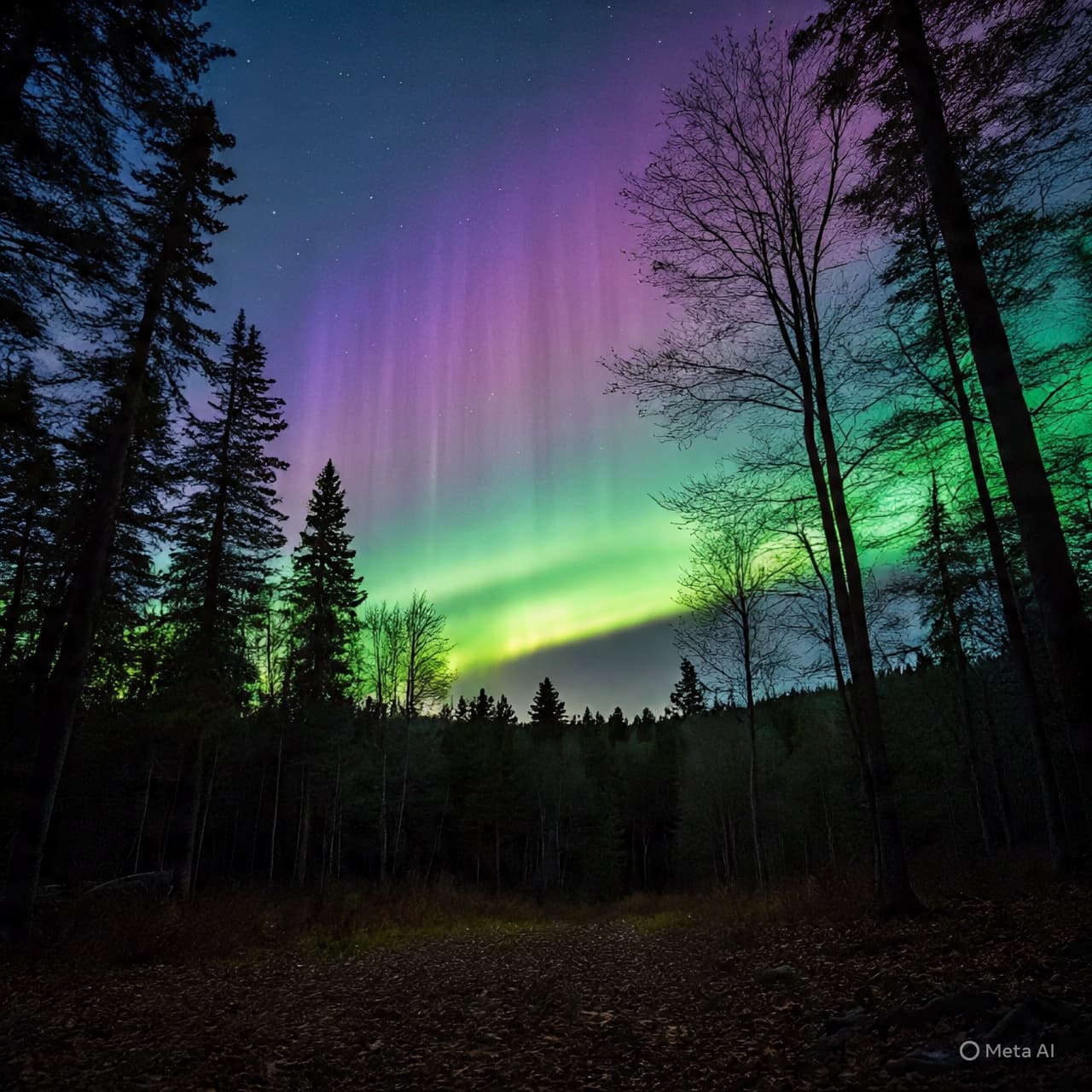
There are evenings when the sky behaves as it always has—dark, steady, familiar. And then there are rare nights when something quieter yet far more mysterious unfolds. High above the atmosphere, invisible currents from the Sun begin a slow journey toward Earth. By the time they arrive, they do not speak with sound but with color, brushing the sky with soft ribbons of green and violet.
This weekend may offer one of those gentle spectacles. Astronomers and space weather forecasters say increased solar activity could bring the aurora borealis—the Northern Lights—into view across parts of the northern United States.
The event is linked to a minor geomagnetic storm, triggered by a stream of fast-moving solar wind flowing from a coronal hole on the Sun’s surface. When these charged particles reach Earth, they interact with the planet’s magnetic field, funneling energy toward the polar regions and igniting shimmering curtains of light in the upper atmosphere.
Under these conditions, the glow of the aurora may drift slightly farther south than usual. Forecasts suggest that several U.S. states near the Canadian border could have the clearest chance of seeing the display.
Among the locations most likely to glimpse the phenomenon are Alaska, Washington, Idaho, Montana, North Dakota, South Dakota, Minnesota, Wisconsin, Michigan, and Maine. In these regions, observers may see faint arcs or waves of light appearing low on the northern horizon, especially if skies remain clear and dark.
Even beyond these states, the sky occasionally surprises. When geomagnetic activity intensifies, faint auroras can sometimes be seen in places slightly farther south, though visibility becomes less certain. Much depends on cloud cover, darkness, and the strength of the solar particles reaching Earth.
Timing, too, plays its quiet role. Experts note that the most favorable viewing window generally falls between 10 p.m. and 2 a.m. local time, when Earth’s night side is most directly facing the incoming solar wind. Away from city lights, with a wide northern horizon and patient eyes, the chances improve.
This period of the year carries its own subtle advantage. As the March equinox approaches, Earth’s magnetic field aligns in a way that can make geomagnetic disturbances more effective at producing auroras. Scientists sometimes refer to this seasonal effect as a reason why spring and autumn often host some of the year’s most vivid light displays.
Yet the aurora remains a phenomenon of both science and uncertainty. Forecasts can estimate the likelihood of geomagnetic storms and solar wind streams, but the final performance in the sky depends on many moving parts—from magnetic orientation to atmospheric clarity.
For those who step outside tonight or tomorrow evening, the experience may be quiet and subtle rather than dramatic. The aurora often begins as a faint green haze, almost like distant twilight returning briefly to the night. But occasionally it strengthens, forming arcs, waves, or curtains that ripple slowly across the stars.
In the end, the forecast is less a promise than an invitation. If the skies cooperate and the solar wind arrives just as predicted, some parts of northern America may witness the familiar yet always surprising dance of light above the horizon.
And for a few hours this weekend, the conversation between the Sun and Earth may once again become visible.
AI Image Disclaimer Visuals are created with AI tools and are not real photographs.
Source Check (Credible Media) Credible sources reporting the increased Northern Lights activity this weekend do exist. Examples include:
BBC Sky at Night Magazine Space.com People Magazine Live Science The New York Post
Published by Banx Network. This article is part of the Banx decentralized media programme, powered by the BXE token on the XRP Ledger.