
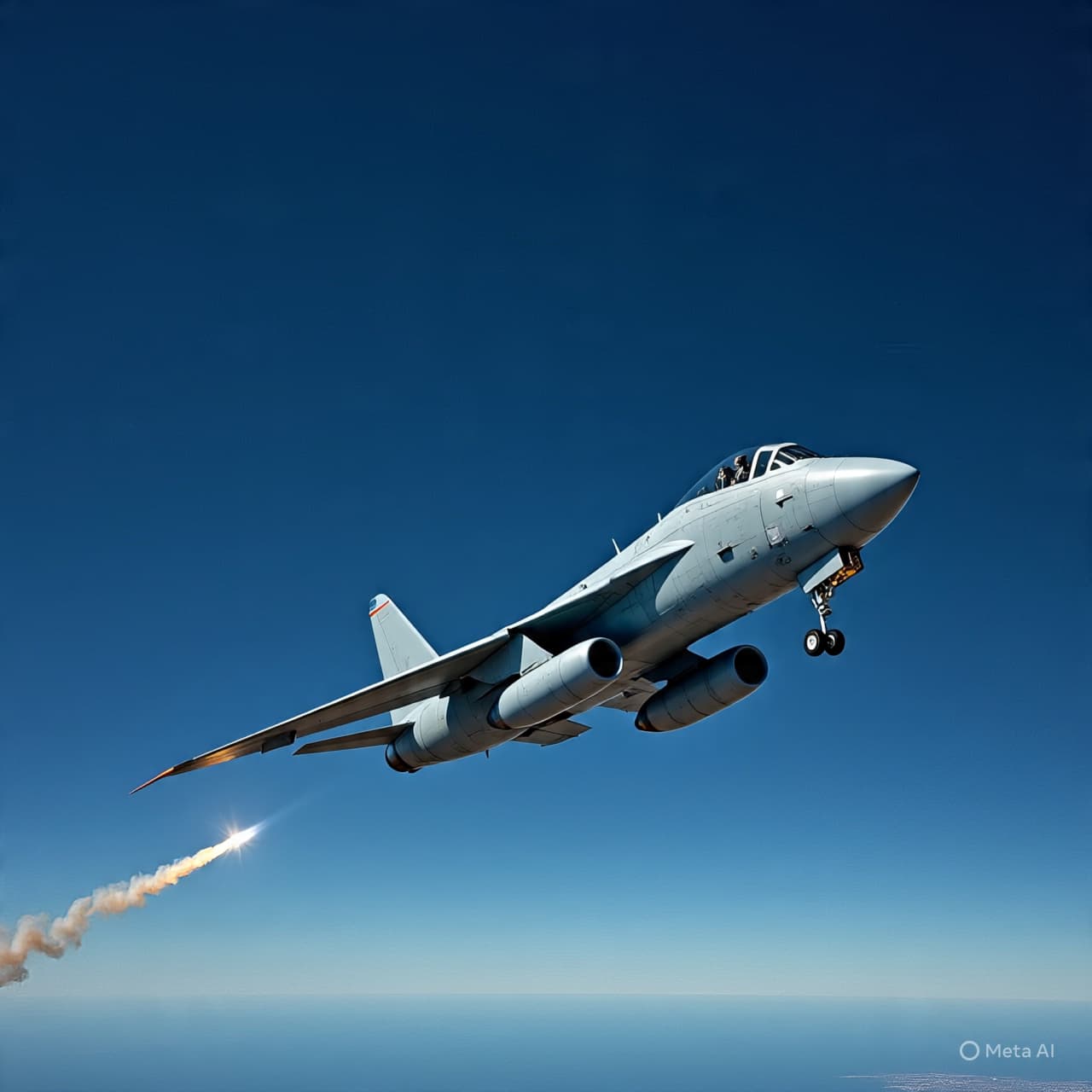
There are moments in history when even the most watchful guardians falter, not from neglect, but from the quiet unpredictability of the world they were built to observe. High above the shifting lines of tension, where machines hum with vigilance and precision, the illusion of invulnerability often lingers—soft, unspoken, but deeply believed. And yet, like a lighthouse facing an unexpected storm, even the brightest beam can flicker.
The recent damage to an E-3 Sentry—an aircraft long regarded as one of the most sophisticated airborne early warning systems—feels less like a single incident and more like a subtle shift in the balance between visibility and vulnerability. Designed to see far beyond the horizon, to detect threats before they materialize, the aircraft represents not just technology, but trust: trust in systems, in preparation, and in the idea that foresight can outpace danger.
Reports indicate that the aircraft suffered severe damage following a missile strike attributed to Iranian forces. The E-3 Sentry, often described as the “eye in the sky,” is not merely an aircraft but a moving command center, capable of coordinating vast operational theaters. Its large rotating radar dome, iconic in silhouette, has long symbolized awareness—an assurance that little escapes its gaze. But in this instance, awareness met its own limits.
What makes the loss particularly striking is not only the cost—financially, these aircraft represent billions in investment—but the symbolic weight they carry. When a platform designed to detect threats becomes one itself, the narrative shifts. It is no longer just about defense capabilities, but about the evolving nature of modern conflict, where speed, precision, and unpredictability converge in ways that challenge even the most advanced systems.
In many ways, this event echoes a broader pattern seen across recent conflicts: the gradual narrowing of the gap between offense and defense. Missile technology has grown more precise, more adaptive, and increasingly capable of targeting high-value assets once thought to be relatively secure. The sky, once considered a domain of relative advantage for such platforms, now feels more contested, more uncertain.
Still, it would be too simple to view this as a singular failure. Systems like the E-3 Sentry operate within complex networks, supported by layers of intelligence, coordination, and contingency planning. One damaged aircraft does not erase decades of operational success, nor does it diminish the strategic role these platforms continue to play. Rather, it invites reflection—a moment to reassess assumptions, to refine strategies, and to quietly adapt.
There is also a human dimension often left unspoken. Behind every aircraft are crews, planners, engineers—individuals who trust not only the machinery, but each other. Incidents like this ripple outward, touching not just military calculations but the broader sense of stability and predictability that such systems are meant to uphold.
As details continue to emerge, the focus will likely turn toward implications: operational adjustments, technological upgrades, and the recalibration of risk. These are the quiet mechanics of response, unfolding away from headlines but shaping what comes next.
In the end, the story of the damaged E-3 Sentry is not only about loss, but about transition. It reminds us that even the most advanced tools exist within an ever-changing landscape, where certainty is rare and adaptation is constant. And in that space—between what is seen and what is yet to unfold—the sky remains both a domain of watchfulness and a mirror of uncertainty.
AI Image Disclaimer
Visuals are created with AI tools and are not real photographs.
Source Check (Credible Media Scan) Reuters Associated Press BBC News CNN Al Jazeera
Published by Banx Network. This article is part of the Banx decentralized media programme, powered by the BXE token on the XRP Ledger.
.jpg&w=3840&q=75 "US Declares Drought Disaster for Parts of Puerto Rico as Dry Conditions Persist")
