The universe is often perceived as a static canvas, but in reality, it is a dynamic theater of motion and transformation. Our own galaxy, the Milky Way, has not always spun in its current graceful orientation. Recent astronomical findings suggest that roughly ten billion years ago, a violent encounter with a smaller dwarf galaxy caused our cosmic home to flip upside down. This revelation invites us to reconsider the stability of our celestial neighborhood and appreciate the turbulent history written in the stars.
Body: The discovery stems from detailed analysis of stellar movements and chemical compositions within the Milky Way’s halo. Astronomers have long known that galaxies grow by merging with smaller neighbors, but the specific mechanics of these collisions are often obscured by time. By mapping the orbits of ancient stars, researchers identified a distinct pattern indicating a major disruption event that altered the galaxy’s angular momentum.
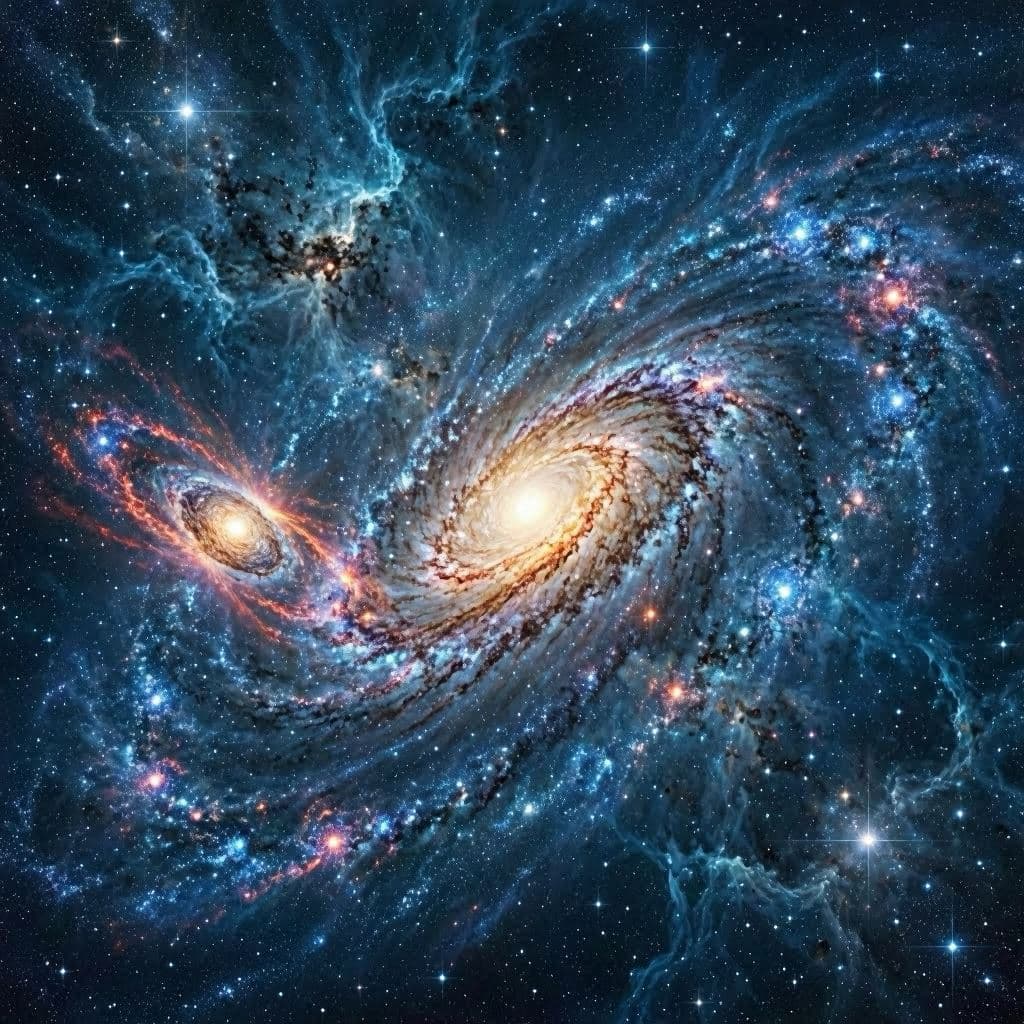
The culprit appears to be a dwarf galaxy, now largely absorbed into the Milky Way’s structure. This smaller companion, though modest in size compared to our spiral giant, possessed enough gravitational influence to destabilize the disk. The collision did not merely add mass; it torqued the entire system, causing the plane of the galaxy to invert relative to its previous orientation. Such an event would have been catastrophic for any existing structures, reshaping the distribution of gas and dust.
This "flip" occurred during a formative period in the universe’s history, when galaxy formation was still a chaotic process. The energy released during the merger would have triggered bursts of star formation, lighting up the sky with new suns. For observers at that time, the night sky would have looked dramatically different, with familiar constellations drifting into new configurations over millions of years.
Understanding this ancient upheaval helps explain certain anomalies in the Milky Way’s current structure, such as the warped shape of its outer disk. It also provides context for the distribution of dark matter, which plays a crucial role in holding galaxies together during such violent interactions. The evidence suggests that what we see today is the calm after a storm that raged billions of years ago.
The study highlights the power of modern observational tools, which allow scientists to look back in time by analyzing the light from distant stars. Each star acts as a fossil record, preserving information about its origin and movement. By piecing together these individual stories, astronomers can reconstruct the grand narrative of galactic evolution with increasing precision.
While the idea of our galaxy flipping may seem disorienting, it underscores the resilience of cosmic structures. The Milky Way survived the collision and continued to evolve, eventually forming the stable spiral arm where our solar system resides. This history reminds us that stability is often the result of past chaos, and that change is the only constant in the cosmos.
Closing: As we gaze up at the Milky Way tonight, we are looking at a galaxy that has endured a dramatic transformation. The discovery of its ancient flip adds a layer of depth to our understanding of cosmic history, revealing a past marked by violence and renewal. It is a testament to the enduring nature of the universe, which continues to reveal its secrets to those who look closely.
AI Image Disclaimer: The visuals accompanying this article are AI-generated artistic interpretations of galactic collisions and stellar formations, designed to illustrate the concept of cosmic evolution.
Sources: Nature Astronomy Space.com NASA Goddard Space Flight Center Scientific American
Published by Banx Network. This article is part of the Banx decentralized media programme, powered by the BXE token on the XRP Ledger.