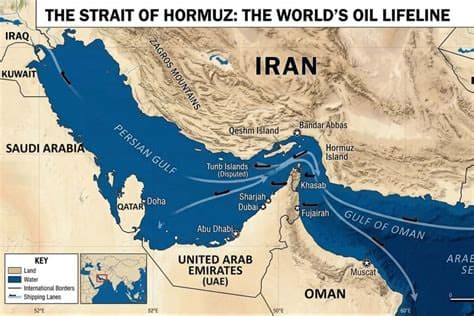
There are moments in history when the sky itself seems to speak—though not in words, but in flashes of light that cut through the quiet. In such moments, nations pause, not always in unison, but in shared awareness that something fragile has been disturbed. The recent reports of missile launches attributed to Iran toward multiple countries—Israel, Kuwait, Jordan, and Bahrain—arrive like distant thunder, not yet fully understood, but impossible to ignore.
The Middle East has long been a landscape where tension moves like shifting sand—never entirely still, yet rarely erupting without warning. This latest development, however, carries a different resonance. The reported trajectory of missiles across multiple borders suggests not just a singular message, but a widening circle of signal and response. It is less a point of conflict, and more a ripple spreading outward.
Governments in the targeted regions have responded with heightened alertness. Defense systems were activated, airspaces monitored, and statements released with careful wording—firm, yet measured. In Israel, long accustomed to the language of aerial threats, the response leaned on readiness and resilience. In Kuwait, Jordan, and Bahrain, where such direct trajectories are less frequent, the tone reflected both caution and concern, as if listening closely for what might follow.
What makes this moment particularly delicate is not only the act itself, but the context in which it unfolds. The region is already layered with overlapping tensions—political, strategic, and historical. Like threads pulled too tightly, each new action risks tightening the weave further, leaving less room for flexibility and more for fracture.
Yet even in such circumstances, there remains an undercurrent of restraint. International voices have begun to call for de-escalation, not with urgency alone, but with a kind of quiet insistence. Diplomacy, though often overshadowed in moments like this, continues to move behind the scenes—less visible, but no less significant.
The question that lingers is not only why this has happened, but what it intends to shape. Is it a demonstration of capability, a message of deterrence, or a signal within a larger, more complex dialogue? In regions marked by long memory, actions rarely stand alone; they are part of a continuum, understood not only in the present, but through the echoes of the past.
For civilians across these nations, the experience is more immediate. The sound of sirens, the flicker of alerts, the uncertainty that follows—these are not abstractions, but lived realities. And yet, life continues, as it often does, moving forward with a cautious awareness that the ground beneath may shift again.
In the end, the skies grow quiet once more. But silence, in such times, is not always an absence of sound. It is often a pause—a space in which decisions are weighed, responses considered, and futures quietly shaped. Whether this moment becomes a turning point or a passing tremor will depend not only on what has been launched, but on what is chosen next.
AI Image Disclaimer
Visuals are created with AI tools and are not real photographs.
Source Check
Credible mainstream / niche media covering developments involving Iran and regional missile tensions:
Reuters
Al Jazeera
BBC News
The New York Times
The Guardian
Published by Banx Network. This article is part of the Banx decentralized media programme, powered by the BXE token on the XRP Ledger.