Some moments arrive once and disappear forever. Others, more rarely, return — as if the sky itself is keeping a memory.
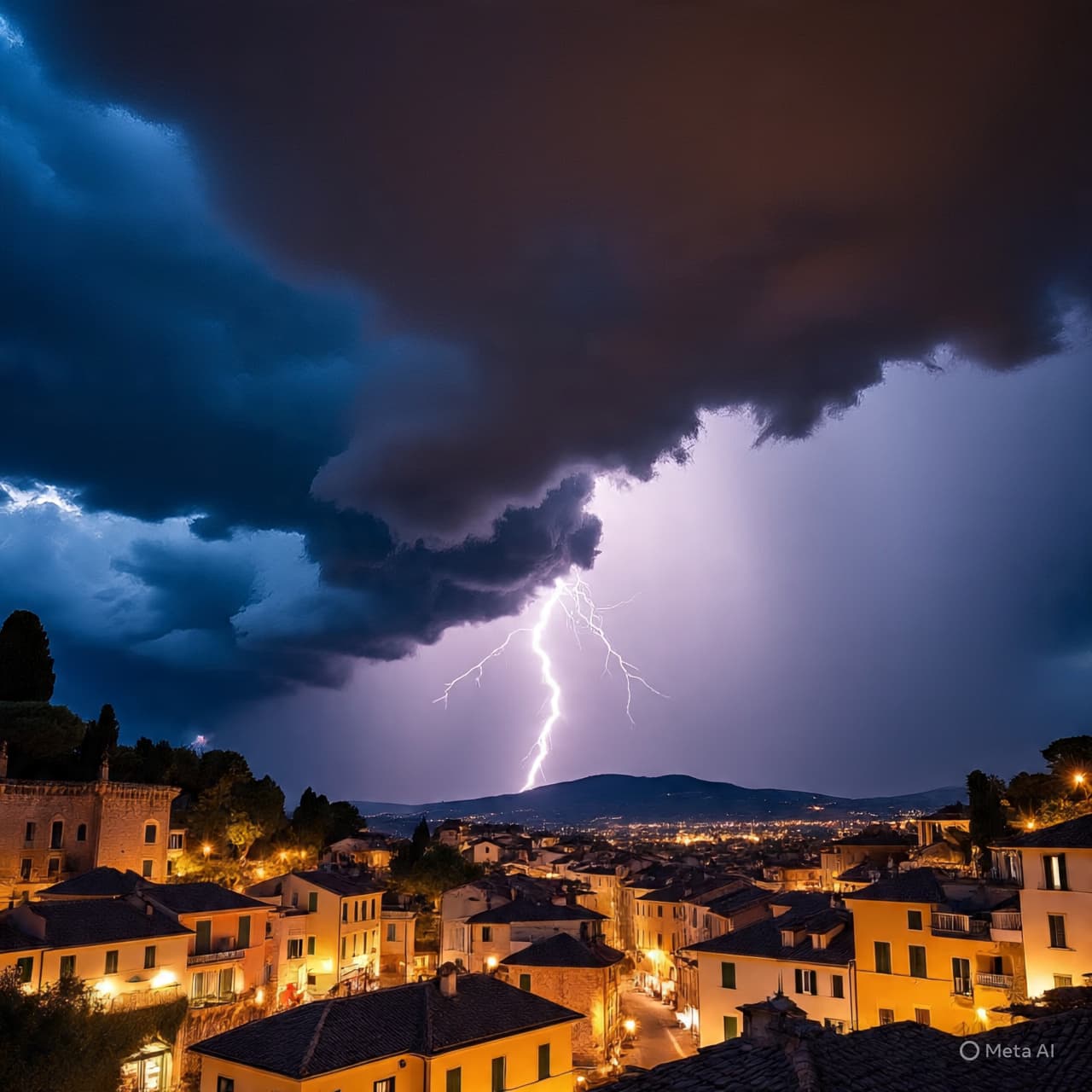
Over a small Italian town, a photographer has captured an extraordinary luminous event for the second time, recording a rare atmospheric phenomenon that few ever witness, let alone photograph twice. The image shows a delicate yet powerful glow stretching across the night sky, suspended between Earth and space, neither lightning nor aurora in the familiar sense.
The event belongs to a category of upper-atmospheric light phenomena that occur far above thunderstorms, often invisible to the naked eye and lasting only fractions of a second. These luminous flashes are known to science, but they remain unpredictable, fleeting, and difficult to document with precision.
What makes this capture remarkable is not only its clarity, but its repetition. The same photographer, in the same location, has now documented the phenomenon twice — an outcome that borders on statistical improbability. Atmospheric scientists note that such events depend on a precise alignment of weather systems, electrical activity, altitude, and viewing conditions.
The glow itself appears as a vertical or slightly curved structure, colored in soft reds and purples, rising high above storm clouds. Though visually striking, it carries no threat. Instead, it represents the release of electrical energy upward, toward the edge of space, rather than downward to the ground.
Researchers continue to study why certain regions occasionally produce these displays more than once, and whether local geography or storm behavior plays a role. Each high-quality image helps refine models of how Earth’s atmosphere moves energy between layers.
Photography has become an unexpected partner in this science. Advances in digital sensors, long exposures, and persistent sky-watchers have dramatically increased the number of documented events in recent years. Still, repeat observations by the same individual remain extremely rare.
For the photographer, the experience is described less as a pursuit and more as patience rewarded. Nights pass with nothing unusual. Then, without warning, the sky opens briefly — and closes again.
Science will continue to analyze the light in terms of physics and probability. But for the town beneath it, the moment carries a quieter meaning: a reminder that even familiar skies can surprise, and sometimes, they choose to do so twice.
Published by Banx Network. This article is part of the Banx decentralized media programme, powered by the BXE token on the XRP Ledger.