In the quiet hours before sunrise, orchards often feel like places of gentle patience. Rows of cherry trees stretch beneath the morning sky, their branches heavy with fruit that farmers have spent months nurturing. Yet within these peaceful landscapes, a subtle tension has long existed between agriculture and the wildlife that shares the same fields.
Birds, drawn by the promise of sweet fruit, frequently descend upon orchards in flocks. For generations, cherry farmers have watched as these visitors pecked at ripening crops, sometimes leaving behind fruit that could no longer be sold or safely processed. What appears to be a small nibble in the orchard can create larger concerns once the harvest reaches markets and consumers.
In recent years, however, some farmers have discovered an unexpected ally in the effort to protect both crops and food safety. The solution does not arrive in the form of machines or chemicals, but on wings.
Falcons.
Across several cherry-growing regions in North America, farmers have begun working with trained falcons and professional falconers to discourage flocks of smaller birds from settling in orchards. The idea is both ancient and surprisingly modern. Falconry, the centuries-old practice of hunting with trained birds of prey, has been reimagined as a natural form of agricultural protection.
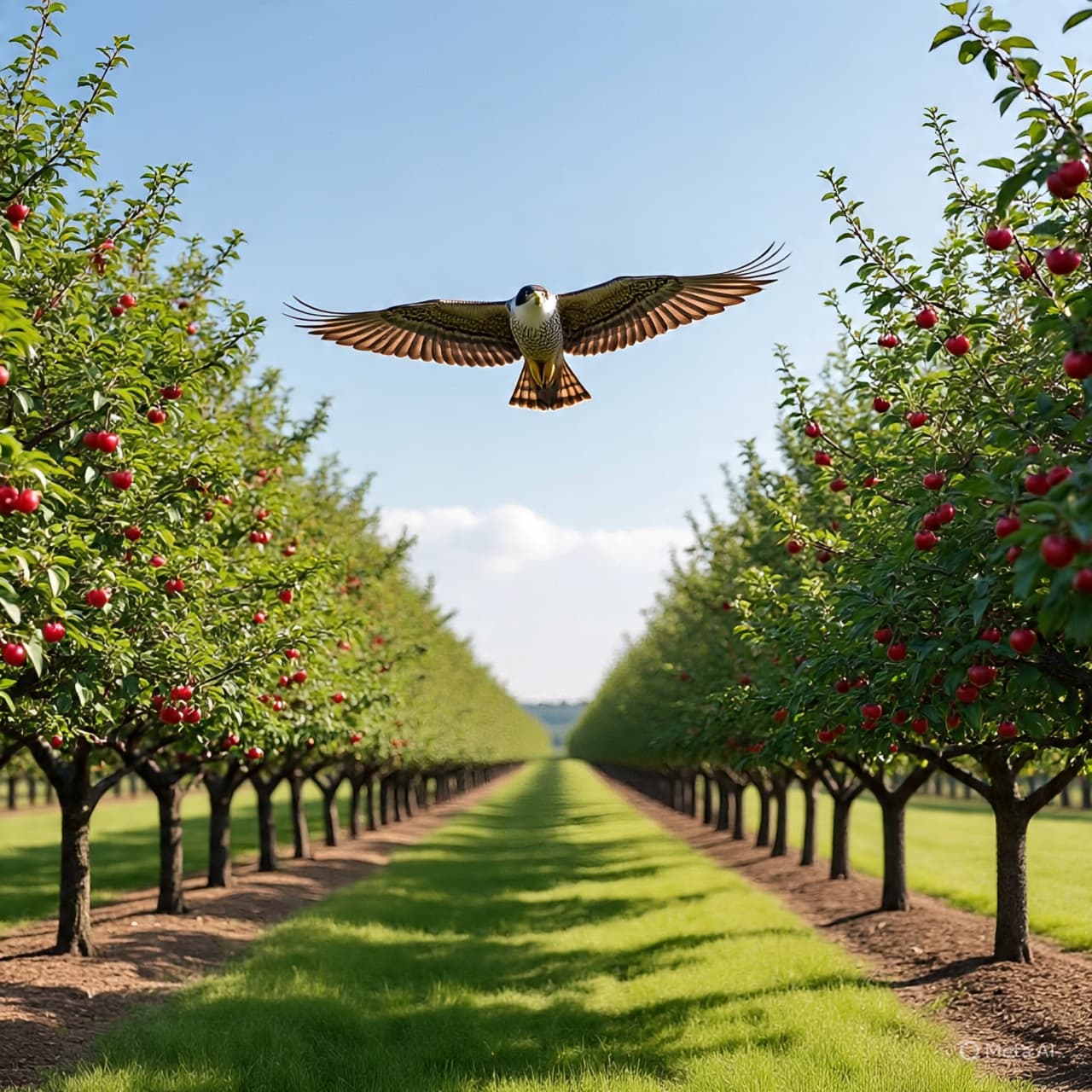
The presence of a falcon soaring above an orchard sends a clear signal through the avian community. Smaller birds, including starlings and other species known to feed on fruit, instinctively recognize the silhouette of a predator. Even when the falcon rarely engages in an actual hunt, its mere presence can persuade flocks to avoid the area altogether.
For cherry farmers, the effect can be immediate. Instead of relying solely on netting, noise cannons, or reflective devices, they introduce a living deterrent that interacts naturally with the ecosystem.
Yet the benefits extend beyond protecting the fruit itself. Food safety has become an increasingly important concern in modern agriculture, particularly for crops eaten fresh. When birds feed in orchards, they can sometimes leave behind droppings that may carry pathogens. Even a small amount of contamination can lead to strict food safety responses, including rejected shipments or costly recalls.
By discouraging large flocks from gathering in orchards, falcons help reduce this risk. Fewer birds mean fewer opportunities for contamination, allowing farmers to maintain cleaner growing environments during the crucial weeks leading up to harvest.
Falconers typically visit orchards regularly throughout the season, releasing their birds to patrol the skies above the trees. The routine flights help reinforce the sense that the orchard is already claimed territory. Over time, many smaller birds learn to seek food elsewhere rather than challenge the presence of a predator.
For growers, the arrangement represents a blend of tradition and sustainability. Unlike some deterrent technologies that birds may gradually learn to ignore, a falcon remains unpredictable. Each flight is slightly different, maintaining the natural tension that keeps flocks at a distance.
The approach also aligns with a broader movement in agriculture toward environmentally conscious pest management. Instead of relying heavily on mechanical or chemical methods, farmers are exploring solutions that work with ecological relationships already present in nature.
The use of birds of prey in farming is not entirely new. Similar strategies have been used at airports to prevent birds from entering flight paths and at landfills where large flocks gather. But its growing role in fruit orchards reflects a wider appreciation for how natural predators can help maintain balance in shared landscapes.
For the falconers themselves, the work offers a unique connection between ancient skills and modern agricultural needs. Many describe the experience as a careful partnership—between bird, handler, and farmer—all working toward the same goal of protecting the harvest.
As harvest season approaches each year, the sight of a falcon gliding above rows of cherry trees has become an increasingly familiar one in some orchards. Its shadow passing briefly across the leaves may seem like a small moment in the vast choreography of nature.
Yet within that moment lies a quiet collaboration between human cultivation and wild instinct.
And sometimes, it appears, the safest harvest may come not only from the work done on the ground, but also from the watchful wings circling above.
AI Image Disclaimer Illustrations were produced with AI and serve as conceptual depictions.
Sources Associated Press The Washington Post NPR Smithsonian Magazine Modern Farmer
Published by Banx Network. This article is part of the Banx decentralized media programme, powered by the BXE token on the XRP Ledger.