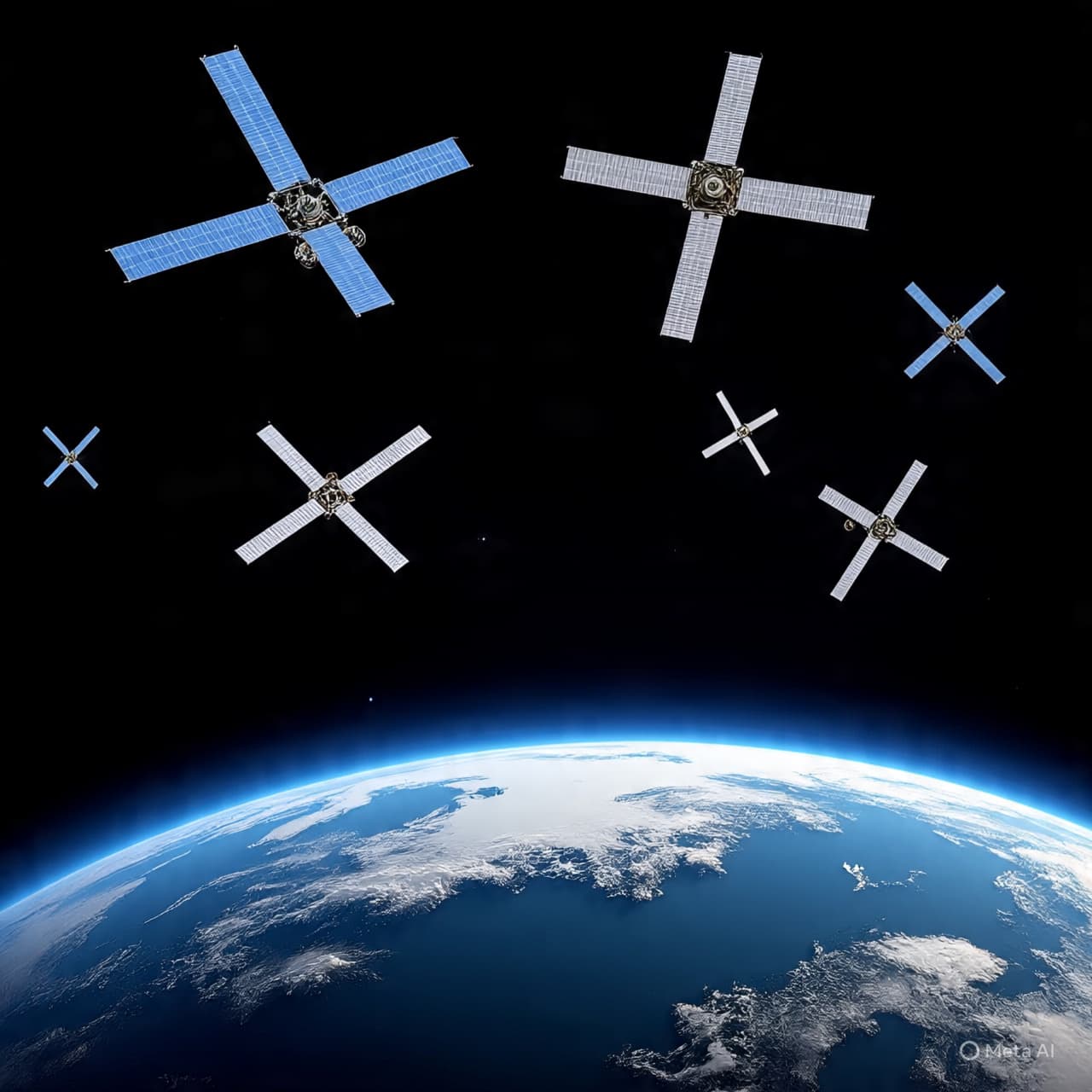
At dusk, the sky can appear empty, a vast blue fading into indigo. Yet above that calm gradient, traffic has grown dense and restless. Tiny machines trace invisible paths in low Earth orbit, glinting briefly in sunlight before slipping back into shadow. The modern space race does not always roar like its predecessor; often, it hums — a steady deployment of satellites launched by governments and private companies alike. Still, some scientists now warn that if this momentum accelerates unchecked, the atmosphere itself could begin to resemble what one researcher called a “crematorium for satellites.”
The phrase is not poetic for its own sake. It refers to the growing number of spacecraft that, after years of service, reenter Earth’s atmosphere and burn up. As constellations expand — from communications networks to Earth-observation fleets — so too does the cycle of launch, orbit, decay, and fiery descent. Companies such as , through its constellation, and initiatives like have placed thousands of satellites into orbit, with more planned in the years ahead.
Most satellites are designed to disintegrate upon reentry, a safety measure intended to prevent debris from reaching the ground. But researchers studying atmospheric chemistry suggest that the cumulative effect of frequent reentries could introduce new variables into the upper layers of the atmosphere. When satellites burn, they release aluminum oxides and other particles. While current levels are considered manageable, some atmospheric scientists caution that an exponential rise in satellite traffic could alter high-altitude chemistry in ways not yet fully understood.
The renewed competition extends beyond commercial networks. National space agencies, including and its counterparts in Europe and Asia, continue to launch scientific missions, defense assets, and exploratory probes. Meanwhile, emerging spacefaring nations seek to secure orbital positions as markers of technological and strategic presence. The result is a crowded orbital environment — one that must accommodate not only active satellites but also aging hardware and fragments of past missions.
Experts note that the atmosphere has long served as a protective veil, absorbing meteors and dissipating debris. Yet human-made objects are different in composition and scale. Studies published in recent years have examined whether metallic particles from reentering satellites could affect ozone chemistry or contribute to long-term atmospheric changes. The science remains evolving, and there is no consensus that catastrophe is imminent. What is clear, however, is that orbital expansion now intersects with environmental stewardship.
Regulators and international bodies are increasingly discussing debris mitigation guidelines, deorbit timelines, and sustainable satellite design. Proposals range from stricter end-of-life protocols to improved tracking systems that reduce collision risk in orbit. The challenge is global: satellites circle without regard to national borders, and their remnants disperse across shared skies.
For now, the night sky still offers familiar constellations, though streaked more often by moving points of light. Each launch represents ambition — connectivity for remote regions, data for climate monitoring, precision for navigation. Yet ambition carries residue. If the next phase of the space race multiplies the number of objects returning through the atmosphere, the cumulative burn could leave traces not immediately visible to those watching from below.
The warning of a “crematorium for satellites” is less a prediction than a prompt — an invitation to weigh innovation against impact. The upper atmosphere may seem distant, but it is part of the same fragile envelope that sustains life. As rockets rise and satellites fall, the question lingers in the thinning air: how many cycles of ascent and fire can the sky quietly absorb?
Published by Banx Network. This article is part of the Banx decentralized media programme, powered by the BXE token on the XRP Ledger.