Air travel is built on invisible lines.
Across the globe, aircraft trace quiet arcs over oceans and deserts, stitching continents together with steady precision. At cruising altitude, borders dissolve into cloud patterns and coastlines blur into memory. Yet when those invisible lines are abruptly erased, the stillness can be felt thousands of miles away.
In the wake of escalating hostilities across the Middle East, sweeping airspace closures have left hundreds of thousands of travelers stranded, diverted, or suspended mid-journey. From major hubs in Dubai and Doha to transit gateways in Istanbul, London, and Singapore, departure boards shifted in rapid succession — “Delayed,” then “Diverted,” then simply “Canceled.” Flights en route were rerouted across longer corridors; some turned back entirely, circling toward the cities they had only just left.
Civil aviation authorities across multiple countries announced temporary closures of key airspace sectors after missile launches and defensive interceptions created uncertainty along established flight paths. Airlines responded with caution, suspending routes through portions of Iran, Iraq, Israel, Jordan, and parts of the Gulf. For long-haul carriers connecting Europe and Asia, the closures disrupted some of the world’s busiest aviation corridors, forcing detours that added hours of fuel, cost, and fatigue.
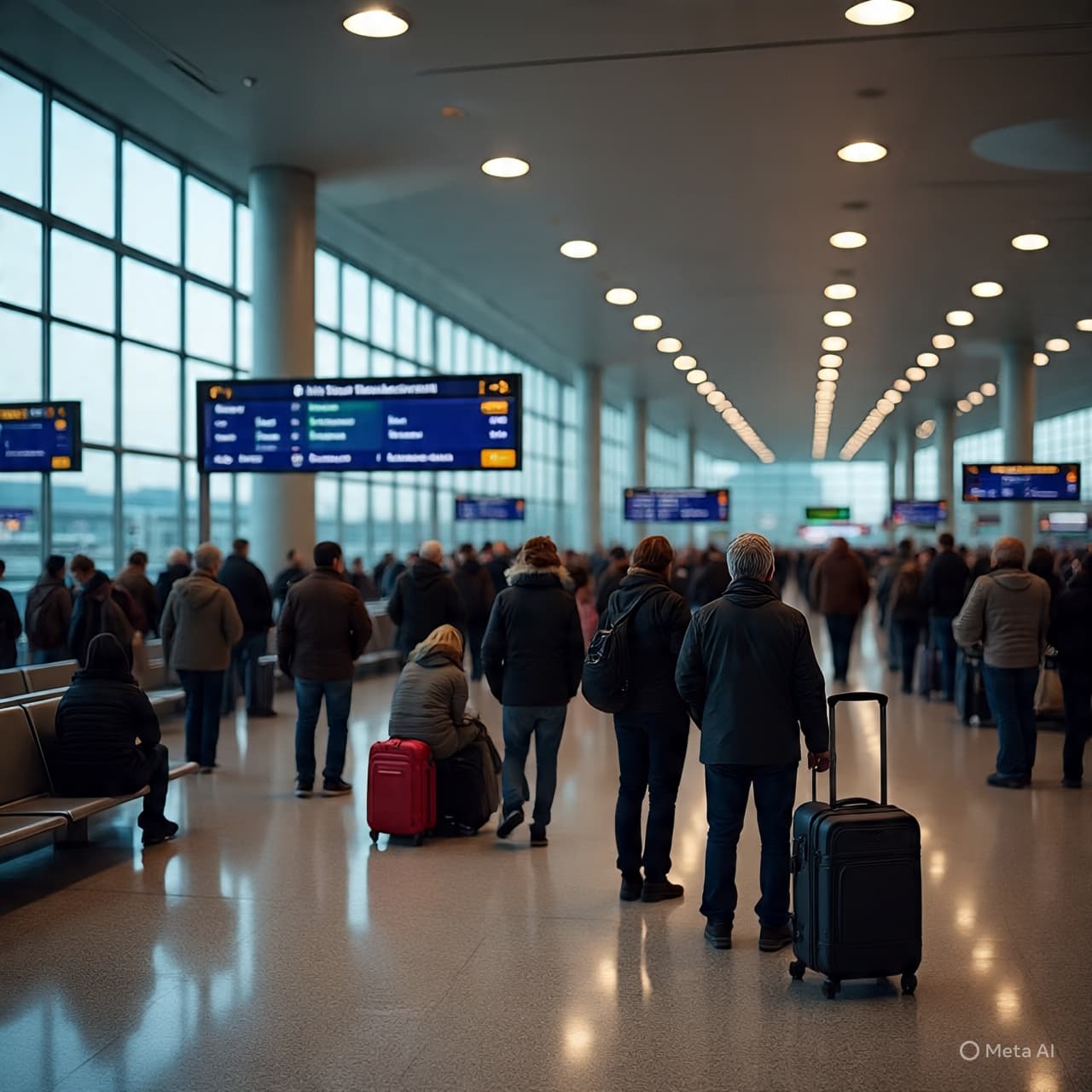
The numbers quickly became striking. Industry analysts estimated that hundreds of thousands of passengers were affected within the first 48 hours alone. Aircraft idled at gates in regional hubs, while others landed in alternate cities far from their intended destinations. Pilots announced diversions with measured calm; cabin crews moved through aisles offering reassurance. On the ground, terminal floors transformed into temporary waiting rooms, lined with suitcases and quiet endurance.
Governments issued updated travel advisories, urging citizens to reconsider non-essential travel to affected areas. Embassies advised nationals to monitor airline communications and prepare for extended delays. Insurance providers fielded inquiries about coverage amid conflict-related disruptions. Meanwhile, cargo shipments — pharmaceuticals, electronics, perishable goods — slowed as freight carriers recalculated routes through safer corridors.
Financial markets reacted to the aviation disruption alongside concerns over energy transit, particularly near the Strait of Hormuz. Oil prices fluctuated as traders weighed the risks of prolonged instability. Shipping companies and insurers reassessed exposure, mindful that air and sea lanes often echo one another in moments of tension.
Yet inside airports, life unfolded in quieter tones. Families huddled near charging stations, children sleeping against backpacks. Business travelers improvised meetings in lounge corners. Airline staff — the steady diplomats of global motion — worked counter to counter, printing revised itineraries and explaining weather maps that were not about storms but about strategy.
Airspace closures are designed as precaution, officials emphasized, not permanence. Military and civil aviation authorities coordinated in real time to assess risk levels and reopen corridors when deemed secure. Gradually, some routes resumed with revised paths arcing wide of contested zones. Others remained suspended, reminders that the sky, for all its vastness, can narrow quickly.
As evening light spreads across terminal windows, aircraft tails line the tarmac in patient formation. The choreography of departure is paused but not forgotten. The world remains connected — by fiber optics, by sea lanes, by memory — even when its flight paths falter.
For travelers caught between origin and arrival, the disruption is immediate and personal. A missed wedding. A postponed conference. An unexpected night in transit. Yet the broader pause carries a subtler meaning: it reveals how deeply interwoven global movement has become, and how swiftly that movement can be reshaped by events far beyond the departure gate.
Eventually, the invisible lines will be redrawn. Routes will curve differently for a time, then perhaps return to familiar arcs. Departure boards will glow again with confident destinations. But for now, beneath ceilings of steel and glass, there is a shared stillness — a reminder that even the most routine journeys depend on calm skies overhead.
AI Image Disclaimer Visuals are AI-generated and serve as conceptual representations.
Sources Reuters Associated Press BBC News Financial Times International Air Transport Association
Published by Banx Network. This article is part of the Banx decentralized media programme, powered by the BXE token on the XRP Ledger.