Airports are built on precision — arrivals measured to the minute, departures aligned with weather, air corridors drawn across maps like invisible highways. When skies close, even briefly, that careful choreography shifts. Screens update. Announcements repeat. Travelers pause mid-journey, listening for guidance as routes are redrawn above them.
In recent days, rising tensions between Iran and Israel have contributed to heightened uncertainty across parts of the region’s airspace. Reports of military exchanges and subsequent safety assessments led several aviation authorities to review flight paths, with some corridors temporarily adjusted or closed as precautionary measures. The evolving situation has prompted responses far beyond the immediate zone of conflict, touching global travel networks that connect continents daily.
In India, officials at Indira Gandhi International Airport in India issued advisories to passengers as airlines monitored rerouted flights and potential delays linked to Middle Eastern airspace restrictions. The guidance emphasized checking with carriers for updated schedules, as international routes often pass through or near affected corridors. Airport authorities noted that operational adjustments were being coordinated with airlines to ensure passenger safety and clarity.
Delhi’s airport, one of the busiest in South Asia, serves as a central hub for long-haul travel between Europe, the Middle East, and Asia-Pacific destinations. When regional airspace changes occur, ripple effects can extend to connecting flights, baggage transfers, and crew rotations. Airlines typically respond by revising flight paths, which may increase travel time or alter arrival windows. In such circumstances, communication becomes as important as navigation — with digital notices, airline alerts, and airport advisories working together to keep passengers informed.
The broader aviation industry relies on continuous coordination between national authorities, air traffic controllers, and international organizations. When tensions rise in any corridor, safety assessments guide decisions about temporary closures or adjustments. These measures are designed to minimize risk while maintaining as much continuity as possible. For travelers, the impact may appear as longer routes or revised boarding times, but behind the scenes, operational teams recalibrate schedules in real time.
As the Middle East remains under close international attention, governments and aviation regulators continue to evaluate developments. Airspace management is a shared responsibility, and changes in one region can influence global traffic flows. In response, airlines often issue travel advisories, rebook passengers, and provide assistance for affected itineraries. The emphasis remains on safety, transparency, and steady updates.
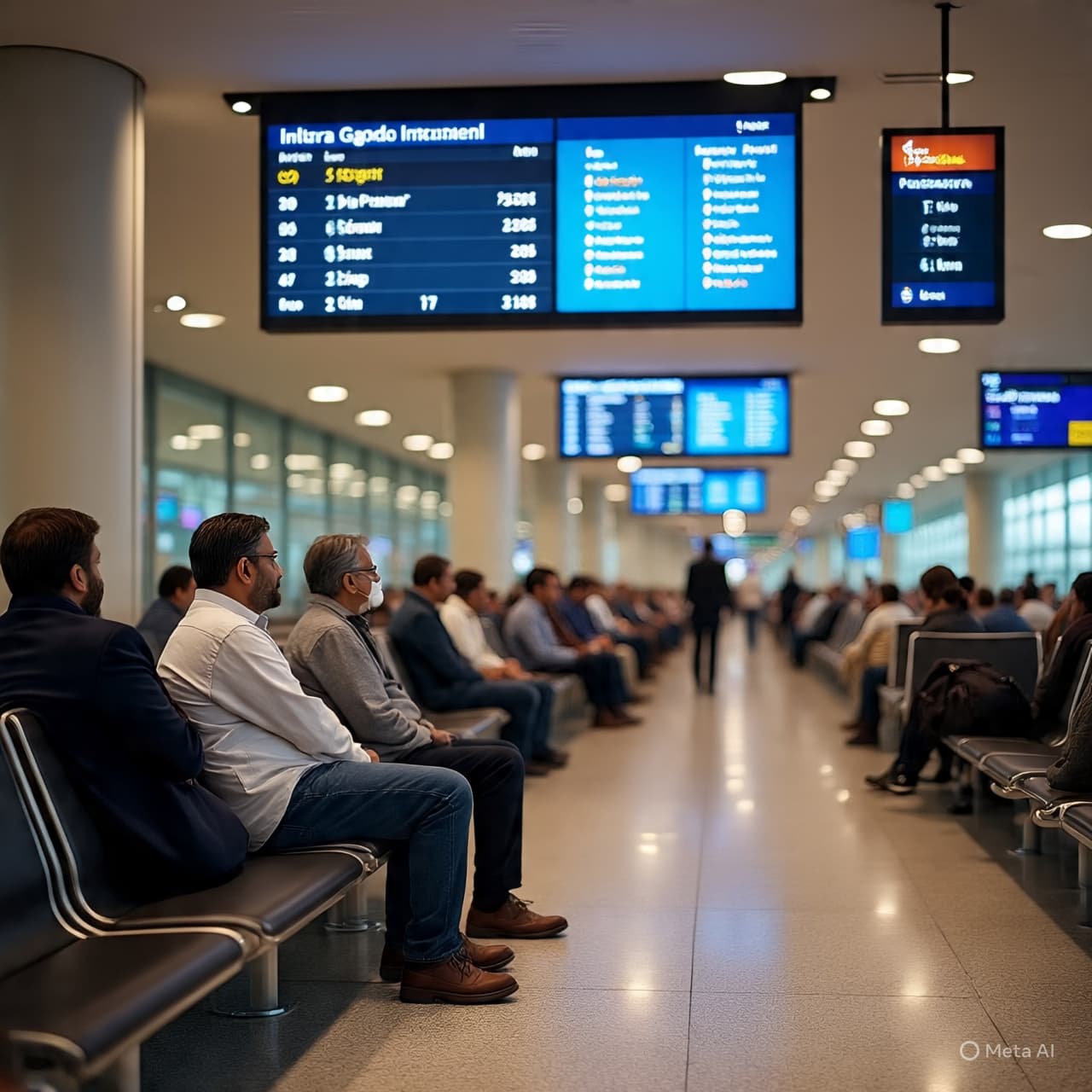
Despite the turbulence of geopolitics, airports like Indira Gandhi International function as spaces of constant movement. Even when skies shift, ground operations continue — check-in counters remain open, security procedures proceed, and departure boards refresh with revised information. For passengers, the experience may involve waiting, but it is accompanied by structured communication and logistical support.
As tensions between Iran and Israel continue to shape regional dynamics, aviation authorities will monitor conditions closely. Any sustained changes in airspace access could influence scheduling across multiple continents. For now, advisories serve as reminders that global travel is interconnected, and that developments in one part of the world can alter routes far beyond their origin. In this unfolding landscape, coordination between nations, airlines, and airports remains the steady thread guiding travelers through uncertain skies.
AI Image Disclaimer Illustrations are AI-generated and intended as conceptual visual representations, not real photographs.
Sources Reuters Associated Press BBC News The Hindu The Indian Express
Published by Banx Network. This article is part of the Banx decentralized media programme, powered by the BXE token on the XRP Ledger.