
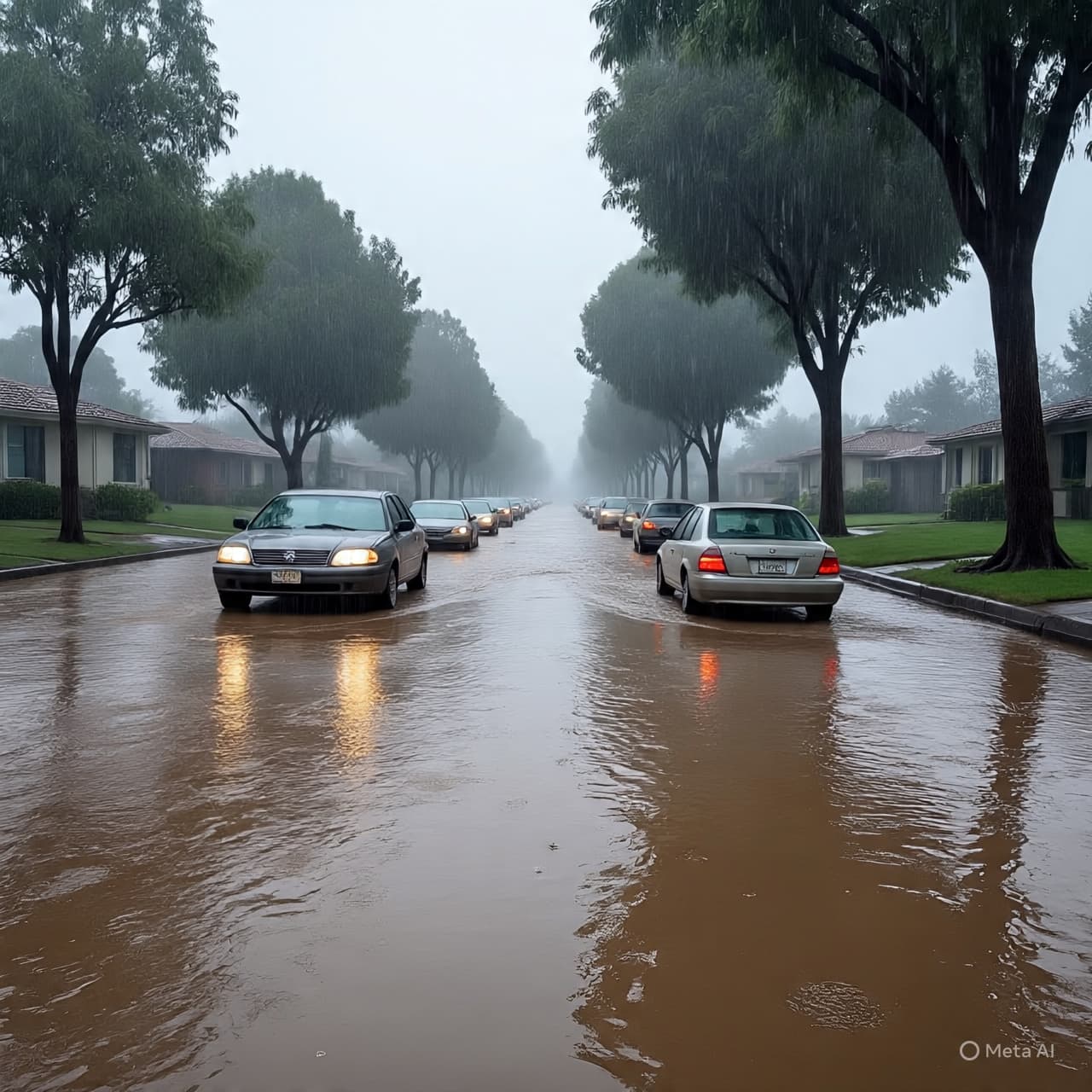
Weather, in its quiet way, often reminds a continent of its scale. Across Australia’s vast horizon, skies can carry different stories at once — rain pressing heavily in the south while northern waters begin to turn with restless energy. This week, the map itself seems divided by mood: a soaking deluge sweeping through South Australia and Victoria, while Queensland, the Northern Territory, and Western Australia watch the tropics with careful eyes.
In South Australia and Victoria, rainfall has settled in with steady persistence. Roads glisten under low gray skies, and rivers, once modest, have begun to swell beyond their banks. Communities accustomed to seasonal shifts now find themselves measuring hours by radar updates and sandbag deliveries. The soundscape has changed — from dry wind through trees to the constant percussion of rain on rooftops.
Emergency services have moved with practiced coordination. Flood warnings have been issued in vulnerable catchments, and residents in low-lying areas have been advised to monitor conditions closely. While rainfall totals vary by district, the cumulative effect has been unmistakable: saturated ground, rising waterways, and disruptions to travel. Farmers, particularly, watch their fields with mixed feelings — grateful for water after long dry spells, yet wary of excess that can undo months of careful work.
At the same time, far to the north and west, a different tension builds over warm ocean waters. Meteorologists are tracking multiple tropical systems developing in the Coral Sea and the Indian Ocean basin. The possibility of three cyclones forming within a similar window — a so-called “triple threat” — has drawn national attention. Though not unprecedented, the scenario underscores the breadth of Australia’s climate patterns during peak cyclone season.
In Queensland, coastal communities are reviewing preparedness plans, securing properties, and staying attuned to updates from the Bureau of Meteorology. The Northern Territory, no stranger to tropical systems, remains alert as forecasts evolve. In Western Australia, particularly along the northwest coast, authorities are advising residents and industries to monitor developments closely, given the region’s exposure to powerful storms during this time of year.
Cyclones, by their nature, carry uncertainty. Their paths can curve, their intensity can shift, and their impact depends as much on timing as strength. For communities that have weathered past storms, preparation has become part of routine — checking emergency kits, reviewing evacuation routes, reinforcing infrastructure. There is caution, but also familiarity.
Climate scientists often note that Australia’s geography places it at the crossroads of multiple weather systems. The same warm seas that nourish marine life can also fuel cyclonic circulation. The same frontal systems that bring relief to drought-stricken regions can, under certain conditions, tip into flooding rains. It is a balance that requires vigilance rather than alarm.
For now, the southern states focus on managing flood risks, while northern and western regions prepare for what may approach from offshore. Authorities emphasize that forecasts are evolving and urge residents to rely on official updates rather than speculation. The coming days will clarify whether the tropical systems intensify or shift course, and whether rainfall in the south eases as predicted.
As it stands, South Australia and Victoria continue to manage widespread rainfall and localized flooding, while Queensland, the Northern Territory, and Western Australia remain on alert for potential cyclone development. Emergency services are active, weather advisories remain in place, and communities across the continent are adjusting to a week defined by water — falling from the sky and gathering at sea.
AI Image Disclaimer Graphics are AI-generated and intended for representation, not reality.
Source Check: Credible mainstream coverage on Australian severe weather, flooding, and cyclone threats can be found in:
ABC News Australia The Guardian Australia SBS News The Australian 9News Australia
نُشر بواسطة Banx Network. هذا المقال جزء من برنامج الوسائط اللامركزية من Banx، مدعومًا برمز BXE على شبكة XRP Ledger.


