There are moments in Earth’s long history when the quiet rhythm of oceans and continents is suddenly interrupted. For millions of years the seas may rise and fall gently, shaped by winds, tides, and shifting climates. Yet every so often, the planet experiences an event so sudden that it leaves behind a story written not in words, but in stone and sediment.
One such story may lie hidden beneath the waters of the North Sea.
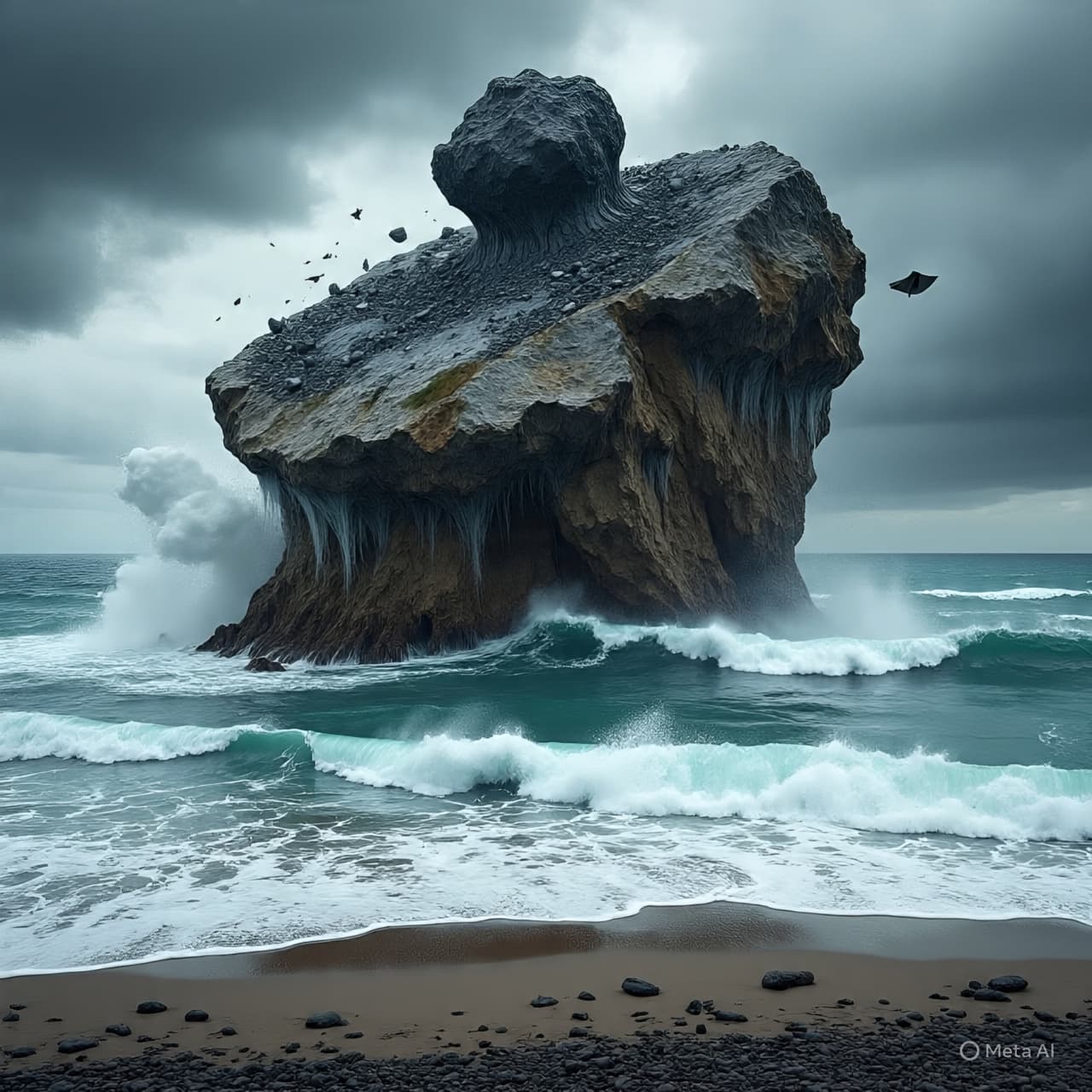
Recent research has drawn renewed attention to evidence suggesting that a massive asteroid once struck this region, releasing energy powerful enough to generate a towering tsunami—one that may have surged as high as 330 feet. The event, scientists say, would have unfolded in a matter of minutes, transforming a quiet stretch of ocean into a landscape of immense and violent motion.
Asteroid impacts are among the most dramatic natural forces known to science. When a large object traveling through space collides with Earth, it carries enormous kinetic energy. Even a body only a few hundred meters wide can unleash an explosion comparable to thousands of nuclear weapons, instantly vaporizing rock and water at the point of impact.
In the case of the North Sea event, researchers believe the asteroid struck a shallow marine environment. Instead of impacting dry land, the object would have plunged directly into the ocean basin. The collision would have excavated a vast crater in the seafloor while sending a tremendous column of water and debris high into the atmosphere.
Within moments, the displaced water would begin to collapse outward. That collapse—driven by gravity and the force of the explosion—could generate waves of extraordinary height.
Computer simulations suggest that the resulting tsunami may have reached approximately 330 feet, sending massive walls of water racing across the surrounding seas. Such waves would travel outward in all directions, eventually colliding with coastlines that existed around the ancient North Sea basin.
At the time of the impact, the geography of the region looked very different from the one seen on modern maps. Parts of what are now the United Kingdom, Norway, Denmark, and northern Germany were connected by different coastlines and shallow marine shelves. A tsunami moving across this environment would have surged over low-lying terrain, reshaping shorelines and scattering sediments across wide areas.
Scientists studying the region have identified unusual geological layers that may preserve traces of this ancient catastrophe. In certain sedimentary deposits, researchers have discovered disturbed rock formations, chaotic debris layers, and patterns consistent with large-scale underwater landslides and tsunami activity.
These clues have encouraged scientists to model what might have happened if a large asteroid had struck the North Sea basin millions of years ago. Their simulations indicate that such an impact could indeed generate waves hundreds of feet high, particularly in a relatively enclosed body of water where energy reflects and amplifies across continental shelves.
The research is part of a broader effort among geologists and planetary scientists to understand how asteroid impacts shape Earth’s environment. While the most famous example remains the asteroid linked to the extinction of the dinosaurs some 66 million years ago, smaller impacts have occurred throughout the planet’s history.
Many of these events left craters that are still visible today, while others are hidden beneath oceans or buried beneath layers of younger rock. Detecting them often requires careful analysis of geological records, seismic data, and computer simulations.
The North Sea, with its long history of geological activity and thick sediment layers, offers scientists a valuable archive of such ancient events. Each discovery adds another piece to a puzzle that stretches back hundreds of millions of years.
Understanding these past impacts also has modern relevance. Astronomers and planetary defense researchers continue to monitor near-Earth asteroids, tracking objects whose orbits pass close to our planet. While large impacts are rare on human timescales, studying ancient collisions helps scientists refine models of how such events unfold and what their consequences might be.
For coastal regions especially, tsunami modeling remains an important part of this research. Knowing how water behaves when massive energy enters the ocean can help scientists better understand both asteroid impacts and other tsunami-generating events such as underwater earthquakes or landslides.
In the quiet waters of the modern North Sea, fishing vessels and cargo ships move across a surface that often appears calm and predictable. Yet far below those waves, the geological record suggests that the region may once have experienced a moment of astonishing violence.
The idea that a stone from space could strike the sea and send a towering wave across ancient coastlines serves as a reminder of the dynamic forces that shape our planet. Earth’s landscapes, after all, are not only formed slowly by time, but sometimes by sudden encounters with the wider universe.
Today, scientists continue to examine sediments, map seafloor structures, and refine their simulations in hopes of understanding the full story of this possible impact. While many details remain under study, the evidence suggests that the North Sea may once have witnessed a dramatic meeting between sky and ocean—an encounter powerful enough to lift the sea itself toward the horizon.
AI Image Disclaimer Images in this article are AI-generated illustrations, meant for concept only.
Sources BBC The Guardian Live Science Nature Science Magazine
Published by Banx Network. This article is part of the Banx decentralized media programme, powered by the BXE token on the XRP Ledger.