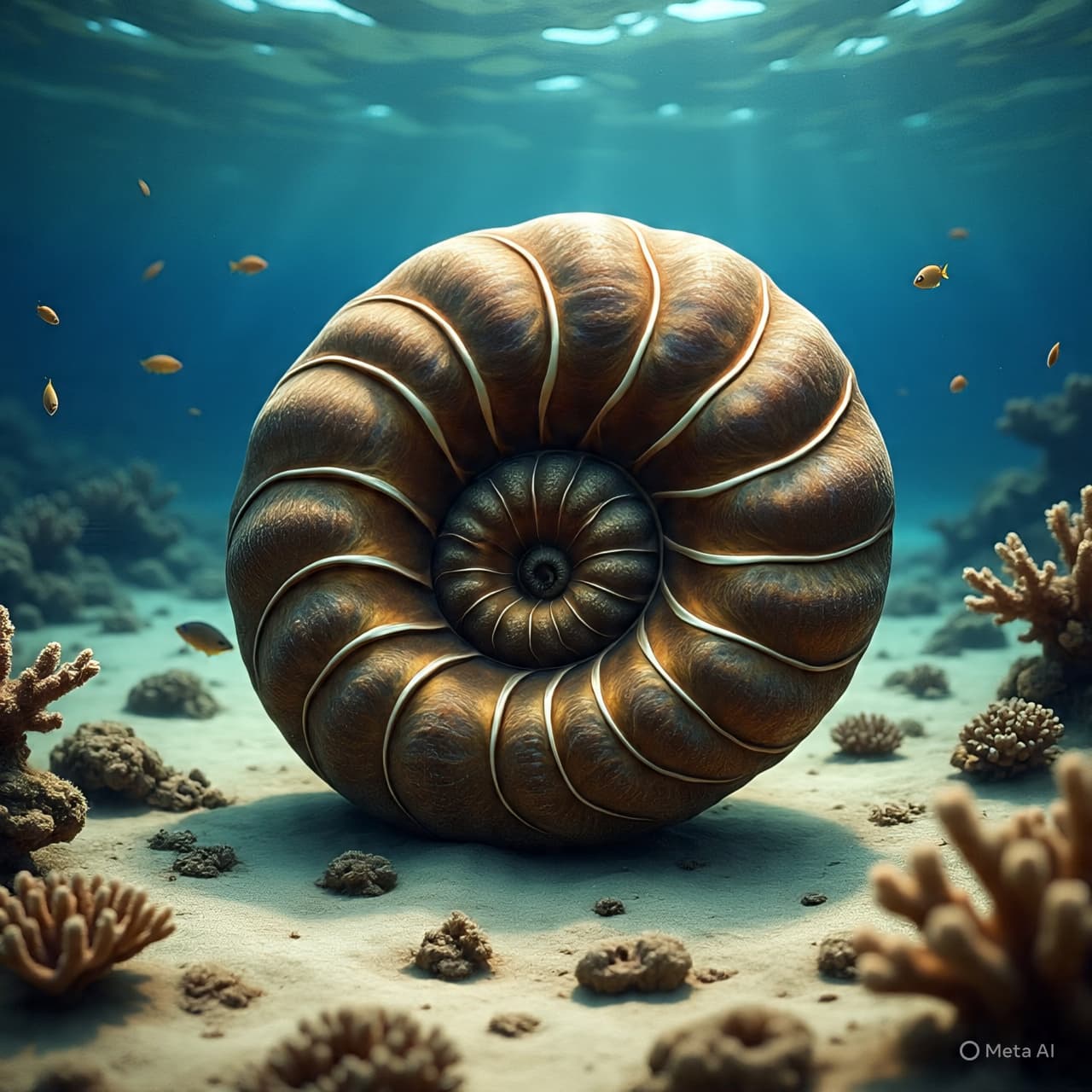
There was a time when the oceans were not only wide, but wondrous in ways that defy modern imagination. Beneath waters that shimmered under prehistoric suns, coiled shells drifted like spirals of stone, turning slowly in a blue world without borders. These were ammonites—creatures whose forms resembled the quiet geometry of galaxies, whose shells curled inward as if guarding secrets of time itself. In their spirals, one might read not only the passage of life, but the ambition of growth. Some remained modest in size, delicate and palm-held in imagination. Others, astonishingly, grew into giants—shells stretching more than two meters across, monumental and patient as underwater moons. Why did certain ammonite species become so immense? The question feels less like a scientific puzzle and more like a meditation on nature’s quiet experiments. Ammonites, marine mollusks that thrived from the Devonian to the end of the Cretaceous period, occupied seas for hundreds of millions of years. Like their modern relatives—the nautilus, squid, and octopus—they relied on buoyant, chambered shells. As they grew, they built new chambers, sealing off old ones, adjusting gases within to maintain balance in the water column. Growth was not simply expansion; it was architecture. Gigantism among some ammonite species likely arose from a confluence of environmental abundance and evolutionary opportunity. During certain geological periods, oceans were warmer and richer in nutrients. Plankton flourished, food webs expanded, and ecological niches opened like doors in a vast corridor. In such circumstances, larger size could become an advantage. A greater body mass might deter predators. A wider shell might stabilize movement in open waters. Size, in nature, can be both shield and sail. There is also the matter of oxygen. Scientific studies suggest that ancient oceans, at times, contained higher levels of dissolved oxygen. Just as dragonflies of the Carboniferous grew to startling wingspans in oxygen-rich air, marine invertebrates may have benefited similarly beneath the waves. More oxygen can support greater metabolic demands, allowing organisms to sustain larger bodies without compromise. Predation, too, writes its own chapter in this story. The Mesozoic seas were far from gentle. Marine reptiles such as ichthyosaurs and mosasaurs, alongside fast-swimming fish, transformed the oceans into arenas of pursuit. In such an environment, evolutionary pressures often reward innovation—thicker shells, spines, tighter coils, or simply greater size. Becoming larger might have reduced vulnerability, shifting the balance between hunter and hunted. Yet gigantism is never without cost. Larger organisms require more resources, mature more slowly, and may struggle in times of scarcity. This delicate equation between benefit and burden suggests that giant ammonites thrived when conditions were stable and plentiful. When environments shifted—through climate fluctuations, sea-level changes, or catastrophic events—their very size may have become a liability. Indeed, all ammonites, giant and small alike, met their end approximately 66 million years ago during the mass extinction event that closed the Cretaceous period. The impact that reshaped the Earth did not discriminate by scale. Spirals large and small vanished together, leaving only fossilized echoes embedded in stone. In the end, the story of giant ammonites is not merely about size. It is about possibility. It is about how life responds to abundance, to danger, to opportunity. In their vast coils we see nature’s willingness to explore extremes—testing how large a shell can grow, how far a lineage can stretch before time gently folds it away. We may never hear the sound of those ancient seas, nor witness a living ammonite turning through filtered light. But in museums and sedimentary cliffs, their spirals remain. They remind us that growth, in any age, is shaped by circumstance. And sometimes, when the world allows it, life dares to become magnificent.
AI Image Disclaimer Illustrations were produced with AI and serve as conceptual depictions.
Source Check
Credible sources available on this topic include: National Geographic Smithsonian Magazine BBC Earth Scientific American Nature
Published by Banx Network. This article is part of the Banx decentralized media programme, powered by the BXE token on the XRP Ledger.