
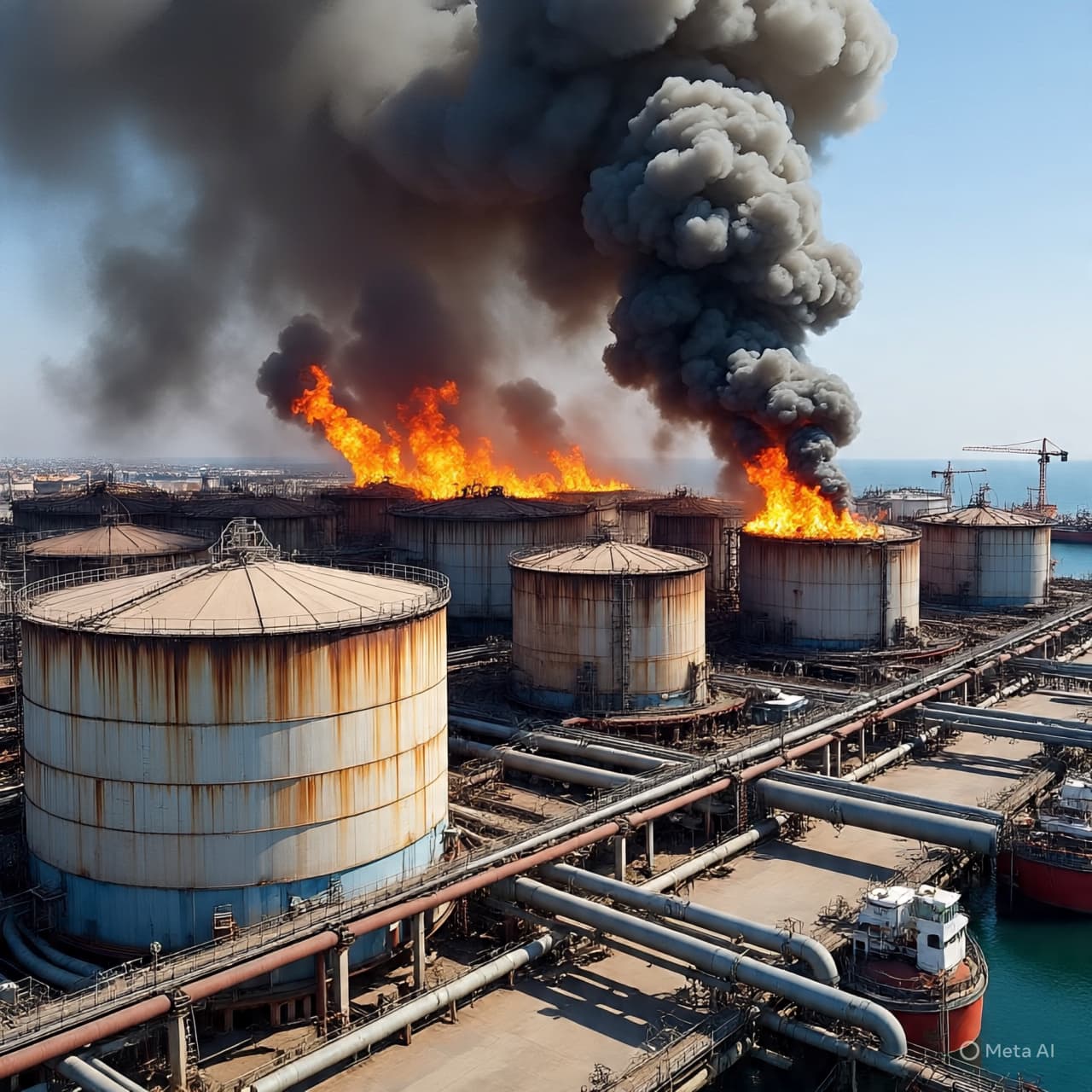
Along the warm waters of the Gulf, the rhythm of industry rarely pauses. Tankers glide across narrow sea lanes, cranes move with patient precision, and the steady pulse of oil terminals continues through day and night. Ports along these shores have long served as quiet engines of the global economy, where energy flows outward toward distant cities and continents.
Yet sometimes the calm geometry of these places—pipes, tanks, docks, and ships—can be interrupted by something sudden and bright against the sky.
Images emerging from Fujairah, a major oil hub on the eastern coast of the United Arab Emirates, show thick plumes of smoke rising above storage tanks and port infrastructure after a significant fire broke out at one of the region’s key petroleum facilities. Flames appeared to spread across parts of the terminal area, sending dark columns of smoke drifting over the harbor and nearby shoreline.
The port of Fujairah holds a strategic place along the energy routes of the Gulf of Oman, serving as one of the world’s largest bunkering hubs where ships refuel before continuing their journeys through global shipping lanes. Vast storage farms and pipelines link the port to the wider energy network of the Gulf, making it a critical node in the flow of oil.
The fire, captured in photographs and circulating widely, occurred just a day after the United States military reportedly struck a major Iranian oil depot in Iran. That earlier strike targeted energy infrastructure believed to be connected to broader regional tensions that have recently intensified across parts of the Middle East.
While the two incidents unfolded within a short span of time, officials have not publicly confirmed any direct connection between the fire at the UAE port and the U.S. strike in Iran. Investigations into the cause of the blaze were still underway, with authorities assessing damage and working to contain the flames.
At energy facilities like Fujairah, fires can spread rapidly due to the presence of fuel storage tanks and pipelines, requiring coordinated response efforts from firefighters and port authorities. Emergency teams reportedly moved to control the situation while ships remained anchored offshore and operations around the affected area were closely monitored.
For the region, energy infrastructure is more than industrial architecture—it forms the backbone of economic activity that links Gulf producers with markets across Asia, Europe, and beyond. Ports like Fujairah function almost like crossroads, where tankers pause briefly before continuing along maritime routes that stretch across oceans.
Against this vast network of movement, a column of smoke can feel like a sudden interruption in an otherwise steady current.
Across the Gulf, geopolitical tensions have periodically intersected with the world of shipping and energy logistics. Incidents involving ports, pipelines, and tankers have, over the years, reminded observers how closely global energy systems are tied to regional stability.
Still, the Gulf’s ports have often returned quickly to their familiar rhythm after such disruptions—ships docking, fuel flowing, and the slow choreography of maritime trade resuming once the immediate crisis passes.
Authorities in the United Arab Emirates said investigations into the Fujairah fire would determine its cause and assess the extent of the damage. Meanwhile, images of flames and smoke continue to circulate, offering a stark visual reminder of how quickly events in the region’s energy landscape can shift.
And as the smoke gradually thins above the harbor, the port remains where it has always been—at the meeting point of sea routes, commerce, and the fragile balance that shapes the wider Gulf.
AI Image Disclaimer These visuals were generated with AI and depict imagined scenes inspired by reported events.
Sources Reuters Associated Press BBC News Al Jazeera Bloomberg
Published by Banx Network. This article is part of the Banx decentralized media programme, powered by the BXE token on the XRP Ledger.
.jpg&w=3840&q=75 "Blake Lively Awarded $400,000 in Legal Fees After Justin Baldoni Lawsuit Dismissed")

