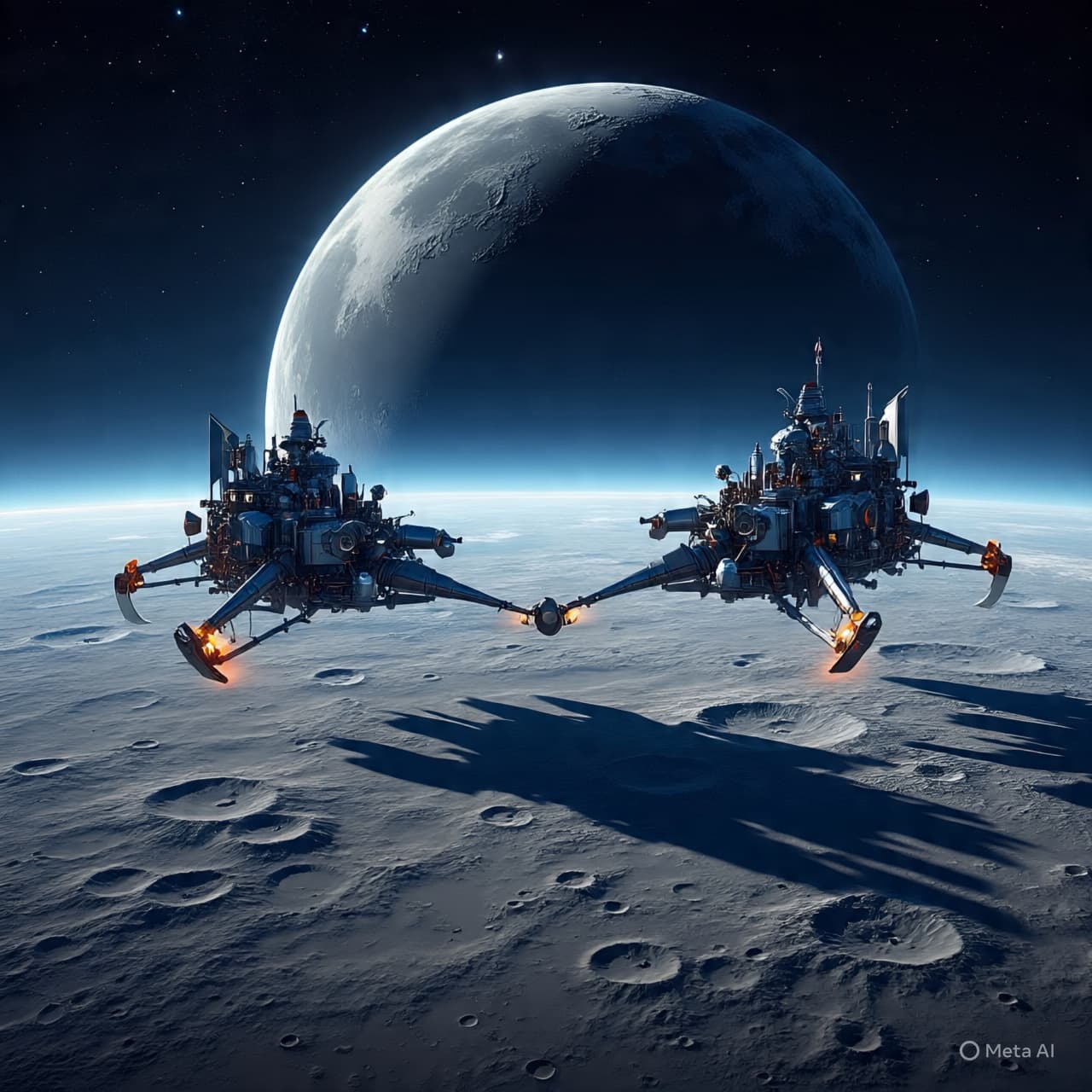
The Moon has always invited human imagination with a quiet kind of gravity. From ancient myths to modern rockets, it has stood not only as a destination but also as a place where ambition gathers before taking its next step. In recent years, NASA’s Artemis program envisioned that gathering place as the Lunar Gateway—a small station circling the Moon, waiting like a harbor where spacecraft could meet, exchange crews, and prepare for the descent to the surface.
But space exploration is rarely a straight road. Plans evolve, budgets shift, engineering realities emerge, and the architecture of a mission sometimes changes shape before the first hardware leaves Earth.
Now, with the future of the Gateway increasingly uncertain within NASA’s evolving Artemis plans, a new question quietly circulates among engineers and mission planners: If the station never becomes the central meeting point, where will lunar landers rendezvous with Orion instead?
For years, the Gateway was meant to be that meeting point. Positioned in a unique orbit around the Moon known as a Near-Rectilinear Halo Orbit (NRHO), it would serve as a staging hub for missions to the lunar surface. Astronauts arriving aboard NASA’s Orion spacecraft would dock with the station, transfer to a lunar lander—such as SpaceX’s Starship-based Human Landing System or Blue Origin’s Blue Moon—and descend to the Moon before returning to the Gateway.
The concept promised flexibility. Multiple landers could visit. International partners could add modules. Crews could stay longer and assemble missions in lunar orbit much as astronauts do aboard the International Space Station.
Yet the Gateway also introduced complexity. Docking sequences multiplied. Hardware had to be developed and launched in a specific order. And as Artemis schedules shifted, the station gradually moved from being an immediate requirement to something more optional in the early missions.
Recent discussions inside NASA and among policymakers have suggested that the Gateway might not remain on the critical path for returning astronauts to the Moon. The focus instead appears to be shifting toward increasing launch cadence and accelerating lunar surface operations.
If that path continues, mission planners are likely to consider a simpler alternative—one that echoes an earlier era of exploration.
During the Apollo missions of the 1960s and 1970s, astronauts used a lunar orbit rendezvous strategy. The command module remained in orbit while a separate lander descended to the surface. After completing their exploration, astronauts lifted off from the Moon and rejoined the orbiting spacecraft before heading home.
A similar approach could return for Artemis.
In that scenario, the Orion spacecraft and the lunar lander would meet directly in lunar orbit, rather than at a space station. Astronauts would transfer to the lander, descend to the Moon, and later dock again with Orion for the journey back to Earth.
However, modern mission architecture introduces some complications. The Orion spacecraft’s propulsion system was designed around the Gateway’s distant lunar orbit and may not have the same flexibility as Apollo-era spacecraft when operating in lower lunar orbits. Because of this, engineers have studied alternative elliptical orbits that Orion can safely reach and depart from with its current capabilities.
These alternative orbits could become the quiet crossroads of Artemis missions—places where landers and Orion meet briefly before astronauts descend toward the Moon’s surface.
Such an approach would reduce the number of spacecraft required for a single mission and potentially simplify early lunar landings. At the same time, it would postpone the vision of a permanent orbital outpost around the Moon, a goal many international partners had hoped would anchor long-term exploration.
Still, space exploration has always unfolded in stages. A harbor may be built later, once the first journeys are underway.
For now, the possibility remains that Orion and the next generation of lunar landers will meet not beside a station, but in open lunar orbit—an invisible crossroads circling quietly above the Moon’s ancient terrain.
And in that silent meeting place, humanity may begin writing the next chapter of its long conversation with the Moon.
AI Image Disclaimer Visuals are created with AI tools and are not real photographs.
Sources Ars Technica Space.com NASA Spaceflight Now Universe Today
Published by Banx Network. This article is part of the Banx decentralized media programme, powered by the BXE token on the XRP Ledger.