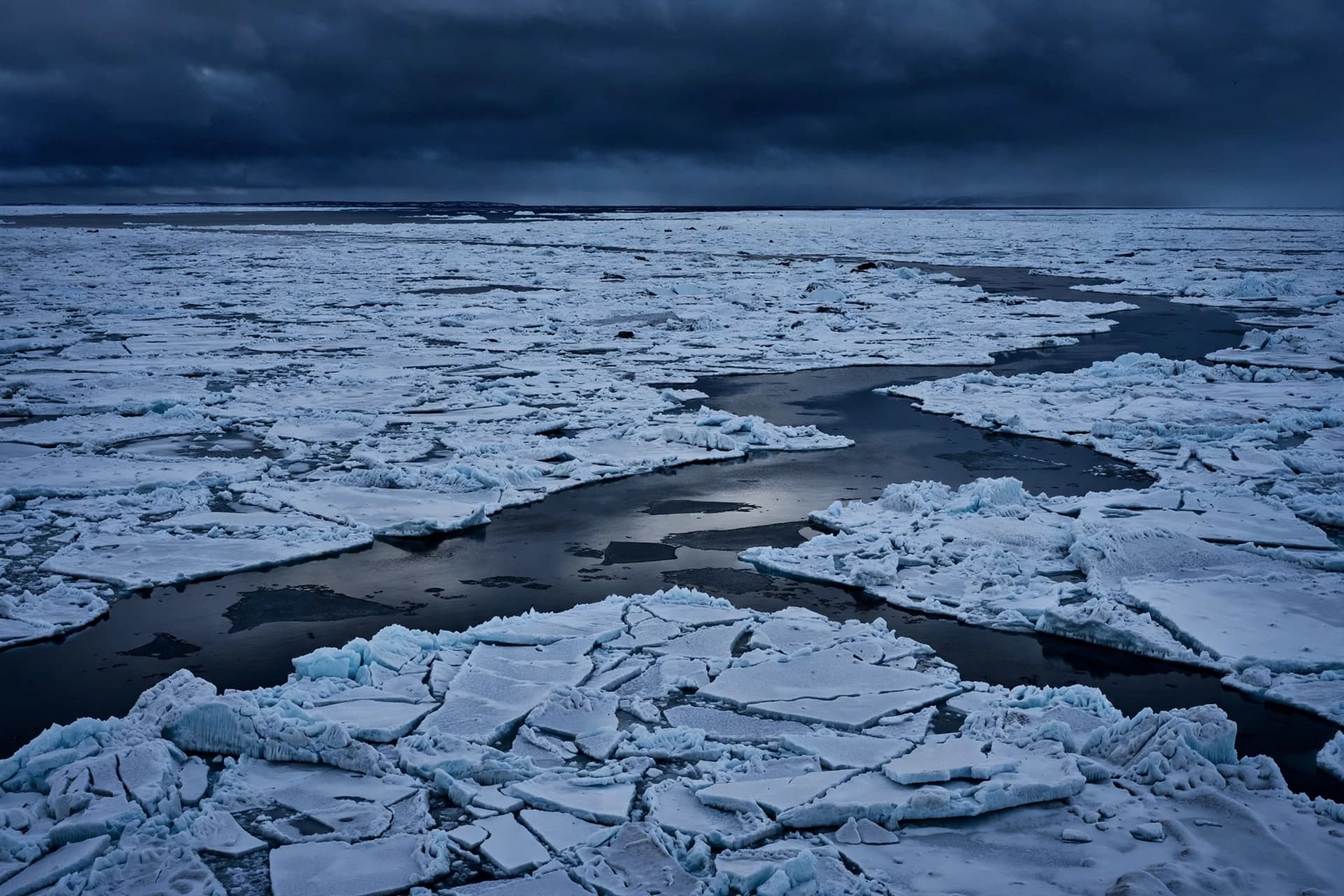
There is a particular fragility to winter ice that is easy to overlook. Summer sea ice melts and refreezes with annual drama, its retreat visible in satellite images and headlines. But winter ice—the vast, quiet sheet that covers the Arctic Ocean in darkness—has received far less attention. New research suggests that may be a mistake, and that its loss could be greater than we thought.
Researchers from the University of Cambridge and the Centro de Investigación en Matemáticas in Mexico have compiled the largest-ever database of a biomarker produced by algae living in sea ice, using ocean sediment cores from a warm period 6,000 years ago. Their findings, published in Nature Geoscience, suggest that future Arctic winter sea ice is likely to shrink by around one million square kilometres more than previous climate models predicted .
The mid-Holocene period offered a natural laboratory. Subtle shifts in Earth's orbit made the Arctic warmer, and sea ice was less extensive. By measuring levels of a biomarker called IP25, alongside complementary biomarkers from organisms living in open water, researchers could estimate ancient sea ice cover with greater precision. They then compared these measurements to simulations from 27 climate models of the same period .
Using a statistical technique called Bayesian weighting, the researchers gave different weights to models based on how well they reproduced the ancient conditions. When they applied those weights to modern and future simulations, the results were striking. The models had been over-predicting how much winter sea ice there should be. “When we apply the model weights to historical simulations, we completely eliminated the positive bias,” said lead author Crystal Fu. “The future projections similarly end up being lower than previous estimates, by about a million square kilometres” .
The approach reduced the range of uncertainty in their projections by as much as 85 percent. “By using evidence from the past, we can now produce more reliable maps of where Arctic winter sea ice is likely to disappear,” said co-author Marco Aquino-López .
The implications extend far beyond the Arctic. Winter ice cover regulates the release of heat and moisture to the atmosphere, and its loss has been linked to colder winters and heavier snowfall in the United Kingdom, northern Europe, and North America. In March 2025, the Arctic recorded its lowest maximum sea ice extent since modern measurements began—a record tied again this year .
The researchers also found hints that knock-on effects could be larger than expected. Applying their revised model weights to precipitation projections suggested that snowfall over southeast Greenland and rainfall in the Mediterranean may also be underestimated, with potential consequences for the stability of the Greenland ice sheet and future flood risk in southern Europe .
“It doesn’t matter if the warming is natural variation or caused by human activity: if it warms, sea ice is going to melt,” Fu said . The ancient clues, it seems, are speaking clearly to the present.
AI Image Disclaimer: This article's image is AI-generated and does not depict actual Arctic conditions or research sites.
Sources: University of Cambridge, Nature Geoscience, SciTechDaily
Published by Banx Network. This article is part of the Banx decentralized media programme, powered by the BXE token on the XRP Ledger.