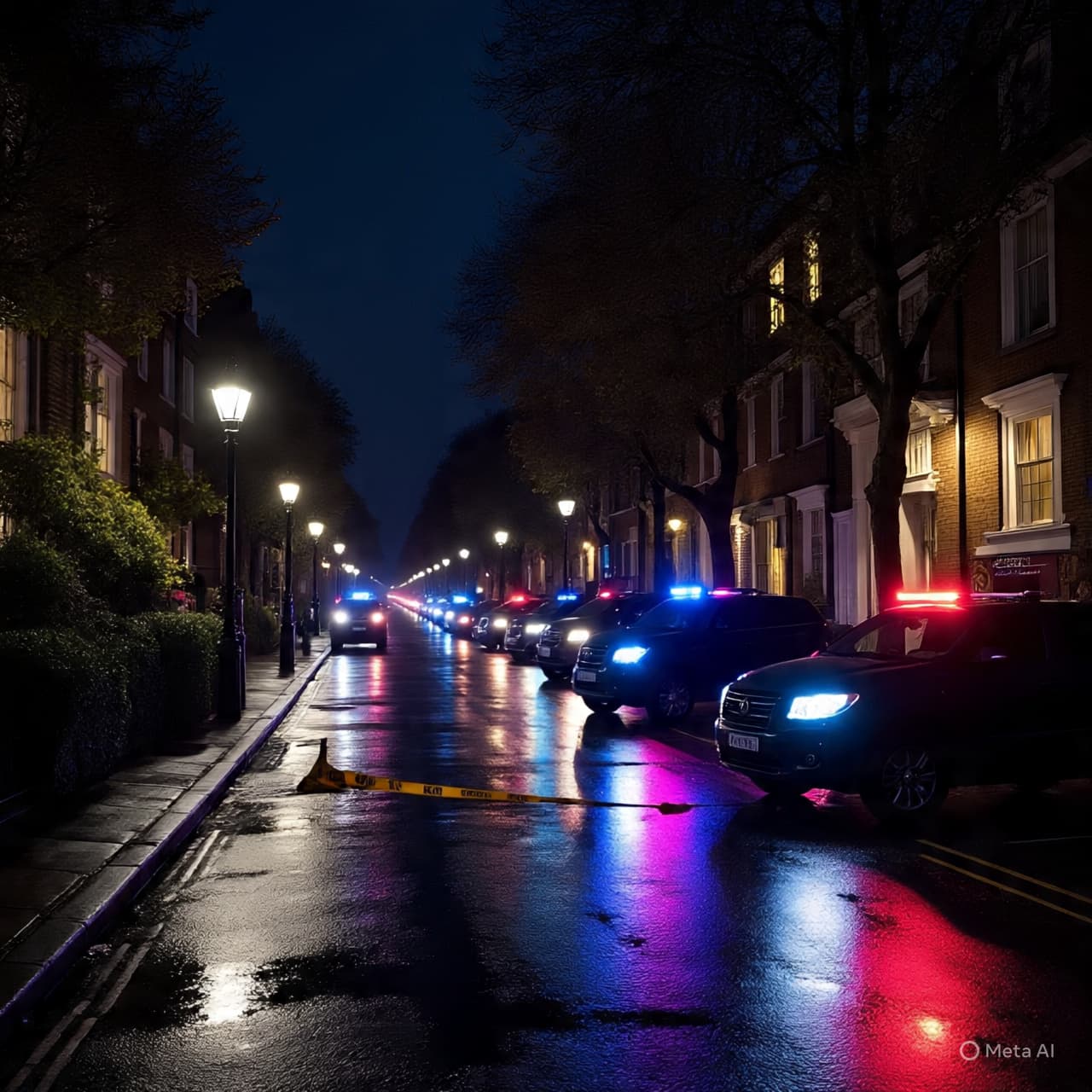
It was an ordinary stretch of evening in South London, the kind where traffic hums steadily and shopfront lights glow against the early dark. Then came the sharp interruption—sirens rising, voices carried on urgency, a scene unfolding too quickly for those nearby to understand at first glance.
A man has been charged with attempted murder after two police officers were allegedly attacked with an axe in London. The incident occurred in the southern part of the capital, where officers had responded to reports that required their presence. Within moments, what began as routine policing escalated into violence, leaving the officers injured and a suspect detained at the scene.
The Metropolitan Police Service confirmed that both officers received medical treatment following the attack. Their injuries, while serious enough to require hospital assessment, have not been described as life-threatening. The suspect was arrested shortly afterward and has since been formally charged with attempted murder, as well as related offences connected to the assault.
Investigators have begun piecing together the sequence of events—how the confrontation unfolded, what led to the alleged use of a weapon, and whether there were warning signs in the moments before it occurred. Forensic teams examined the area under bright portable lights, while uniformed officers maintained a cordon through the night.
Attacks on police officers, though statistically uncommon relative to the scale of daily duties, carry a particular resonance. Officers are trained to approach uncertainty with caution, but they often do so in neighborhoods where familiarity softens the edge of risk. When violence intrudes, it disrupts not only personal safety but a broader sense of civic steadiness.
Community leaders in South London have urged calm as legal proceedings move forward. The courts will now take up the matter, weighing evidence and determining accountability. For the officers involved, recovery will come first—physical healing measured alongside the quieter recalibration that follows sudden danger.
By morning, the street where it happened returned to its routine rhythm: buses passing, commuters walking, storefronts reopening. Yet the memory of flashing lights and raised alarms lingers. In cities as large as London, the unexpected can unfold within seconds. What remains afterward is the collective hope that justice proceeds carefully, and that those who serve—and those they protect—can return to a measure of ordinary safety.
AI Image Disclaimer
Visuals are AI-generated and serve as conceptual representations.
Sources
Metropolitan Police Service BBC News The Guardian Sky News Evening Standard
Published by Banx Network. This article is part of the Banx decentralized media programme, powered by the BXE token on the XRP Ledger.