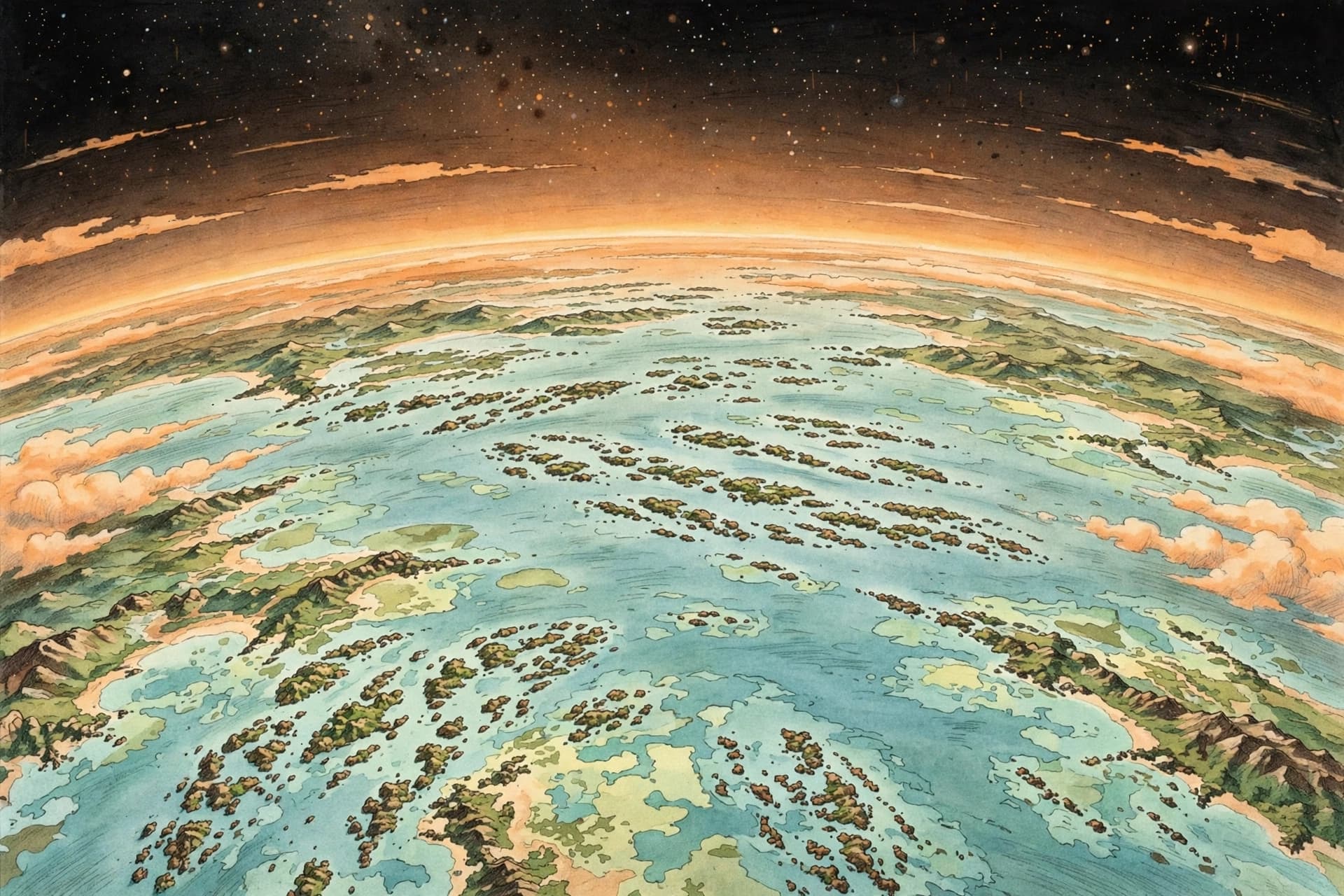
There are moments in Earth’s long history when silence gives way to motion, when stillness transforms into rhythm. The oceans, vast and ancient, have always carried secrets beneath their surface—stories written not in ink, but in currents that shape climates and continents alike.
Among these flows, one stands above the rest: the Antarctic Circumpolar Current, the strongest ocean current on the planet. It circles Antarctica endlessly, connecting the Atlantic, Pacific, and Indian Oceans in a continuous loop. For decades, scientists have wondered how such a powerful force first came into being.
New simulations are now offering answers. Using advanced climate modeling, researchers have reconstructed ancient ocean conditions, tracing back millions of years to understand when and how this current emerged. Their findings suggest that tectonic shifts played a decisive role.
As the continents slowly drifted apart, the opening of ocean gateways around Antarctica allowed water to circulate freely around the continent. This marked a turning point. Without land barriers to interrupt the flow, currents began to strengthen and organize into the massive system we observe today.
The simulations reveal that this transformation did not happen overnight. Instead, it unfolded gradually over millions of years, as shifting seafloors and changing atmospheric conditions worked together to amplify the current’s strength. It was less an abrupt birth and more a slow awakening.
Temperature differences between polar and equatorial waters also contributed to the current’s formation. As colder waters sank and warmer waters moved in, the resulting circulation patterns fed into the growing قوة of the current. It became a self-reinforcing system.
Scientists emphasize that this current plays a crucial role in regulating global climate. By distributing heat and nutrients, it influences weather patterns, marine ecosystems, and even carbon storage in the ocean. Understanding its origins helps illuminate its future.
The research also raises questions about how the current might respond to modern climate change. As ice melts and temperatures shift, the delicate balance that sustains the current could be altered. Simulations suggest both resilience and vulnerability.
What emerges from this work is not just a scientific explanation, but a reminder of Earth’s interconnected systems. A movement of continents millions of years ago continues to shape the air we breathe and the oceans we depend on.
In quiet, measured tones, scientists continue to refine these models. The story of the ocean’s strongest current is still unfolding, carried forward by data, curiosity, and the steady flow of discovery.
AI Image Disclaimer Visuals are created with AI tools and are not real photographs.
Source Check Nature Science Advances NASA Earth Observatory National Oceanography Centre NOAA
Published by Banx Network. This article is part of the Banx decentralized media programme, powered by the BXE token on the XRP Ledger.