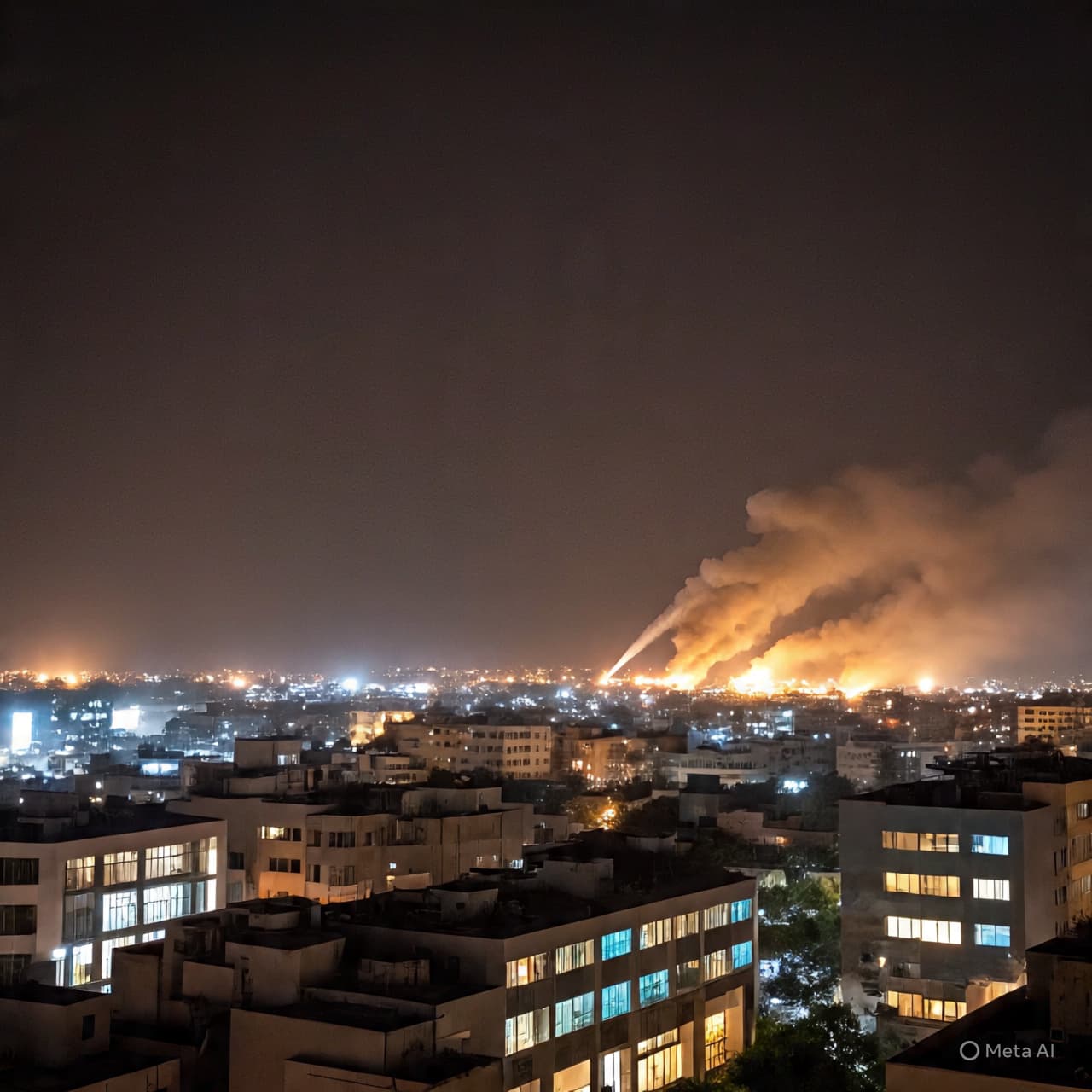
There are moments in history when the night sky above cities seems to carry more than clouds. It carries echoes—distant thunder that is not always weather, and flashes of light that do not belong to storms. In recent days, the skies above the Middle East have felt unusually heavy, as if the horizon itself were holding its breath.
From Tehran to Beirut and Tel Aviv, the rhythm of ordinary life has been interrupted by the quiet but unmistakable language of conflict: alerts in the night, distant explosions, and the cautious movements of governments and militaries responding to one another across borders. Like stones dropped into a wide lake, each strike sends ripples outward, touching cities, politics, and people far beyond the first splash.
Reports from international media indicate that a series of attacks and counterattacks have unfolded across the region. Military activity involving Israel, Iran, and groups aligned with Tehran has intensified in recent days, drawing renewed attention to one of the world’s most fragile geopolitical fault lines.
In Iran’s capital, Tehran, authorities reported explosions linked to aerial strikes that targeted military-related infrastructure. While officials have provided limited details, the developments are widely seen as part of a broader confrontation involving Israel and Iranian-aligned forces across the region.
To the west, Beirut—already a city familiar with the echoes of past conflicts—has also found itself again in the orbit of military tension. Israeli strikes reportedly targeted positions connected to Hezbollah, the Iran-backed Lebanese armed group that has long stood at the center of Israel’s northern security concerns. For residents, the sounds of aircraft and distant blasts have revived uneasy memories that many had hoped belonged to history rather than the present.
Further south, Tel Aviv has experienced its own moments of alarm. Missile alerts and defensive responses have punctuated the city’s routines, as Israeli defense systems moved to intercept incoming threats believed to be linked to forces aligned with Iran. For many residents, the familiar siren has once again become a reminder of the region’s delicate balance between normal life and sudden disruption.
Observers note that the exchanges reflect a long-simmering rivalry that periodically surfaces in visible and dramatic ways. Israel and Iran have for years engaged in what analysts often describe as a shadow confrontation—one that spans cyber operations, covert actions, proxy groups, and occasional direct strikes.
Yet in moments like these, the shadows grow brighter, and the distance between quiet tension and open confrontation appears smaller than before.
Diplomatic voices across the international community have begun to call for restraint, emphasizing the risks of escalation in a region where conflicts rarely remain contained within national borders. Each new strike, each response, carries the possibility of widening a circle that already touches multiple countries and alliances.
For the people living beneath those skies—in Tehran’s crowded streets, Beirut’s coastal neighborhoods, and Tel Aviv’s busy boulevards—the experience is often less about geopolitics and more about the fragile continuity of daily life. Shops still open, buses still move, and conversations still happen over coffee, even as the distant rumble of events reminds everyone how quickly the atmosphere can change.
History often shows that conflicts do not only unfold through decisive battles, but through moments of uncertainty—days when the world watches carefully, waiting to see whether the winds will calm or gather strength.
For now, the region stands in such a moment. The echoes have not yet faded, and the direction of the next sound remains uncertain.
In the coming days, attention will likely remain fixed on Tehran, Beirut, and Tel Aviv—not only to measure the scale of military developments, but also to see whether diplomacy can gently guide the region away from a deeper storm.
AI Image Disclaimer Illustrations were produced with AI and serve as conceptual depictions.
Sources Reuters Associated Press (AP News) The Guardian The Washington Post The Boston Globe
Published by Banx Network. This article is part of the Banx decentralized media programme, powered by the BXE token on the XRP Ledger.