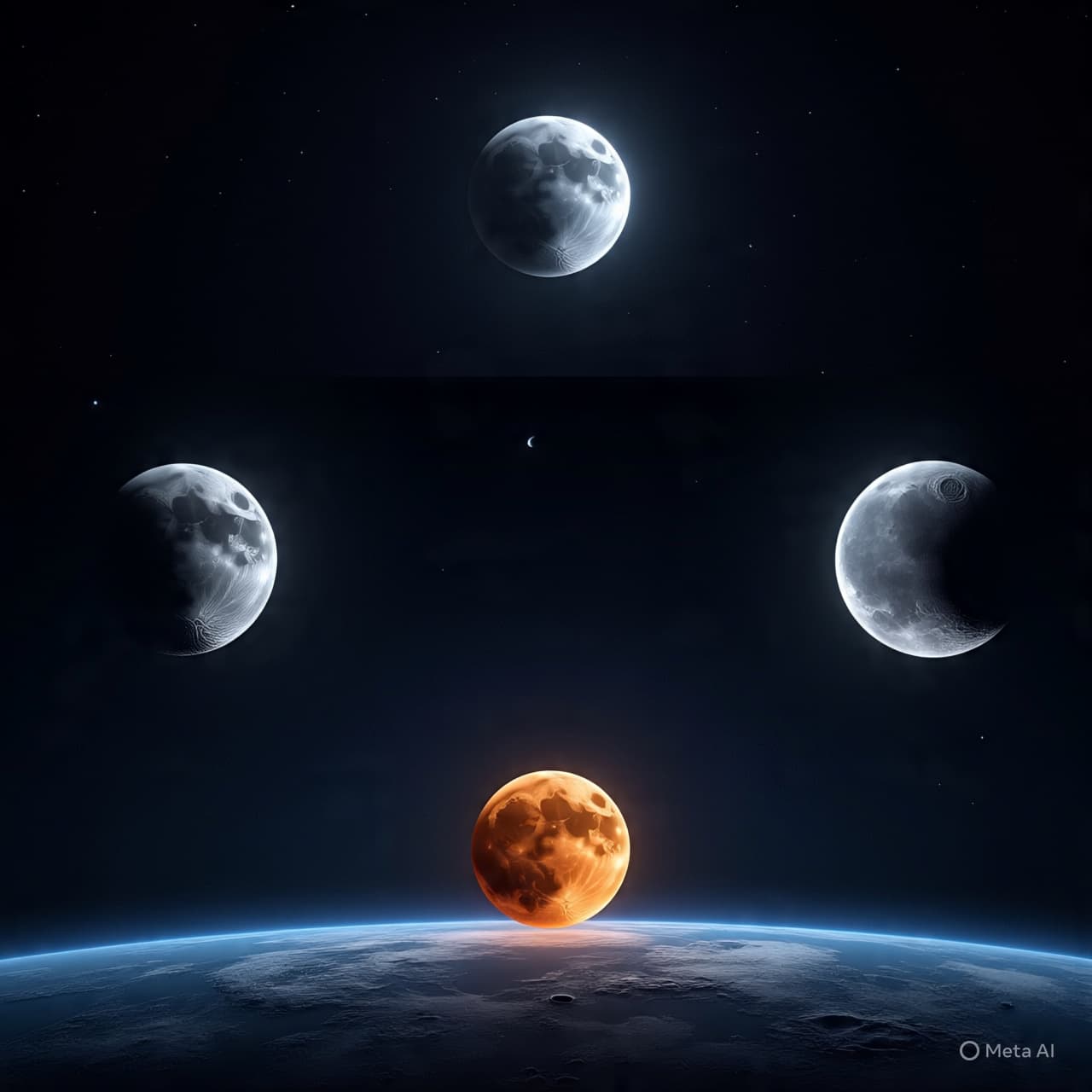
There are evenings when the sky feels closer than usual, as though the universe has leaned in to be noticed. The Moon, so familiar in its pale constancy, occasionally reminds us that even the most dependable companions can surprise us. On March 3, it will slip into Earth’s shadow and emerge transformed — copper-toned, subdued, and quietly dramatic. The so-called “Blood Moon” total lunar eclipse invites us not only to look up, but to pause. A total lunar eclipse occurs when Earth moves directly between the Sun and the Moon, casting a shadow that gradually envelops the lunar surface. Unlike a solar eclipse, which demands protective eyewear and careful positioning, a lunar eclipse is gentle on the eyes. It unfolds slowly, often over several hours, allowing viewers across wide regions of the world to witness each stage.
The reddish hue that gives rise to the phrase “Blood Moon” is not a sign of spectacle so much as physics. As sunlight passes through Earth’s atmosphere, shorter blue wavelengths scatter, while longer red wavelengths bend and continue onward. That filtered red light bathes the Moon during totality, tinting it with shades that can range from soft amber to deep rust, depending on atmospheric conditions.
To view the March 3 eclipse, timing will matter. Observers should check local schedules for when the partial phase begins, when totality is reached, and when the Moon exits Earth’s shadow. The event will be visible from regions experiencing nighttime during the eclipse window. Clear skies are, of course, essential.
No special equipment is required, though binoculars or a small telescope can enhance the view, revealing subtle gradations in color and the curved edge of Earth’s shadow crossing the lunar surface. Even a camera mounted on a tripod can capture the progression, particularly during totality when the Moon’s brightness dims enough for longer exposures.
For those in urban areas, the eclipse remains accessible. Unlike meteor showers that benefit from dark rural skies, a total lunar eclipse can be seen even amid city lights. The Moon’s transformation is gradual, offering time to step outside, adjust one’s gaze, and watch as brightness yields to shadow and then to copper glow.
Weather forecasts will play their part, as they always do in skywatching. If clouds intervene, live streams from observatories and space agencies may offer an alternative vantage point. But there is something quietly grounding about standing beneath the night sky, aware that countless others are looking up at the same moment.
The total lunar eclipse on March 3 is expected to follow its predicted path barring unforeseen atmospheric conditions. Observers are encouraged to consult reliable astronomical resources for precise local viewing times. For a few hours, the Moon will trade its usual silver for a deeper tone — a reminder that even in shadow, there is light refracted and returned.
AI Image Disclaimer Images in this article are AI-generated illustrations, meant for concept only.
Sources
NASA
Space.com
The Associated Press
Time and Date
Sky & Telescope
Published by Banx Network. This article is part of the Banx decentralized media programme, powered by the BXE token on the XRP Ledger.