

Key Highlights
- Crescent Moon Visibility:Recent calculations show the crescent moon's position in Indonesia did not meet visibility thresholds.
- MABIMS Framework:The agreed lunar standards require specific altitude and elongation for observation.
- Importance of Tradition:Observers continue to gather, reflecting the blend of science and faith in determining Islamic dates.
Indonesia's evening skies often hold quiet expectations, especially as the sun sets and the crescent moon, or hilal, emerges. This slender arc of light is not just an astronomical phenomenon; it serves as a marker of time and a signpost for faith, deeply intertwined with the rhythms of life in the archipelago.
However, recent astronomical calculations indicate that the crescent moon has not yet reached the visibility threshold known as imkanur rukyah. This standard, established by religious authorities in Brunei, Indonesia, Malaysia, and Singapore under the MABIMS framework, requires a minimum lunar altitude of three degrees and an elongation of about 6.4 degrees for the crescent to be reasonably observed. On the evening of observation, the moon's position fell below these thresholds, making visibility unlikely across Indonesia.
In light of these findings, the Lembaga Falakiyah of Nahdlatul Ulama (PBNU) expressed hope that the Ministry of Religious Affairs would adhere to the agreed MABIMS criteria when determining the start of the Islamic month. Their message emphasized continuity and the importance of maintaining the shared framework that has guided lunar observations in the region for years.
For scholars of Islamic astronomy, this discussion highlights the interplay between calculation and observation. The method of hisab, or astronomical computation, provides a predictive map of the sky, while rukyat, or direct observation, confirms these predictions through tradition. In Indonesia, these two approaches have historically worked in tandem, each supporting the other in determining the Islamic calendar.
Recent data suggests that the crescent moon's altitude across Indonesia was below the horizon, with elongation angles also falling short of the MABIMS benchmark. Astronomers note that under such conditions, observing the crescent with the naked eye would be extremely challenging, if not impossible.
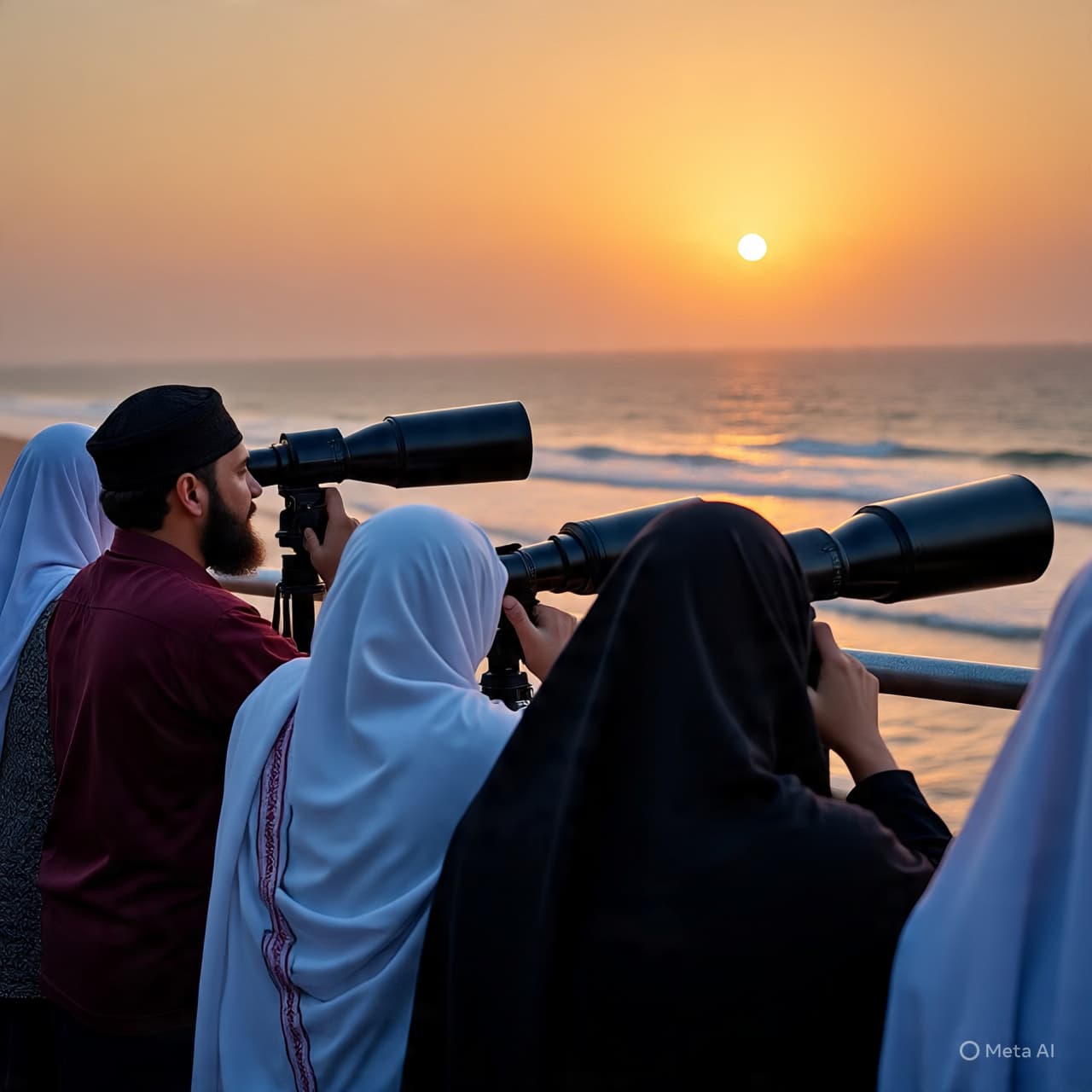
Despite these challenges, the practice of observation continues across various locations. Organizations like Nahdlatul Ulama emphasize the spiritual and historical significance of rukyat. Observers gather at coastal towers, hilltops, and observatories, aligning telescopes and instruments with quiet patience as dusk transitions into night.
This process, where science, faith, and tradition converge, illustrates Indonesia's approach to determining Islamic dates. It is both technical and communal, combining astronomical calculations, field observations, and deliberations within the government's sidang isbat.
PBNU's message serves as a reminder of the importance of shared standards. The MABIMS criteria were developed to harmonize lunar visibility across Southeast Asia, providing a scientific framework recognized by many Muslim communities in the region.
As evening observations conclude and reports travel from observatories to Jakarta, the final decision rests with the Ministry of Religious Affairs. Their determination, informed by both data and observation, will ultimately guide the official start of the new Islamic month.
For now, beneath the vast Indonesian sky, the crescent moon remains a quiet symbol—inviting patience, reflection, and the continuation of a long-standing tradition.
Published by Banx Network. This article is part of the Banx decentralized media programme, powered by the BXE token on the XRP Ledger.




